Having driven for over a decade, I’ve seen countless owners agonise over whether to choose xenon (HID) or LED headlights. The real differences, however, come down to operating principles and real‑world experience. Here’s a breakdown based on years of hands‑on driving.
- Light generation and brightness characteristics
Xenon lamps produce light by ionising xenon gas under high voltage, delivering 3000‑5000 lumens at a typical 4300K warm‑white colour temperature. This warm light cuts through fog and rain effectively – on poorly lit highways or national roads, it helps you spot roadside obstacles earlier. LEDs, by contrast, rely on semiconductor emission, offering 4000‑6000 lumens with a cool‑white colour temperature above 5500K. Their beam is even with no obvious hot spots – under city streetlights, they make lane markings and road signs significantly clearer.
- Response time and energy consumption
From my experience, xenon lamps take 3‑5 seconds to warm up to full brightness – a noticeable lag in emergencies – and draw 35‑45W. LEDs light up instantly with no delay, which makes a real difference when following, meeting, or entering tunnels at night, and they consume only 20‑30W – lighter on the battery and noticeably more efficient over the long term.
- The technical core
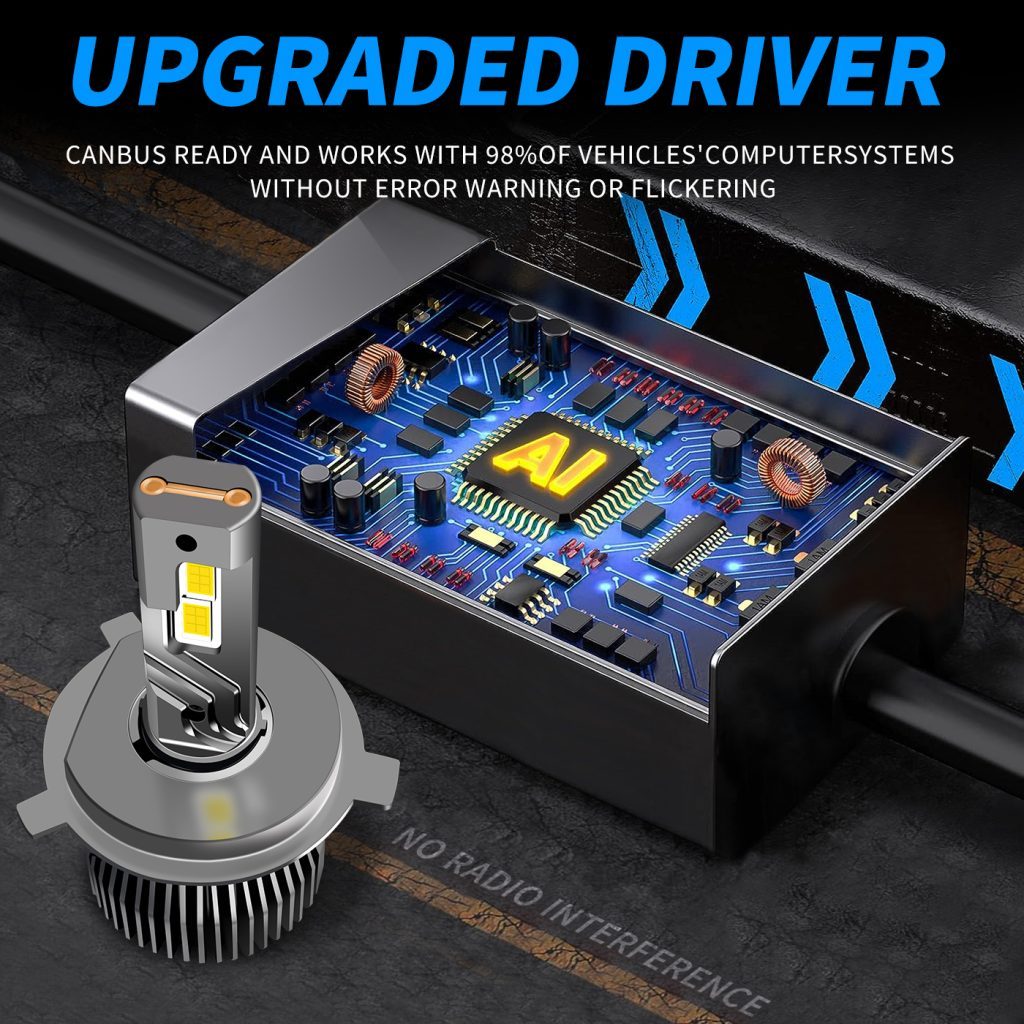
Xenon (HID) uses a high‑voltage arc to excite xenon gas, with colour temperatures from 4300K to 6000K – high luminous flux and strong penetration, but with a start‑up delay and dependence on a ballast. LEDs rely on semiconductor chips, responding in milliseconds, using less energy, lasting over 30,000 hours, and offering precise beam control – with a proper lens, they give a sharp cut‑off and wide, even coverage.
The real difference isn’t about which is “brighter” – it’s about how the light is distributed. Xenon scatters light through gas‑discharge diffusion; LEDs project light directionally through chip arrays. Premium models like the Mercedes‑Benz C‑Class, GLA, and CLS are gradually shifting to LED as standard – precisely because of their combined advantages in fog/rain stability, dynamic cornering performance, and lower depreciation over time.
- Real‑world feel
After switching to LEDs, night driving feels different – bridge underpasses no longer seem dim; tree shadows on country roads are crisp, almost like a filter. At a red light, a quick glance in the rearview mirror shows the car behind clearly – a reassuring detail. The low beam spreads evenly across the lane without glare; a light touch brings the high beam on with a solid, focused column of light – none of the “hazy white wall” feeling that old xenon lamps gave.
The LED set plugs directly into Mercedes‑specific sockets – no wiring changes, no height adjustments. When they light up, the whole car feels more composed – not flashier, but sharper, steadier, and closer to what it was always meant to be.