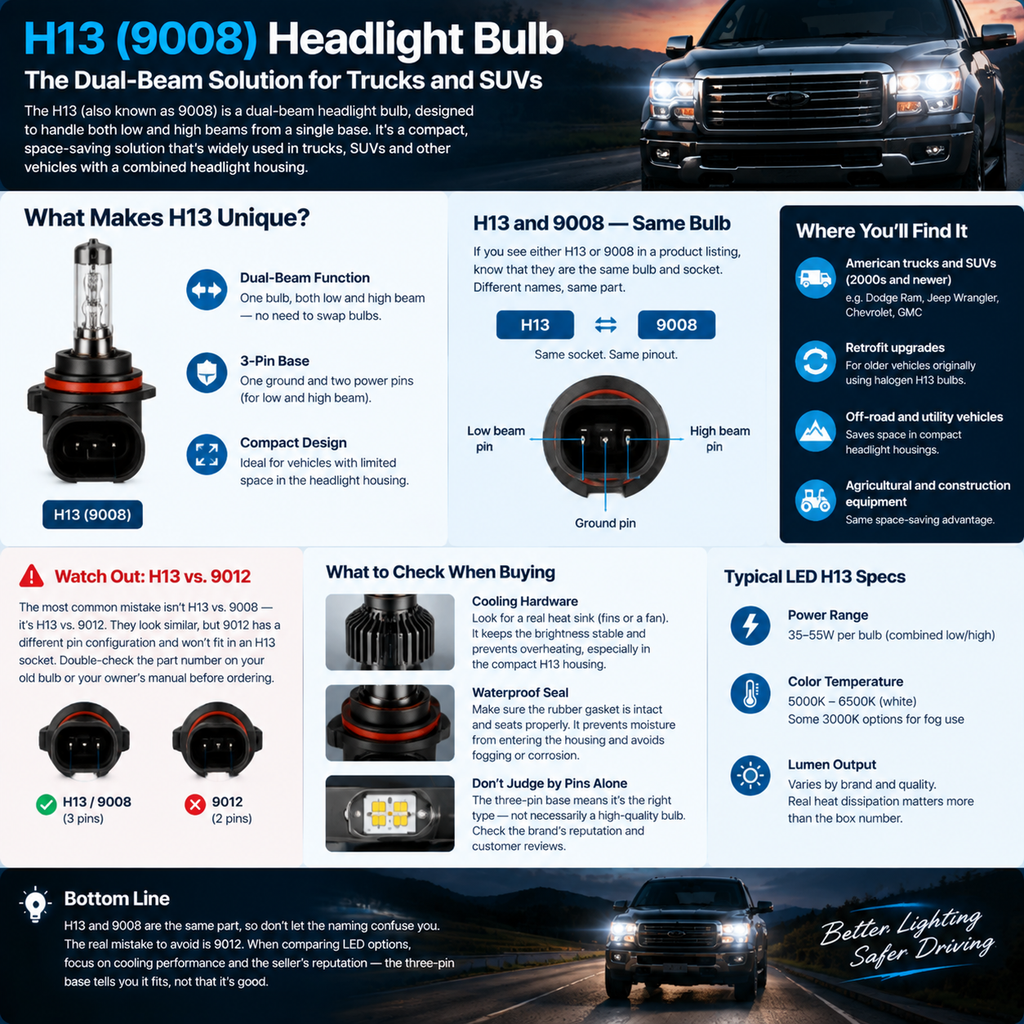
Most headlight bulbs are single-purpose — one for low beam, one for high beam, wired and swapped separately. H13 does both from a single base, switching between filaments (or, on the LED version, between chip circuits) depending on which beam you’ve selected. It’s a compact, one-socket solution, which is exactly why you’ll find it all over trucks and SUVs where the headlight housing doesn’t have room for two separate bulbs.
The two names for the same bulb
If you’re searching for this online, know that H13 and 9008 are the same socket and pinout — different naming conventions for the identical bulb. You’ll see both used interchangeably in parts listings, and neither is more “correct” than the other; it’s worth knowing so a search for one doesn’t make you think you’ve come up empty when the part you need is listed under the other name.
Where you’ll actually find it
H13 shows up most in American trucks and SUVs from the 2000s onward — think Dodge Ram, Jeep Wrangler, and a number of Chevrolet and GMC pickup trims that use a combined low/high housing rather than separate bulbs. It’s also common in:
Retrofit upgrades on older vehicles originally running halogen H13s, swapping in an LED version for better output
Off-road and utility vehicles, where the combined design saves space in a compact housing
Some agricultural and construction equipment, for the same space-saving reason
The mix-up that actually costs people money
The confusion that trips up more buyers than anything else isn’t H13 vs. 9008 — those are the same thing. It’s H13 vs. 9012. They look similar, they’re both automotive headlight bulbs, and it’s an easy typo or a careless glance at a listing away from ordering the wrong one. 9012 is a different pin configuration and won’t work in an H13 socket. Double-check the exact code printed on your old bulb (or your owner’s manual) before ordering — this single mix-up accounts for a lot of returns in this category.
What to actually check when buying
Three contacts, not two, not four. An H13 base has three pins — one for low beam, one for high beam, one shared ground. This is fixed by the spec itself, not a mark of authenticity: a knockoff can be wired with three contacts just as easily as a genuine part, since the pin count is dictated by the socket standard, not by quality. What three contacts actually confirms is that you’re holding the right bulb type — it doesn’t tell you anything about build quality. For that, you’re better off checking the brand’s reputation and reviews than counting pins.
Cooling hardware, not just wattage on the label. For the LED version specifically, a bulb with a real heat sink — fins or a small fan — holds its brightness far longer than a bare-shell budget option. This matters more for H13 than for most bulb types, because the compact combined housing gives heat less room to dissipate than a typical single-beam setup.
The waterproof seal at the base. Check that the rubber gasket around the bulb’s base is intact and seats properly against the housing before you close everything up. A gap here lets moisture into the housing over time, and condensation inside a headlight is one of the more common causes of premature failure — fogging the lens and, eventually, corroding the electrical contacts.
Rough specs, if you’re comparing options
Typical LED H13 replacements run somewhere in the 35–55W range per bulb (combined low/high), with color temperature options usually spanning 5000K–6500K on the white end, sometimes with 3000K amber variants for dedicated fog applications. Lumen output varies a lot by build quality — this is exactly where the cheap-shell-versus-real-heat-sink difference shows up most, since a bulb that can’t manage its heat won’t sustain its rated output for long even if the box number looks competitive.
Bottom line: H13 and 9008 are the same part, so don’t let the naming trip you up. The mix-up to actually watch for is 9012. And when you’re comparing LED options, spend your attention on the cooling hardware and the seller’s reputation — the three-pin base tells you the bulb fits, not that it’s good.