H13’s combined low/high design packs a lot into one compact housing — which is exactly the problem when you’re also trying to manage LED heat. There’s less room around the chip for heat to escape than in a typical single-beam bulb, which makes cooling design the single biggest factor separating an H13 LED bulb that still looks good in three years from one that’s visibly dimmer by next winter.
Why the heat actually matters
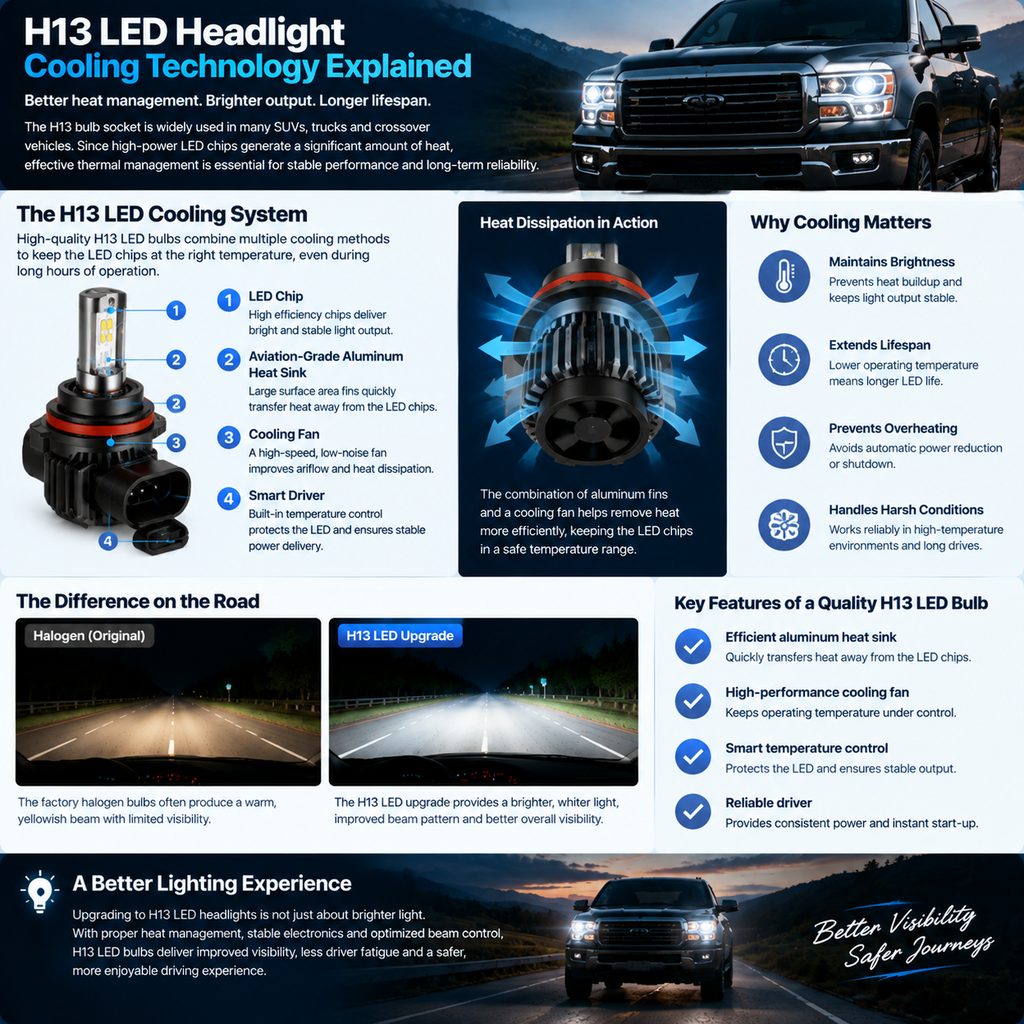
LED chips are efficient at converting power to light, but the heat they do produce concentrates right at the junction. Push that junction temperature past roughly 85°C for extended periods and light output starts degrading noticeably faster — some rough industry figures put every additional 10°C of sustained heat as cutting usable lifespan close to in half. Cross a higher threshold and most decent driver circuits will step in and throttle power automatically to protect the chip, which shows up to you as a sudden dip in brightness rather than a failure — annoying, but better than the alternative of the chip cooking itself.
That’s the real argument for spending more on cooling hardware: a bulb with an actual heat sink and fan keeps that junction temperature down where degradation stays slow. A bare aluminum shell with no fan — regardless of what the packaging calls the metal — just doesn’t move enough heat in a housing this compact, and it shows up as gradual dimming within the first year or two of regular driving.
What I actually noticed switching from halogen
I put an H13 LED kit in a 2014 pickup that had been running the stock halogen bulbs since new — by that point noticeably yellowed and visibly weaker than they were originally. The difference wasn’t subtle, but it also wasn’t uniformly “better in every way,” which is worth being honest about.
The upgrade genuinely nailed the cutoff line — no vague transition between lit and dark road, just a clean edge that didn’t spill up into oncoming drivers’ mirrors, which is the thing I was most nervous about going in (a badly-oriented LED chip ruins this fast, and I got lucky or the kit was decent — hard to say which without another data point). Road signs and shoulder markings read earlier and more clearly than before, and lane lines on unlit stretches were noticeably easier to track.
What surprised me less pleasantly: on the first genuinely cold morning after the install, the bulbs took a beat longer than I expected to hit full brightness — not the multi-second xenon-style warmup, more like a half-second ramp that I only noticed because I was paying attention. Whether that’s normal for this driver or a sign of a mediocre one, I honestly don’t know yet — it’s the kind of thing that only becomes clear after a full winter of use, which is also when cheap cooling hardware tends to show its limits.
What separates a good H13 LED bulb from a mediocre one
Given the housing’s tight thermal envelope, this list matters more here than for most bulb types:
A real heat sink with actual surface area — fins that move air, not just a thicker metal shell with no path for heat to actually leave
A fan or a genuinely well-engineered passive design — passive-only cooling can work, but it needs real engineering behind it, not just “no fan” marketed as a feature
A driver that throttles gracefully rather than flickering or cutting out — a bulb that dips brightness smoothly under heat stress is doing its protection circuit correctly; one that flickers or blacks out briefly is a warning sign
Consistent output across a full drive, not just in the first ten minutes — this is the one spec sheets can’t show you, and the reason a cheap bulb that looks great in a five-minute demo video can still disappoint after an hour on the highway
Raw lumen numbers on the box tell you almost nothing about which category a given bulb falls into — a bulb that can’t manage its own heat won’t hold its rated output long enough for that number to mean much in practice.
Bottom line
The brightness difference over halogen is real and immediate. Whether it stays that way depends almost entirely on cooling hardware you can’t see from the outside of the box — which makes checking reviews and asking specifically about thermal design worth more than comparing lumen claims between listings.