- Thermal Management Requirements of Automotive LED Headlights
The heat dissipation requirements of LED headlights stem from their fundamental working principles and thermal characteristics. Unlike traditional light sources, LEDs convert a significant portion of input electrical energy into light, yet a considerable proportion is still released as heat. Studies indicate that the photoelectric conversion efficiency of current commercial LEDs is approximately 30–40%, meaning about 60% of electrical energy is ultimately converted into heat.
This heat is primarily generated at the PN junction of the LED chip. If not promptly conducted away, it causes the junction temperature to rise rapidly. LED performance parameters are closely related to temperature. Experimental data shows that when the junction temperature exceeds the critical threshold (typically 120–150°C), LED light output drops significantly, and luminous efficiency (lumens per watt) may decrease by 20–30%. Simultaneously, high temperatures accelerate the aging process of LED devices, exponentially shortening their lifespan. It is estimated that for every 10°C increase in junction temperature, the expected lifespan of an LED decreases by approximately 50%. Additionally, non-uniform temperature distribution can cause color temperature drift, compromising optical performance.
The operating environment of automotive LED headlights is even more complex and variable, further increasing the difficulty of thermal design. Under high summer temperatures, the ambient temperature inside the engine compartment can exceed 80°C. In cold regions, thermal cycling stress under extremely low temperatures must also be addressed. Factors such as vibration, dust, and moisture during vehicle operation impose higher demands on the reliability and durability of heat dissipation structures. These unique operating conditions require that automotive LED headlight thermal designs balance efficiency, compactness, and environmental adaptability. - Optimized Design and Performance Analysis of Heat Dissipation Structures
2.1 Material Selection for Heat Dissipation Structures
Material selection directly impacts the thermal management performance of automotive LED headlights. Ideal heat dissipation materials should possess high thermal conductivity, low density, good processability, and reasonable cost.
Aluminum alloys are currently the most widely used heat dissipation materials, particularly the 6061 and 6063 series, with thermal conductivity of approximately 150–200 W/(m·K) and excellent casting and machining properties. In recent years, high-thermal-conductivity aluminum alloys such as ADC12 die-casting alloys have seen increased application in headlight heat sinks, offering up to 20% improvement in thermal performance.
Copper and its alloys offer superior thermal conductivity (approximately 400 W/(m·K)), but due to high density and cost, their application in automotive LED headlights is relatively limited—mainly used for critical thermal interfaces or localized heat dissipation. To balance performance and cost, copper-aluminum composite heat dissipation structures are gaining popularity, using copper in high-heat-flux areas and aluminum alloys elsewhere, joined by friction welding or brazing.
Metal matrix composites (MMCs), such as aluminum-diamond and aluminum-graphite, can achieve thermal conductivity of 300–600 W/(m·K) while maintaining low density. Carbon fiber-reinforced polymer composites offer lightweight and design flexibility; although their thermal conductivity is moderate, anisotropic heat transfer can be achieved through specific orientation design.
Phase change materials (PCMs) perform exceptionally well under transient thermal loads, absorbing substantial heat while maintaining relatively stable temperatures. Anodizing forms a dense oxide layer on the aluminum surface, improving radiative heat dissipation efficiency, while micro-arc oxidation creates a thicker porous oxide layer, further enhancing heat dissipation. For components requiring electrical insulation, ceramic coatings or thermal greases can ensure electrical safety without compromising thermal performance.
These material selection and optimization strategies must be carefully balanced based on specific headlight model requirements, space constraints, and cost targets.
2.2 Optimization of Heat Dissipation Structure Design
Optimization of Heat Sink Fins
The geometric parameters of cooling fins—height, thickness, and spacing—have an optimal combination. Numerical simulation and experimental findings show that overly dense fins impede airflow, while overly sparse fins reduce heat dissipation area. Surface treatments such as anodizing can increase emissivity, improving heat dissipation efficiency by 10–15%.
Heat Pipe Technology
Heat pipes utilize phase-change heat transfer principles, offering extremely high equivalent thermal conductivity. Embedding heat pipes into the heat sink base allows rapid heat transfer from the LED to remote cooling fins. Experiments show that heat pipes can reduce LED junction temperature by 15–20°C, making them particularly suitable for space-constrained headlight designs. Optimization must consider heat pipe orientation and fluid charge volume.
Phase Change Material (PCM) Heat Dissipation
PCMs utilize the latent heat absorption property of materials during phase transition, buffering temperature rise under transient high-power conditions. Combining PCMs with conventional heat dissipation structures helps manage thermal shock during vehicle start-stop cycles. Research shows that appropriate PCM selection can reduce temperature fluctuations by over 30%. Design must balance phase change temperature, latent heat, and encapsulation volume.
2.3 Design Methodologies and Performance Evaluation
The optimization of automotive LED headlight heat dissipation structures requires a systematic approach combining theoretical calculation, simulation analysis, and experimental validation.
Thermal Resistance Network Analysis serves as a fundamental design tool, establishing thermal resistance models from the LED junction to the environment for preliminary performance assessment.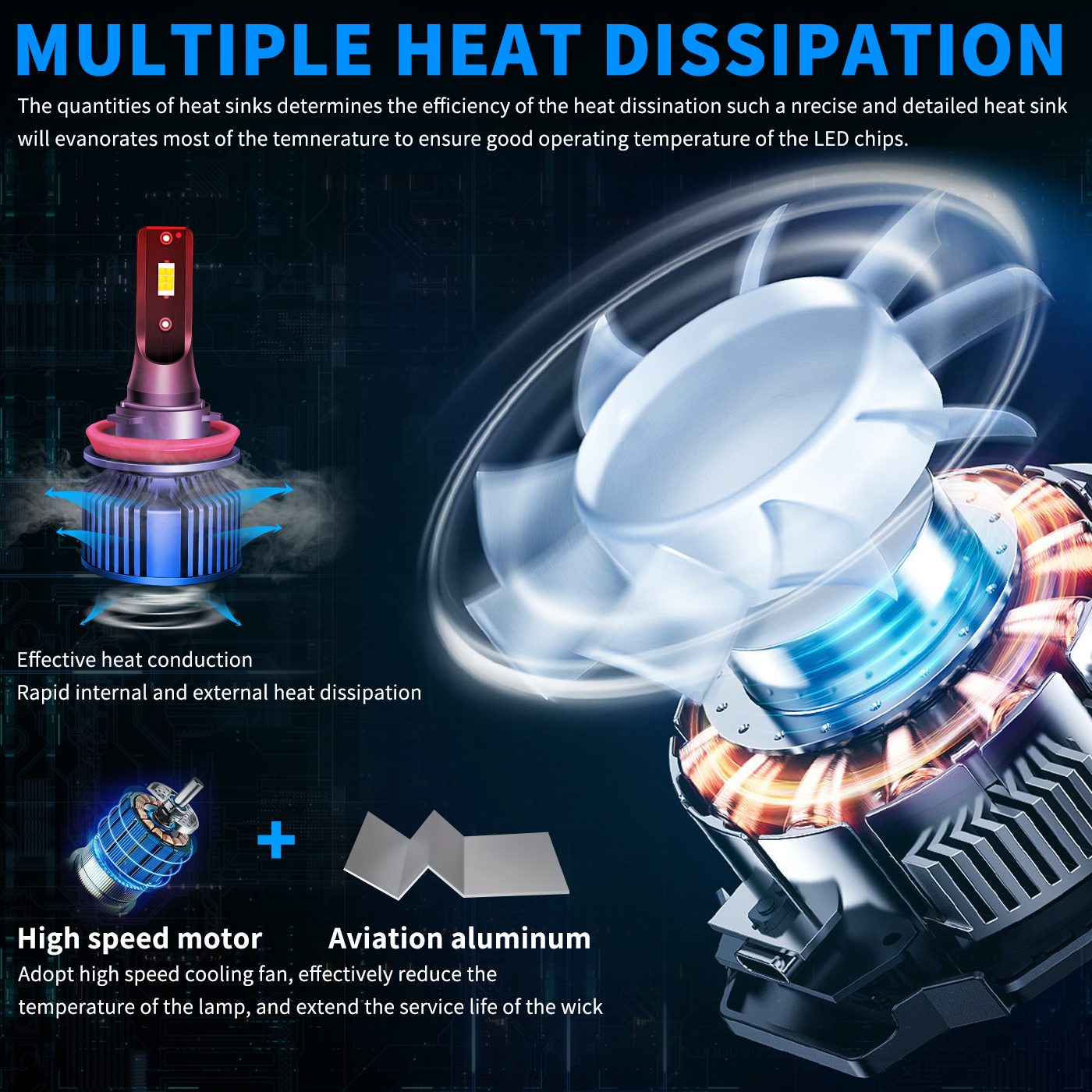
Computational Fluid Dynamics (CFD) simulation provides more precise predictions of temperature distribution and airflow patterns. Modern simulation software such as FloTHERM and ANSYS Icepak enables 3D thermal-fluid coupled analysis, helping optimize heat sink geometry, spacing, and layout.
Infrared Thermography allows visual display of headlight surface temperature distribution, identifying localized overheating areas. Junction temperature measurement typically employs electrical or spectral methods—the former estimates junction temperature through forward voltage changes, while the latter analyzes LED emission spectral characteristics.
Reliability Testing includes temperature cycling, high-temperature high-humidity, and vibration tests, simulating heat dissipation performance changes under actual automotive operating conditions.
Biomimetic Design draws inspiration from natural heat dissipation mechanisms—for example, honeycomb-structure heat sinks mimic the efficient heat transfer characteristics of bee nests. Topology Optimization uses algorithms to automatically identify optimal material distribution within given spaces for maximum heat dissipation performance. Modular Design improves system versatility and maintainability, allowing LED modules of different power levels to share basic heat dissipation architectures, reducing development costs.
The application of these advanced design methods enables modern automotive LED headlights to achieve better balance between thermal performance, weight, and cost. - Future Development Trends
Automotive LED headlight thermal dissipation technology is evolving toward higher efficiency, greater compactness, and intelligent control.
Advanced Materials: Novel heat dissipation materials such as graphene and metal foams offer extremely high thermal conductivity, significantly enhancing heat dissipation performance.
Microchannel Liquid Cooling: This technology enables efficient heat dissipation within minimal space, suitable for next-generation miniaturized headlight designs.
Smart Thermal Management Systems: Real-time temperature sensors and controllers adjust heat dissipation intensity—such as variable-speed fans or variable-flow liquid cooling pumps—optimizing energy efficiency.
System-Level Thermal Integration: Headlight heat dissipation is integrated with the vehicle’s overall thermal management system, sharing cooling resources for greater overall efficiency.
These innovations will drive automotive LED lighting toward higher power, longer lifespan, and more compact form factors.
💎 Conclusion
The design of heat dissipation structures for automotive LED headlights presents a comprehensive engineering challenge requiring a balance of thermal performance, reliability, cost, and space constraints. Research demonstrates that composite heat dissipation structures, combining multiple thermal management technologies, effectively address the heat dissipation challenges of high-power LEDs. As new materials and technologies continue to emerge, the thermal performance of automotive LED headlights will further improve, laying the foundation for safer and more energy-efficient automotive lighting systems. https://zblled.com/