LED Headlights
LED headlights and traditional halogen headlights differ significantly across price, operating principle, brightness, penetration, energy consumption, and vehicle configuration. This article systematically compares the two across nine dimensions – helping owners choose based on their driving environment and needs.
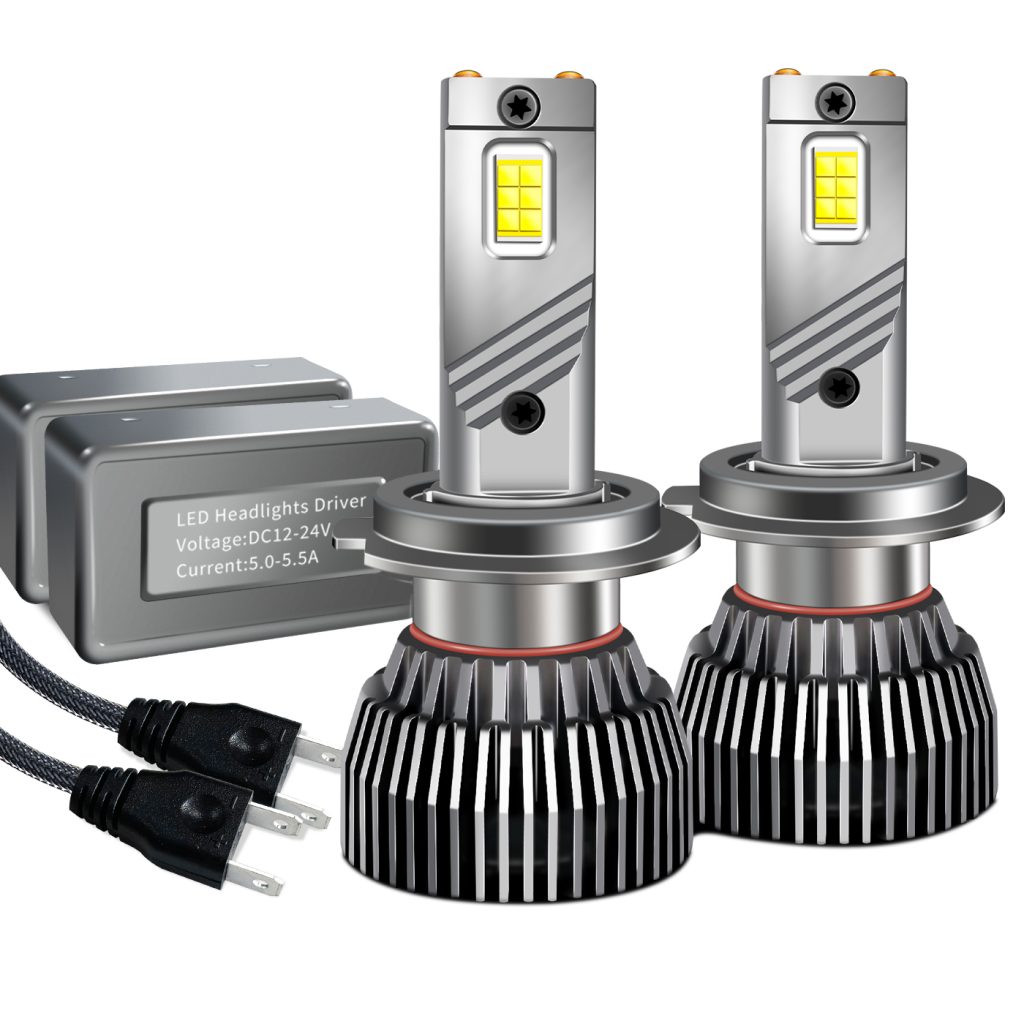
1. Price
LED headlights are more expensive – a quality assembly can cost several hundred to several thousand CNY. Traditional halogen bulbs are far more affordable – a factory‑quality bulb costs just tens of CNY. This price gap is mainly due to LED chips, cooling systems, and driver circuits.
2. Operating Principle
- LED: Uses semiconductor chips as the light source – electricity is directly converted into light. Fast response, cool white light, with colour temperatures typically above 5000K.
- Halogen: Tungsten filament heats up to produce light. Slower response, warm yellow light, with colour temperatures below 4000K.
3. Brightness
LEDs are bright, start instantly, and remain stable – 2‑3 times brighter than halogens at the same power. Halogens are dimmer and noticeably underperform on unlit roads at night.
4. Penetration
Halogens offer stronger penetration – providing good illumination in rain, fog, and dusty conditions. LEDs (especially high‑colour‑temperature models) have weaker penetration – light scatters in wet conditions, reducing visibility.
5. Energy Consumption
LEDs generate almost no heat – most electricity is converted into light, consuming only about 1/10th of a halogen’s power – reducing overall vehicle energy use. Halogens generate significant heat – only 20‑30% of their ~55W power becomes light.
6. Lifespan
LEDs have no filament or moving parts – with proper current and voltage, they average 30,000+ hours (premium units up to 100,000 hours) – over 10 times longer than halogens. Halogens last only 500‑1,000 hours and require regular replacement.
7. Vehicle Configuration
Mid‑to‑low‑end models typically use halogen headlights; mid‑to‑high‑end models often feature LEDs. LEDs are gradually becoming the mainstream choice, moving from premium to family cars.
8. Beam Pattern and Visual Comfort
- LED: Long range, broad spread – light close to natural daylight (5000K‑6000K) – excellent object recognition in good weather.
- Halogen: Warm‑yellow light (2700K‑3200K) – easier on the eyes over long drives – better rain/fog penetration.
9. Intelligence and Additional Advantages
LEDs enable intelligent features – adaptive cornering lights, automatic high‑beam switching, matrix‑zone lighting – which halogens cannot support. LEDs also offer superior stability, shock resistance (filament‑free), and microsecond‑level response – brake lights react faster, helping prevent rear‑end collisions.
Summary Comparison Table
| Dimension | LED | Halogen |
|---|---|---|
| Price | High | Low |
| Principle | Semiconductor electroluminescence | Tungsten thermal radiation |
| Colour temp | 5000K+ (cool white) | Below 4000K (warm yellow) |
| Brightness | High (2‑3× halogen) | Low |
| Penetration | Weak in fog/rain | Strong |
| Energy | Low (~1/10 halogen) | High |
| Lifespan | 30,000+ hours | 500‑1,000 hours |
| Intelligence | Adaptive, matrix support | Not supported |
| Response | Microsecond | Millisecond |
Both LED and halogen headlights have their strengths – choose based on your driving environment and specific needs.