Headlights have been around almost as long as cars themselves – evolving from the early acetylene lamps used on horse‑drawn carriages to today’s adaptive laser units found in high‑end models like the BMW X5 and Audi A8. The two most common types on the road today are halogen and LED, with manufacturers gradually phasing out halogens in favour of LEDs. But each has its own strengths and weaknesses. This article takes a closer look at both, so you can decide which one suits you best.
- What is a halogen headlight?
Halogen headlights have been around since the 1960s. They’re a modified version of the incandescent bulb – a tungsten filament sealed inside a glass envelope filled with halogen gas and other inert gases, producing a yellowish glow.
Pros:
Cheap to replace (around 20–80 CNY)
Soft, warm light that’s less glaring
Cons:
Lower brightness
High power consumption
Halogen lamps are still common in most entry‑level cars worldwide (e.g., Wuling, Sylphy) because they’re inexpensive to make and replace. Swapping a halogen bulb is simpler than replacing an LED unit – but you’ll do it far more often, as halogen lifespan is only 500–1,000 hours. Taxi drivers who run night shifts may need new bulbs every 2–3 months; turn signals and brake lights also burn out frequently. Still, at 20–80 CNY a pop, it won’t break the bank.
That said, halogens are inefficient – they consume about 80% more energy than LEDs, with much of that energy wasted as heat rather than light. This puts extra load on the car’s electrical system and can affect overall efficiency over time.
- What is an LED headlight?
LED stands for light‑emitting diode. These headlights produce light by passing electricity through a semiconductor that emits photons – resulting in a very bright white beam.
Pros:
Low power consumption
Very bright output
Enables advanced lighting functions
Long lifespan
Instant‑on, no warm‑up delay
Cons:
Can cause glare for oncoming traffic (if not properly aimed)
Expensive to replace
The biggest advantage of LEDs is their efficiency – they use about 80% less energy than halogens for the same or better light output. This reduces strain on the battery and alternator; in petrol cars, it may slightly improve fuel economy; in EVs, every watt saved translates directly into more range between charges.
- Three key factors when buying LED bulbs
Chip (LED package):
Choose CSP‑packaged chips; avoid cheap COB types.
Smaller chips give better beam patterns – they sit closer to the original halogen filament position, improving compatibility with the reflector.
Six chips don’t necessarily mean more light than three – it’s about power and die size.
General performance ranking: single‑row 80mil > single‑row 70mil ≈ dual‑row 55mil > single‑row 55mil > dual‑row 45mil.
Colour temperature:
Mainstream range: 6000–7000K. Lower colour temperature means better fog/rain penetration.
4500K warm white offers a good balance – often the ideal choice.
In practice, the difference between high and low colour temperatures is subtle on clear nights. But in heavy fog or rain, no light works wonders – slow down and drive carefully.
Power (wattage):
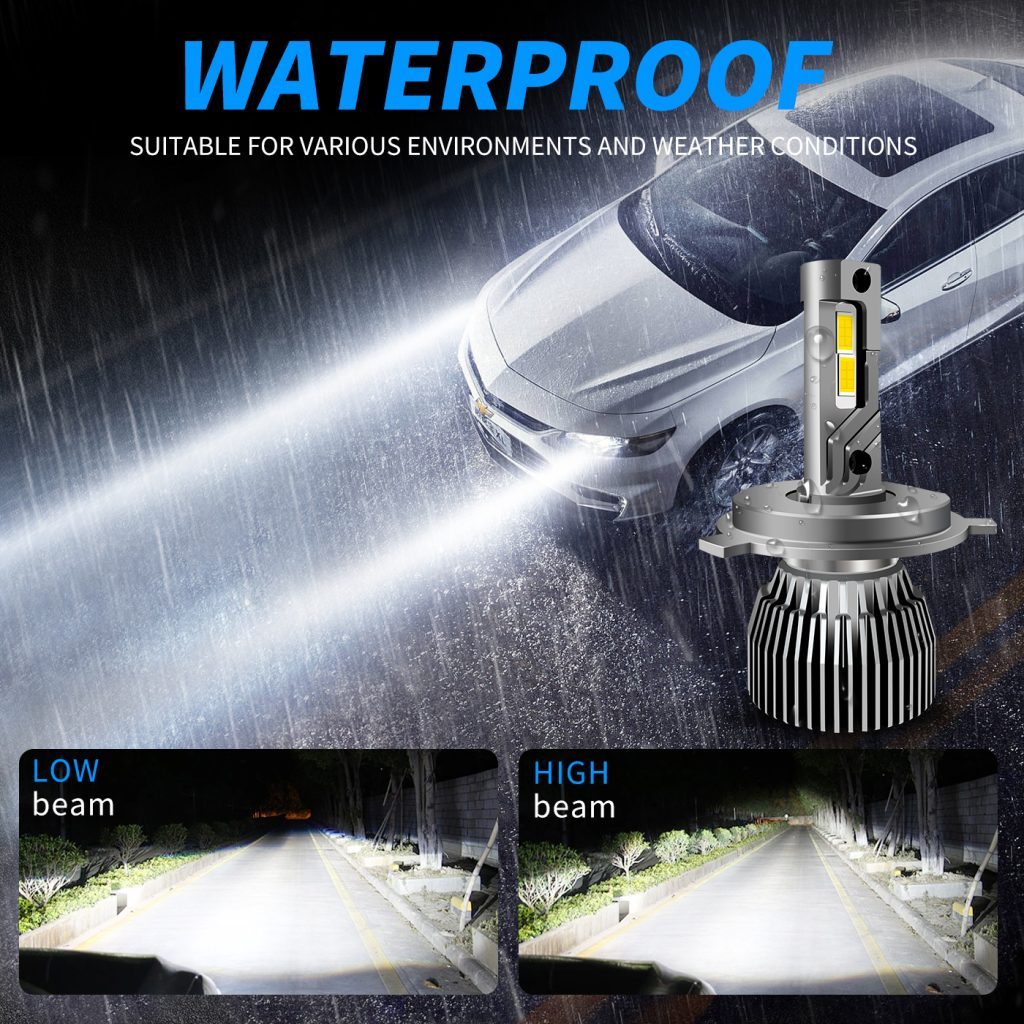
Higher wattage = brighter output, but anything over 55W is usually overstated.
Go for at least 15W; below that, you may not beat a halogen.
If your car has factory projector lenses, factor in the light loss through the lens – you’ll need at least 25W to match a non‑lens halogen setup.
- Two types of LED headlight products
Projector‑lens assembly: a complete unit that includes the light source, reflector, and lens – not just a standalone lens. Pros: wider coverage, more even beam, sharper cut‑off. Cons: requires cutting into the original reflector bowl (permanent modification), costs around 1500–4000 CNY per pair. Best for drivers who want a significant upgrade in beam width and uniformity.
Plug‑and‑play LED bulbs: direct replacements for halogen bulbs in the original reflector housing. Pros: no cutting, no wiring changes – fully reversible, affordable (100–600 CNY per pair). Cons: only improves brightness; the beam pattern stays the same. Best for drivers who just want more light without modifying their car.
- The core principle: why swapping bulbs can mess up your beam pattern
A headlight consists of two parts: the light source (what produces the light) and the beam‑shaping device (what directs it). Halogen, xenon, and LED are all light sources; the reflector bowl or lens is the beam‑shaping device.
The reflector bowl has a focal point. In a factory halogen setup, that focal point is exactly where the filament sits. If you replace the bulb with an LED whose light‑emitting point is in a different position, the beam will no longer be focused correctly – resulting in scatter and glare.
That’s why the most important criterion when choosing an LED bulb is compatibility with your reflector. Smaller chips are better because they come closer to the size and position of a halogen filament. But smaller chips can’t handle as much power – so there’s always a trade‑off between size and brightness.