In modern automotive lighting, both LED and xenon (HID) headlights are mainstream choices – and heat dissipation is always a critical factor affecting stability and lifespan. But the question of which has a “more serious” heat problem isn’t straightforward – it depends on whether you look at total heat output, heat density, or cooling system complexity.
- Operating principles and heat generation
Xenon headlights produce intense light by ionising xenon gas under high voltage. This process releases a significant amount of thermal energy – internal temperatures can reach several hundred degrees Celsius, placing continuous heat stress on the housing materials and surrounding wiring over time.
LED headlights, as solid‑state semiconductor light sources, are more efficient – they consume only about one‑fifth of the energy that xenon lamps need for the same brightness, so total heat output is theoretically lower. However, the heat source in an LED is extremely concentrated – the chip area is only a few square millimetres. If the cooling design is inadequate, heat can’t be carried away quickly enough, forming localised hot spots that accelerate lumen degradation and aging of the driver circuitry.
- Cooling methods compared
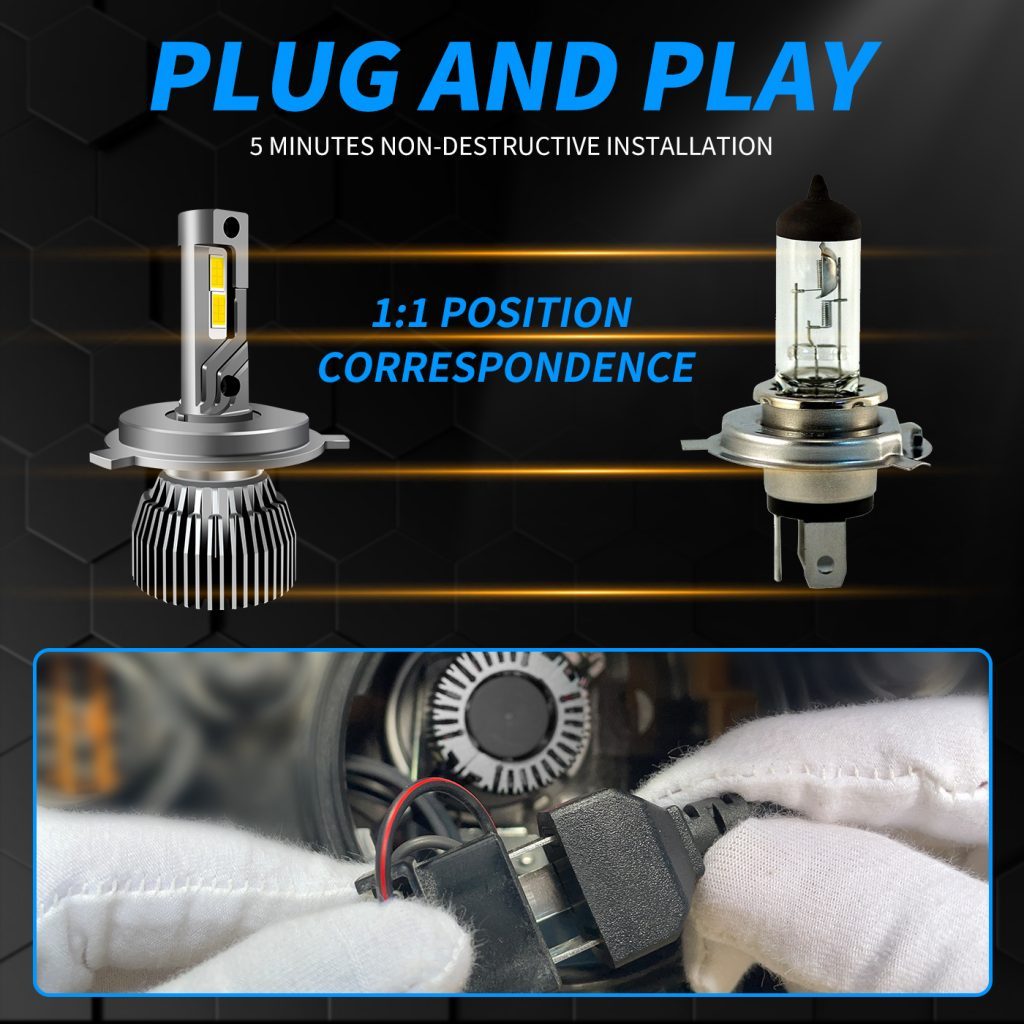
Xenon headlights rely mainly on passive cooling – the metal housing and natural air convection. But because total heat output is large, cooling efficiency is limited by the available space inside the engine bay.
LED headlights, by contrast, typically use active cooling – built‑in fans, multi‑layer aluminium heat sinks, heat pipes, or a combination – using forced air or liquid‑assisted conduction to maintain stable temperatures. In the already hot engine‑bay environment, the LED cooling system carries a heavier thermal‑management burden, and its performance depends heavily on the manufacturer’s engineering quality and quality control.
- Conclusion: “serious” means different things
If you look at total heat output: xenon generates more heat overall and radiates more of it to surrounding components.
If you look at cooling system complexity and reliability: LEDs face a greater challenge – they are highly temperature‑sensitive. Even a small temperature rise can significantly shorten their lifespan, whereas xenon systems rely more on choosing heat‑resistant materials.
Over long‑term use: the cooling design of an LED headlight directly determines its actual service life – which is why premium models increasingly adopt integrated cooling modules and intelligent thermal management strategies.
Supplement – LED technology in practice
Why are LEDs brighter, more efficient, and longer‑lasting than halogens? The core lies in semiconductor emission – current passing through the PN junction releases photons directly, giving high conversion efficiency and relatively low heat.
“Bi‑xenon” (or bi‑LED) doesn’t simply combine two beam patterns – it uses a precision optical lens assembly (often a bi‑xenon projector) to refract and shield light in different zones: near‑beam prevents glare, high‑beam gives strong penetration, and switching between the two is seamless with no noticeable dark gaps. National safety regulations require that low‑beam patterns do not cause visual interference to oncoming drivers. A properly designed lens system can concentrate over 90% of the luminous flux within the legally specified zones – that’s the real key to balancing safety and visibility.
In real‑world use, a well‑matched LED system delivers a low beam that’s even and sharp enough to pick out small stones on the road surface, and a high beam that’s solid and focused, lighting up reflective signs 300 metres away. Anti‑fog nano‑coatings on the lens prevent water droplets from forming in rain or mist; plug‑and‑play connectors match the original harness – no cutting, no error codes, no light leakage.