“How many watts should my LED headlights be? And how many lumens are enough?” – These are the first questions many car owners ask when upgrading their lights. Watts and lumens – one measures power consumption, the other measures brightness. They are related, but it’s never as simple as “higher watts mean brighter light.” In this article, we’ll break down everything from technical principles and real‑world needs to buying pitfalls, so you can make the right choice once and for all.
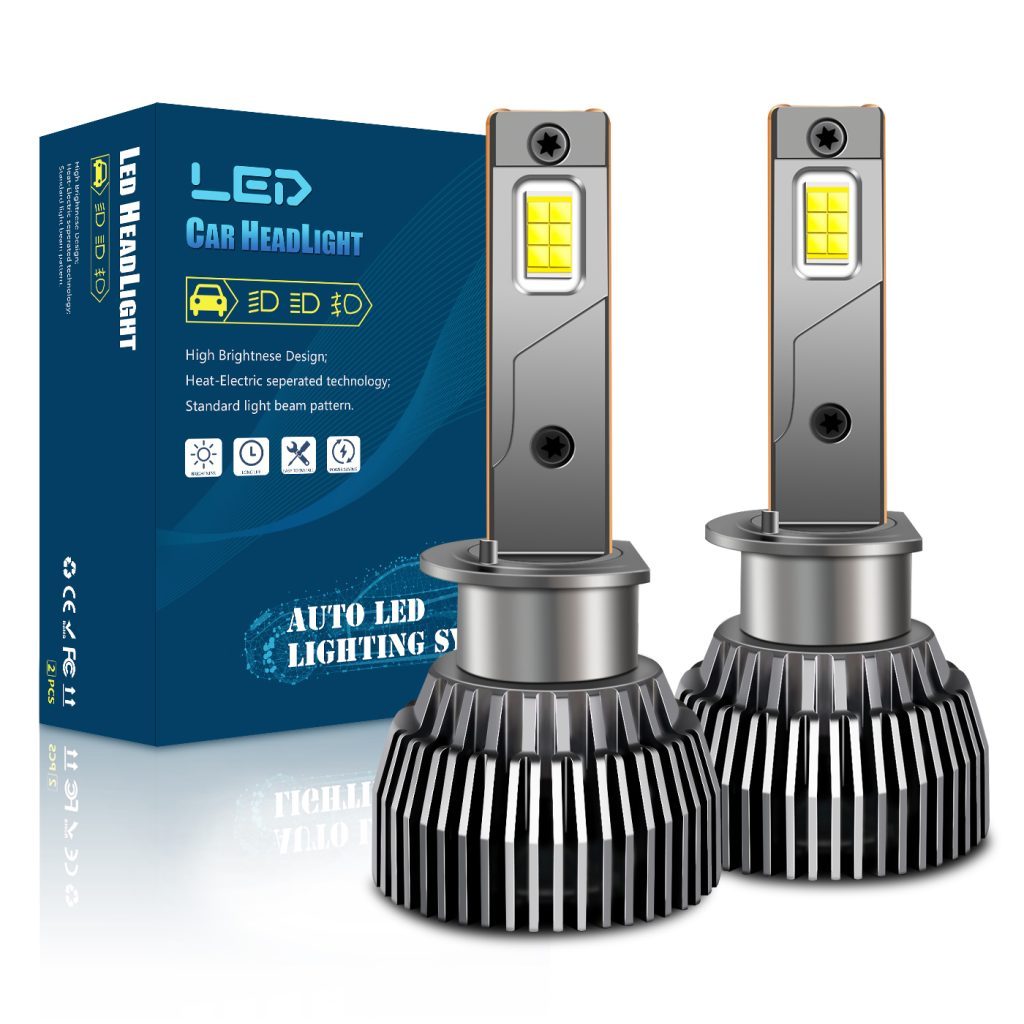
1. Understanding Watts and Lumens – Two Different Concepts
Before we dive into the numbers, let’s clarify two basic concepts:
| Term | Unit | Meaning | Layman’s Explanation |
|---|---|---|---|
| Power | Watt (W) | Electrical energy consumed by the lamp | How much electricity it uses and how much heat it generates |
| Luminous flux | Lumen (lm) | Total amount of light emitted by the lamp | How bright it actually is |
Key takeaway: Brightness depends on lumens, not watts. Wattage determines energy consumption and heat output, while lumens determine how far and clearly you can see at night.
Here’s a vivid example: at the same 35W power, a halogen bulb produces only about 1,000 lumens, whereas an LED can reach over 3,200 lumens. In other words, an LED produces more light with less electricity – that’s the gap in luminous efficiency.
2. Wattage for LED Headlights – What’s the Right Number?
2.1 Common Wattage Ranges
Generally speaking, the power of LED car lights varies by application:
| Light Type | Typical Power Range |
|---|---|
| Daytime running lights | < 10W |
| Low beams | 30–40W |
| High beams | 35–55W |
| Headlight assemblies | 35–55W |
The mainstream LED headlight power on the market is concentrated in the 30W–40W range, with a few high‑performance models exceeding 50W. In practice, most automakers set 35W as the standard for headlights, with only a few models using 55W for high beams.
2.2 Higher Wattage Is Not Always Better
Many owners mistakenly believe that “higher watts mean brighter light” – but that’s a common misconception. Higher wattage actually means:
- Greater power consumption and higher operating temperatures;
- Stricter demands on the cooling system;
- Heavier load on the vehicle’s electrical wiring.
Vehicle wiring has a rated capacity. If the LED headlight draws too much power, the wires may become overloaded, overheat, or even burn out – creating a safety hazard.
Moreover, the LED chip’s operating temperature must be kept below 85°C to ensure a lifespan of over 30,000 hours. If heat dissipation is inadequate, the high temperatures caused by excessive wattage will accelerate luminous decay, shortening the lamp’s life instead – a classic case of diminishing returns.
Bottom line: When upgrading to LEDs, choose a model with the same or lower wattage than your original halogen bulbs. There’s no need to chase higher wattages, because LEDs are already far more efficient – they give you much more light at the same power.
3. Lumens for LED Headlights – How Much Is Enough?
3.1 Reference Lumen Values
The luminous flux (lumens) of an LED lamp depends on both its power and luminous efficiency:
- Typical LED headlights offer 80–100 lumens per watt (premium products can go higher);
- For a 35W LED, the lumen output is usually around 3,200 lm (35W × 91 lm/W ≈ 3,200 lm);
- If the efficiency reaches 100 lm/W, a 35W lamp can deliver 3,500 lm.
Based on different vehicle setups and light types, here are practical reference figures:
| Light Type | Power Range | Lumen Range |
|---|---|---|
| Low beam (2‑headlight or 4‑headlight systems) | 35–55W | Approx. 3,400–5,400 lm |
| High beam (inner lamps in 4‑headlight systems) | 35–60W | Approx. 3,400–5,900 lm |
3.2 Which Lumen Range Is Best for You?
Based on usage scenarios, here are our recommendations:
| Usage Scenario | Recommended Lumens | Reason |
|---|---|---|
| City roads | 3,000–4,000 lm | Streetlights provide auxiliary lighting; extremely high brightness is unnecessary |
| Suburban / national highways / expressways | 4,000–6,000 lm | Poorer lighting conditions demand a brighter view |
| Off‑road / unlit mountain roads | 5,000–6,000 lm | Maximum illumination range and safety margin are essential |
Important reminder: More lumens are not always better. Excessive brightness can cause glare, impairing the vision of oncoming drivers – which is both dangerous and illegal. Sticking to the 3,000–6,000 lm range is generally the ideal choice.
4. Watt‑to‑Lumen Matching Reference Table
For a more intuitive choice, here is a rough watt‑to‑lumen correspondence table for LED headlights (based on 80–100 lm/W):
| LED Power | Estimated Luminous Flux (lm) | Suitable Application |
|---|---|---|
| 20W | 1,600–2,000 lm | DRLs / fog lights |
| 30W | 2,400–3,000 lm | City low beams |
| 35W | 2,800–3,500 lm | Standard low beams (mainstream choice) |
| 40W | 3,200–4,000 lm | Universal low/high beam |
| 50W | 4,000–5,000 lm | High‑brightness high beams |
| 55W | 4,400–5,500 lm | High‑performance high beams |
Recommended combo: For most family sedans and SUVs, choosing an LED headlight with 35–40W and 3,000–4,000 lumens will fully meet daily night‑driving needs, while striking the best balance between safety, energy consumption, and lifespan.
5. Beyond Watts and Lumens – Three More Critical Factors
Wattage and lumens are just the entry‑level metrics. The following three factors are equally critical – they directly determine real‑world illumination performance and service life:
5.1 Color Temperature (Unit: K)
Color temperature affects visual comfort and fog/rain penetration:
- 4,300–5,000K: Warm white – balances brightness and penetration – the most recommended range;
- 5,000–6,000K: Pure white – bright and comfortable on clear days – the mainstream choice;
- Above 6,000K: Bluish light – poor penetration in rain/fog – use with caution.
If you frequently drive in rainy or foggy areas, opt for 4,300–5,000K. If you mainly drive in sunny regions, 5,000–6,000K is perfectly adequate.
5.2 Thermal Performance
Heat dissipation directly determines LED lifespan and the rate of luminous decay. There are two mainstream cooling solutions:
| Cooling Method | Principle | Advantages | Disadvantages |
|---|---|---|---|
| Active air‑cooling (fan) | Built‑in micro‑fan accelerates airflow | High efficiency, suitable for high power | Audible noise; pay attention to bearing quality |
| Passive heat‑pipe (fins) | High‑conductivity materials + large heat sinks | Silent, stable and reliable | Higher cost |
When shopping, inspect the density and material of the cooling fins. Prefer products with aviation‑grade aluminum bodies, dual heat‑pipes, or silent‑fan designs.
5.3 Beam Pattern
- Low beams must have a sharp cut‑off line, focusing light on the road without scattering upward, to avoid glaring oncoming traffic.
- High beams need a broad and even illumination range, covering both sides of the road to minimise blind spots.
Important: If your original car uses a reflector‑bowl design for halogen bulbs, swapping directly to LEDs may cause severe glare. It is highly recommended to install or upgrade to a projector lens assembly, or choose LED products specifically optimised for reflector bowls.
5.4 Compatibility and Compliance
Different vehicle models have different housing structures, connector types, and CAN‑bus protocols:
- Confirm that the connector type (e.g., H7, H4, 9005, D‑series, etc.) matches your vehicle.
- Some European and American models require decoding; otherwise the dashboard may throw error codes or the lights may flicker.
- Always prefer well‑known brands that meet original specifications and carry quality certifications.
6. Veteran Driver’s Summary – One Sentence Gives You the Answer
If we had to give just one safest recommendation, it would be:
For family cars, choose LED headlights with 35–40W, 3,000–4,000 lm, and a color temperature of 5,000–6,000K, paired with a good projector lens and a reputable brand – that’s more than enough.
If you crave extreme brightness, you can go for high‑performance models at 50–55W and around 5,000 lm – but make absolutely sure that cooling is adequate, a lens is in place, and the vehicle’s wiring can handle the load.
One final reminder: After installation, always have a professional adjust the headlight beam height – this ensures you see clearly without causing trouble for oncoming drivers. Safe upgrades start with choosing the right light. 🚗💡