Xenon HID and LED headlights represent the two dominant automotive lighting technologies today. This article systematically compares their advantages and disadvantages from working principles, performance, spectral characteristics, interface standards and installation compatibility, helping car owners make rational upgrade decisions.
- Working Principle & Basic Structure
Xenon (HID) Headlights
High-voltage electric arcs excite inert xenon gas to produce light. A ballast instantly boosts the vehicle’s 12V supply to over 23,000V. There is no tungsten filament; illumination comes purely from high-pressure gas discharge.
LED Headlights
Light relies on electroluminescence inside semiconductor PN junctions, directly converting electric energy into visible light. An LED chip is fixed to a bracket with adhesive, connected by fine wires, sealed with epoxy resin and assembled into a housing. This solid-state structure delivers outstanding shock and vibration resistance. - Core Parameter & Performance Comparison
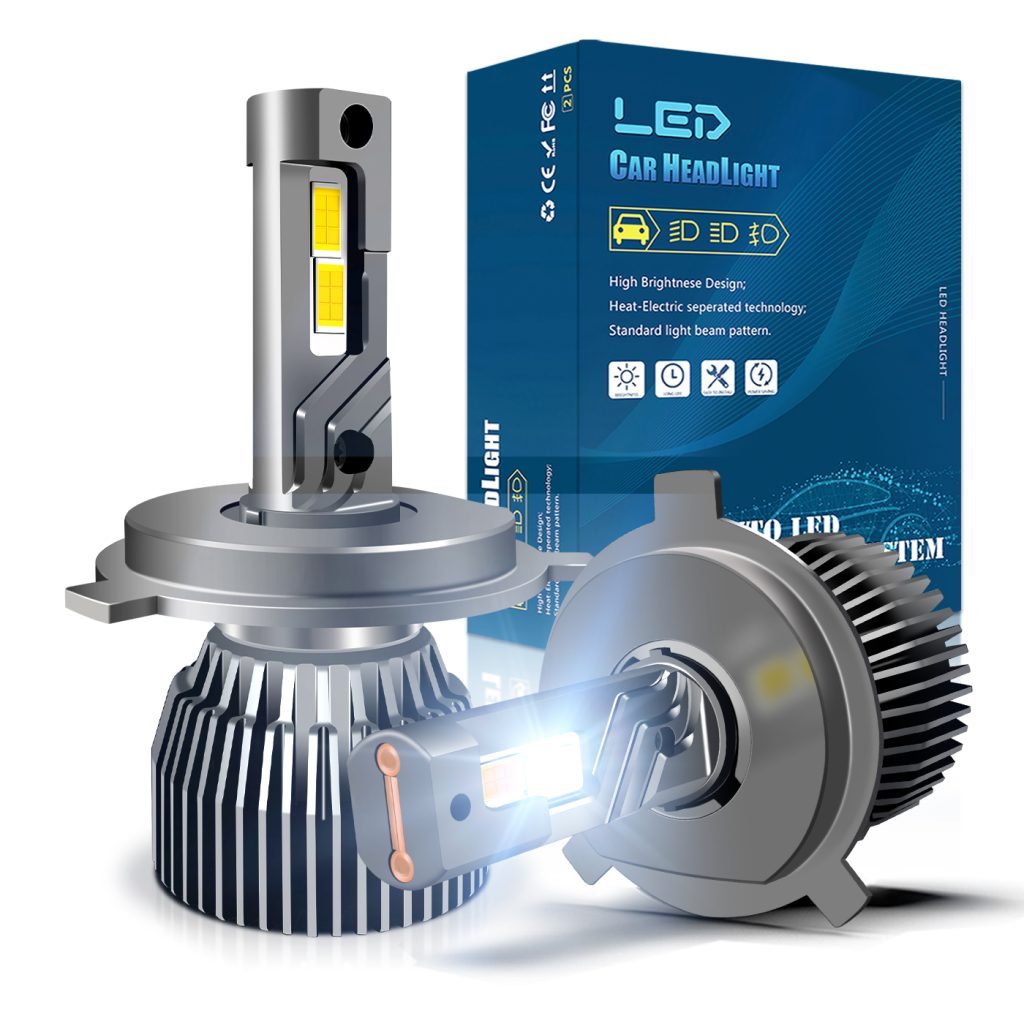
| Comparison Item | Xenon (HID) Lights | LED Lights |
|---|---|---|
| Startup Response | 2–15 seconds warm-up delay to full brightness | Instant full brightness, zero delay |
| Brightness Level | 4–6 times brighter than halogen lights | High luminous output with even low-beam road illumination |
| Power Consumption | 35W, high inrush startup current (~8A) | Ultra-low power, only 1/20 of halogen consumption |
| Color Temperature | 4000K–6000K | Wide adjustable range |
| Spectral Property | Continuous spectrum with weak blue-violet band | Narrow spectrum with distinct emission peak |
| Operating Temperature | Up to 360°C, risks burning sockets & yellowing lenses | Moderate operating temperature |
| Service Life | Outperforms halogen lamps | Far longer lifespan than xenon HID |
| Anti-Glare Performance | Prone to generating stray glare | Matrix LED enables selective high-beam shielding |
3. Typical Disadvantages of Xenon HID Lights
- Light scattering: Lenses or filters are mandatory. Unmodified HID creates severe glare when high beams activate.
- Weak penetration in heavy fog, snow and icy weather.
- Inherent warm-up delay of 2–15 seconds before reaching maximum brightness.
- Current mismatch risks: Factory halogen bulbs draw higher power (55W). Lower 35W HID load may trigger dashboard lamp fault warnings.
- Large inrush startup current (~8A). Some vehicle wiring cannot cope, requiring circuit modification or professional ECU adjustment at dealerships.
- Strict installation requirements. Low-cost telescopic HID bulbs suffer obvious vibration on bumpy roads; professional fitting is strongly recommended.
- Heavy instantaneous load on the vehicle battery during ignition.
4. Significant Advantages of LED Headlights
- Energy-saving & eco-friendly: Power consumption is merely 1/20 of halogen lights and far lower than xenon HID.
- Exceptionally long service life, surpassing both halogen and xenon lamps.
- Sufficient brightness to satisfy all night driving demands.
- Instant activation with zero warm-up delay.
- Falling market prices as manufacturing technology matures, becoming affordable for most drivers.
- Excellent spectral characteristics: fast response, low power draw, narrow spectrum with clear peak wavelength.
An increasing number of luxury automakers adopt LED headlight systems, making them the mainstream lighting solution amid global energy conservation trends.
5. Three Generations of Automotive Headlight Evolution
1st Generation: Halogen Lights (55W, original factory standard equipment)
2nd Generation: Xenon HID Lights (High-pressure gas discharge lighting)
3rd Generation: LED Headlights (Light-emitting diodes)
As the third-generation lighting technology, LED headlights are the most popular upgrade solution on the market.
6. Analysis of Spectral Characteristics & Interface Standards
Spectral Differences
Xenon HID: Metal halide vapor is excited by electric arcs. Color temperature ranges 4000K–6000K with continuous spectrum. It offers decent penetration but easily generates glare without proper optics.
LED: Semiconductor PN junction luminescence with narrow, peaked spectrum. Fast response and low energy use; early-generation models suffered fast brightness decay due to insufficient heat dissipation.
Interface Standard Explanation
D1S / D2S / D3S / D4S are global standard HID bulb interfaces. Each variant differs in ignition voltage, operating current and base structure and cannot be interchanged. Incorrect fitting may permanently damage the ballast.
New laser-assisted LED headlights retain compatible D-series physical interfaces, integrating micro-lens arrays and intelligent thermal control modules. Low-beam illumination becomes more uniform, and high-beam range extends beyond 600 meters with instant-on performance.
7. Selection & Installation Advice
- OEM-grade D-series interface: Plug-and-play, no wire cutting, no fault codes.
- D2H compatible bulbs: Designed to fit original halogen lamp positions, lowering upgrade barriers.
Special installation reminder: For Haima vehicles (especially 323 series), headlight circuits receive weak power supply while dimming circuits connect directly to the battery. Xenon kits may fail to light up; dedicated wiring harnesses are required.
Selection Guide
- Premium budget & pursuit of top-tier performance: Matrix LED headlights
- Frequent night driving, acceptable warm-up delay: Qualified lens-equipped xenon HID
- Daily commuting, prioritizing low maintenance and long service life: LED headlights
8. Summary of Real-World Lighting Experience
When passing through tunnels, driving on rainy nights or meeting oncoming vehicles on mountain roads, stable, well-controlled illumination is irreplaceable. Brighter does not always mean better lighting. Ideal headlights deliver focused brightness where needed and soft light elsewhere. Just like calm eyes — quiet, yet always alert.