LED headlights do not simply become brighter when switching from low beam to high beam. The process involves controlling the light source, beam shape, and projection angle to create different lighting patterns.
Depending on the design, modern LED headlight systems usually use one of three main technologies.
- Internal Shutter Systems (Bi-LED Projector Headlights)
Many modern bi-LED projector headlights use an internal shutter mechanism to switch between low beam and high beam modes.
Instead of using separate bulbs, the system uses a single LED light source combined with a projector lens and a movable metal shield controlled by a small solenoid.
In low beam mode, the shutter blocks part of the light output, creating a sharp cutoff line that prevents glare for oncoming drivers.
When high beams are activated, the shutter moves away, allowing more light to project forward and increasing the illumination distance.
This design provides:
Clear beam cutoff
Strong high-beam performance
Better light control
Compact structure
2. Dual LED Chips and Reflector-Based Systems
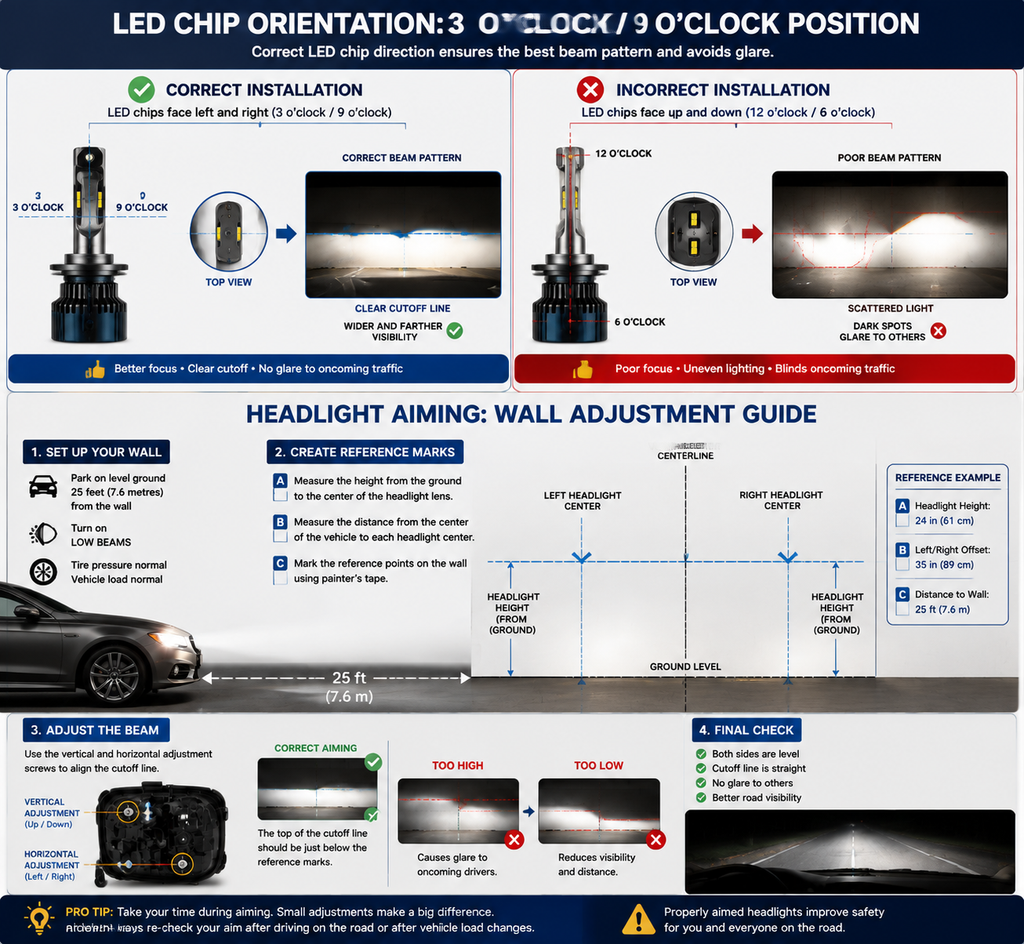
Some LED headlight designs use separate LED chips or reflector structures for high beam and low beam functions.
In low beam mode, dedicated LED chips direct light through specific reflector areas to create a wider, controlled beam pattern.
When high beams are activated, additional LED chips turn on or change their output direction, producing stronger forward illumination for longer visibility.
This type of system is commonly found in:
LED replacement bulbs
Reflector-style headlights
Some OEM LED assemblies
3. Adaptive LED and Matrix Lighting Systems
High-end vehicles may use advanced technologies such as Adaptive Driving Beam (ADB) and Matrix LED headlights.
These systems use:
Front-facing cameras
Vehicle sensors
Electronic control units (ECU)
to monitor road conditions and surrounding vehicles.
Instead of simply switching between high and low beams, Matrix LED systems can control individual LED segments. They can automatically reduce or turn off specific areas of the beam to avoid dazzling other drivers while maintaining maximum illumination in other parts of the road.
Benefits include:
Improved night visibility
Automatic beam control
Reduced glare
Safer highway driving
Final Thoughts
The way LED headlights switch between high and low beams depends on the lighting technology used.
Basic systems rely on different LED chips or reflectors, while advanced bi-LED projector headlights use mechanical shutters and premium vehicles use intelligent Matrix LED technology.
Regardless of the design, the goal remains the same:
Provide maximum road visibility while keeping the light pattern controlled and safe for everyone on the road.