Headlight technology has a genuinely interesting history, and knowing it makes the current choices make a lot more sense than jumping straight into a spec sheet.
How we got from oil lamps to lasers
Early cars didn’t have dedicated headlights at all — drivers borrowed oil lamps straight off horse-drawn carriages, which did almost nothing for nighttime visibility. Acetylene lamps came next and burned brighter, but an open flame bouncing around on a moving vehicle was exactly as risky as it sounds, which pushed the industry toward electric lighting instead.
Halogen became the mainstream standard by the 1960s. HID xenon arrived in the 1990s as the first major brightness leap since then. LED took over as the default through the 2010s, and laser headlights — still a niche, premium technology — represent the current edge of what’s actually shipping on production cars.
Four technologies now coexist, each solving the “how do we make light” problem in a genuinely different way.
Halogen: cheap, simple, and still around for a reason
A halogen bulb is a refined incandescent bulb — a tungsten filament inside a gas fill of iodine or bromine. The halogen gas slows down tungsten evaporating off the filament, which is why halogen bulbs hold their output more steadily over their life than a plain incandescent would.
Where it’s genuinely good: cheap to buy, trivial to replace, available for essentially every vehicle on the road, and the warm color tends to feel easier on the eyes during long stretches of driving or in bad weather — less about “cutting through” rain or fog physically (that particular claim doesn’t hold up well under scrutiny of how light actually scatters off droplets that size) and more about lower glare fatigue when light does bounce back at you.
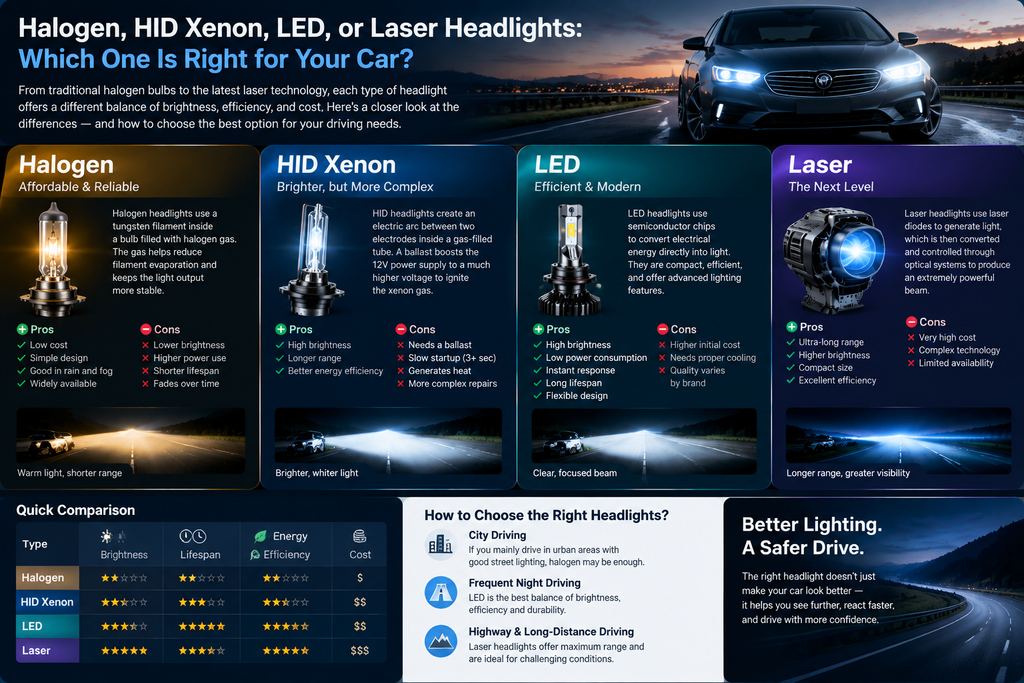
Where it falls short: dimmer than anything newer, less efficient, a shorter working life, and a filament that visibly dims well before it actually fails — the “candle effect” that makes an old halogen headlight look noticeably weaker than it did when new.
HID xenon: a genuine brightness leap, with real complexity attached
Xenon headlights don’t use a filament at all — they strike an electric arc between two electrodes inside a gas-filled tube, with a ballast stepping the car’s 12V supply up to the voltage needed to ignite the gas.
The payoff is real: substantially more light output and range than halogen, and reasonably efficient use of that power once it’s running. The cost is added complexity — a ballast is one more component to fail, startup takes a couple of seconds rather than being instant, the arc runs hot, and repairs cost more than swapping a halogen bulb because you’re dealing with electronics rather than a simple filament.
LED: the current default, for good reason
LEDs use semiconductor chips to turn electricity into light directly, and they’ve become the standard on most new vehicles because they balance brightness, efficiency, and durability better than anything that came before. Instant-on, low power draw, a long working life, and a compact form factor that’s let manufacturers build genuinely useful features — matrix beam arrays, adaptive high beams that dim around other traffic automatically, automatic brightness adjustment.
The honest tradeoff worth naming clearly: heat management isn’t a strength of LEDs, it’s a requirement. The chip itself is efficient, but the heat it does produce concentrates right at the junction in a compact housing, and how well a given bulb handles that heat is the single biggest factor separating a good LED product from a mediocre one. A well-engineered LED headlight manages this properly; a cheap one doesn’t, and that shows up as premature dimming within a year or two. Optical design and beam control matter just as much as the chip itself — brightness alone was never the whole story.
Laser: genuinely advanced, and not something you’re bolting onto your car this weekend
Here’s a detail that gets glossed over a lot: laser headlights don’t shine a laser beam directly at the road. That would be dangerous — a raw laser at that intensity is a genuine eye hazard. What actually happens is a blue laser diode hits a phosphor element inside the headlight, which converts that laser light into a broader, safe white light, and that light gets shaped and projected through conventional optics. The laser is the energy source driving the light, not the light itself hitting the road.
That conversion step is what makes laser headlights both remarkable and expensive: extremely long range — genuinely further than a strong LED setup — with high efficiency and a compact housing, since a laser diode is far smaller than an equivalent LED array. The catch is cost and complexity: this is precision optics and phosphor engineering, currently limited to a handful of premium factory-fitted models. It’s not an aftermarket category. If you’re shopping for headlight upgrades for a car you already own, laser isn’t on the list of options — it’s a factory spec you’d be choosing when you buy the car itself, not something you retrofit.
Rough comparison
Brightness Typical lifespan Efficiency Relative cost
Halogen Lowest of the four Shortest Lowest Low
HID Xenon Strong Moderate-to-good Good Medium
LED Strong to very strong Long, if well-cooled Very good Medium
Laser Highest range Long Very good High (factory-only)
Take this as a rough shape rather than a precise scorecard — actual performance within each category varies a lot by build quality, especially for LED, where a cheap bulb and a well-engineered one can differ enormously despite using the same underlying technology.
What actually fits your situation
Mostly city driving, well-lit streets: a solid halogen setup still does the job — there’s little reason to spend more if this is genuinely most of your driving.
Regular nighttime driving, any budget: LED is the practical upgrade for most people — meaningfully better visibility, lower running cost, and a long life as long as you’re buying a bulb with real cooling hardware rather than the cheapest option on the shelf.
Long-distance highway or rural driving: this is where xenon or a well-specced adaptive LED system genuinely earns its keep with extra range and beam control. Laser is worth knowing about and, if you’re cross-shopping premium vehicles that offer it factory-fitted, worth considering — but it’s not a retrofit decision for the car you already have.