The lumen output of LED car lights is not fixed. Generally, 1600 to 3500 lumens is a suitable range, yet it is affected by various factors. A 35W LED headlight produces roughly 3200 lumens, equal to 91 lumens per watt, while 80 to 100 lumens per watt is regarded as the ideal luminous efficiency. Most LED headlights feature power ratings between 20W and 40W, delivering approximately 2000 to 4000 lumens. In short, the proper lumen output should be determined comprehensively based on lamp type, wattage and personal brightness demands.
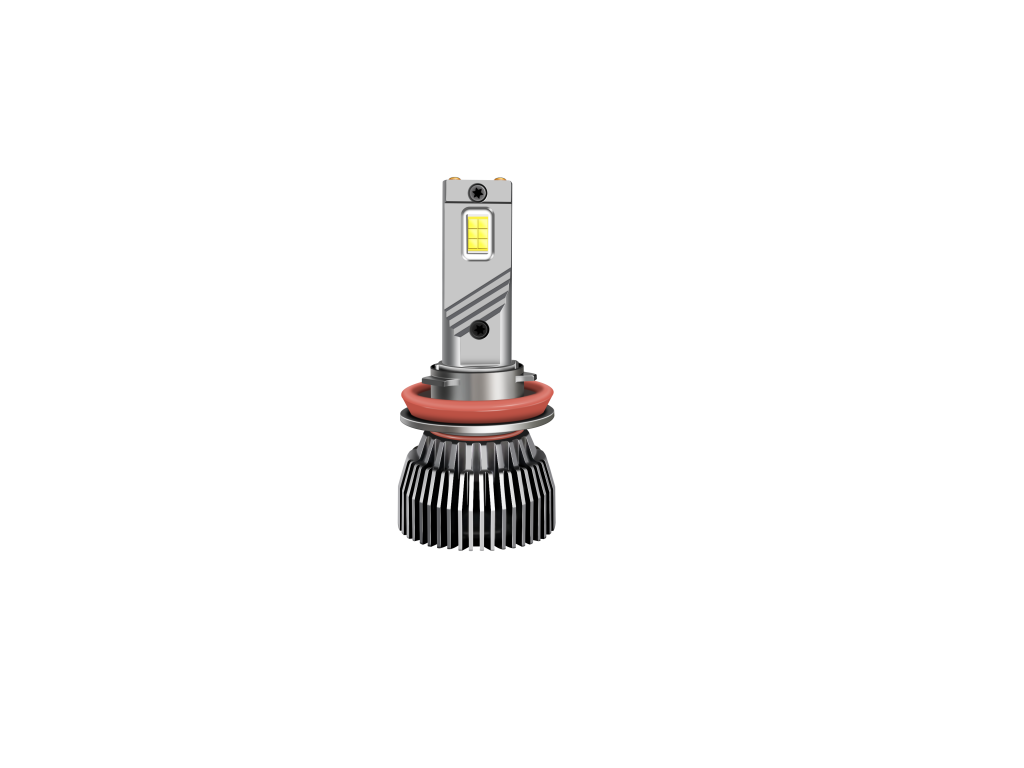
Different types of automotive lamps vary greatly in luminous flux. Traditional halogen low beams output around 1000 lumens, and halogen high beams around 1200 lumens. Xenon HID lights top out at 3200 lumens with a regular output of roughly 2000 lumens. Standard 35W automotive xenon bulbs range from 3500 to 5500 lumens. For 35–60W high beams, the lumen range is 3400–5900, whereas 35–55W low beams sit at 3400–5400 lumens. By contrast, LED headlights boast outstanding luminous efficiency and brightness, with maximum output hitting 6200 lumens.
Multiple factors must be taken into account when selecting LED car lights by lumen value. Theoretically, higher wattage equals brighter light, but excessive wattage brings drawbacks. Higher power generates more operating heat, which requires efficient heat dissipation. To secure a service life of over 30,000 hours, the LED chip temperature must be kept below 85°C. Besides, over-wattage LED headlights may exceed the load limit of the vehicle’s wiring system, triggering circuit overheating or burnout. Therefore, lumen selection should match the original factory lamp power and your personal brightness needs.
Moreover, many LED bulbs on the market carry false power labels. Numerous bulbs marked 40W–50W fail to reach their claimed wattage. A single watt of standard LED chip generates 80–100 lumens; premium chips may theoretically hit 110–130 lumens per watt, yet 100 lumens per watt is the practical ceiling for ordinary mass-produced lamps.
In conclusion, the lumen value of LED car lights is restricted by multiple conditions. Buyers need to weigh all factors thoroughly before purchase. You need to guarantee sufficient illumination for safe driving, while taking the vehicle’s electrical load and lamp heat dissipation into consideration. Only with comprehensive evaluation can you pick LED car lights that deliver ideal brightness and operate stably and safely.
For reference, factory replacement LED low beams are rated 35W–55W with an optimal lumen range of 3400–5400, while LED high beams run 35W–60W at 3400–5900 lumens. It is critical to match parameters to your specific vehicle model. Higher lumens correspond to higher wattage and greater power consumption. However, headlight wattage is not meant to be as high as possible. More power means higher operating temperatures, which demands excellent heat dissipation. Poor cooling will create potential safety hazards.
Car headlights, also known as vehicle headlamps, are symmetrically mounted on both sides of the vehicle front to illuminate the road ahead during night driving. LED stands for light-emitting diode, a solid-state semiconductor light-emitting component. It emits light directly through photon generation from carrier recombination inside the semiconductor chip. LED headlights are lighting fixtures that adopt LED chips as light sources.