One-sentence conclusion: Ultra-high-wattage LED headlights cause serious hidden dangers. Higher power does not mean better lighting. Improper high-power LED upgrades can be even more dangerous than stock halogen bulbs.
Most car owners have a wrong mindset: the higher the LED wattage, the brighter the light. Therefore, many people blindly pursue 80W, 100W, or even higher-power LED bulbs. In fact, this is a extremely risky upgrade. Below is a detailed professional explanation of why high-wattage LED headlights are not recommended.
1. Circuit Overload Risk — Direct Safety Hazard
The original vehicle’s wiring, fuses, relays, and plugs are all designed for the standard 55W halogen power load.
Current comparison under 12V vehicle voltage:
Stock 55W halogen: around 4.6A
100W high-power LED: around 8.3A
The current nearly doubles after upgrading. The factory wire harness is only designed to withstand approximately 5A current. Long-term overcurrent operation will cause severe wire heating, accelerated aging of insulating layers, and in extreme cases, short circuits and vehicle spontaneous combustion.
In addition, factory fuses are usually 7.5A or 10A. High-power LEDs will push the current close to or exceed the fuse limit, resulting in frequent blown fuses. Continuous overcurrent will also overheat relay contacts, causing poor contact or permanent welding failure.
2. Severe Heat Problems — LED Chips Cannot Bear High Power
Although LED chips run cooler than halogen bulbs, they are extremely sensitive to high temperatures. The higher the power, the greater the heat generation.
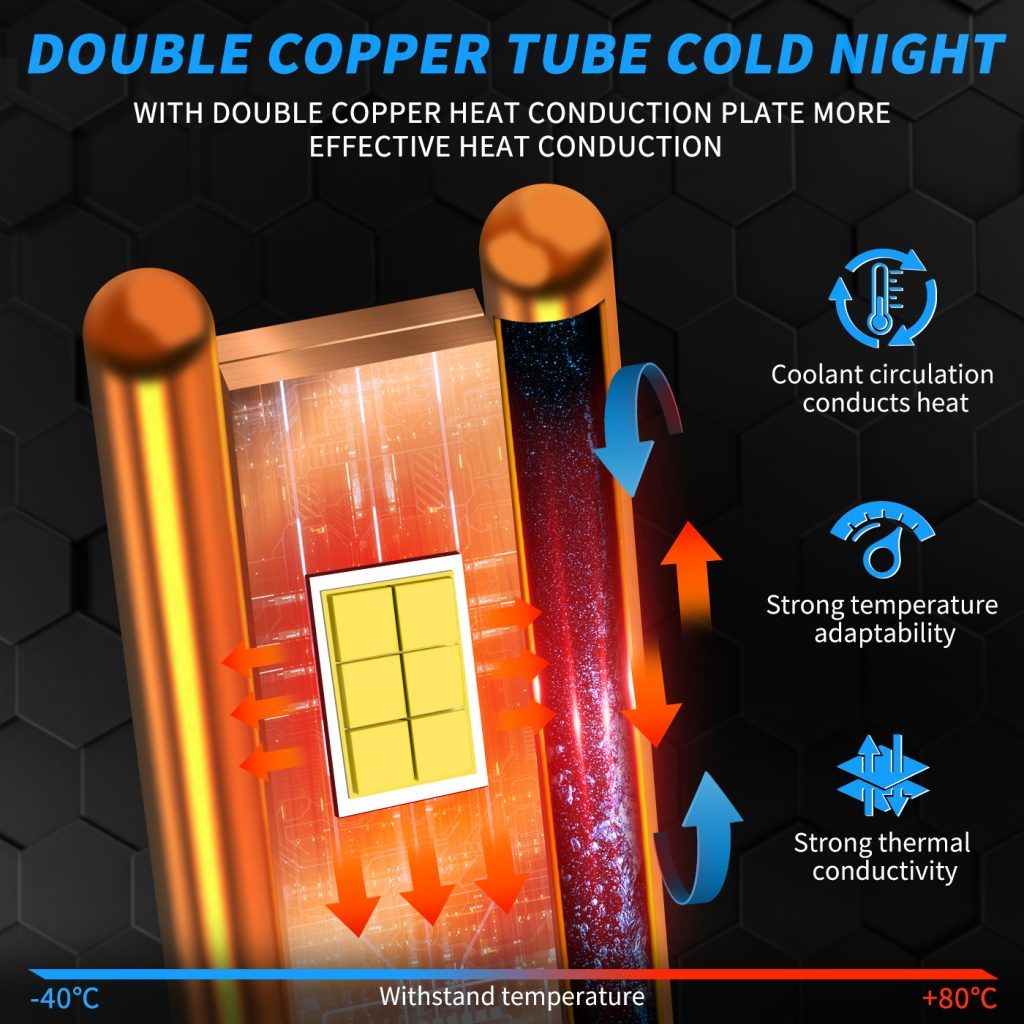
Most generic 80W/100W LEDs do not have qualified heat dissipation structures. Excessive heat accumulation will cause:
- Accelerated luminous decay: Extremely bright at first but dim rapidly within months with irreversible brightness loss
- Color temperature drift: Standard white light turns yellow, greatly reducing night visibility
- Permanent chip burnout: Overheating directly burns out the LED bulb
3. CANBUS Decoders Cannot Solve Overload Issues
Many car owners mistakenly believe that installing a CANBUS decoder can fully solve all problems.
In fact, the function of a decoder is only to simulate halogen resistance values to trick the vehicle computer and eliminate fault codes and flickering. It cannot bear excessive power or suppress overcurrent heat.
If the LED power far exceeds the original 55W standard, circuit heating, overload risks, and fuse burning problems will still exist completely unchanged.
4. Worse Light Pattern & Severe Glare
High-watt LEDs indeed increase pure brightness, but most extra light cannot focus on the road surface.
The factory reflector bowl is designed strictly according to the halogen filament’s 360° luminous position and focal point. After installing high-power LEDs, the mismatched light source position causes severe light scattering.
The light shoots too high, too far, and too scattered, strongly dazzling oncoming drivers, while your own road vision becomes messy and unclear. This creates the typical dangerous situation: blinding others without lighting up the road.
5. Widespread Power False Labeling on the Market
Most cheap generic LED bulbs have serious false wattage marking:
- Marked 100W, actual power only 30W–40W
- Marked 80W, actual power only 25W左右
- Many merchants falsely mark “equivalent brightness” as “actual power”
This leads to two awkward situations:
You chase high brightness and buy falsely labeled high-power LEDs, only to find the brightness even lower than original halogen lights.
Or some products have higher actual power than marked, causing hidden circuit overload risks you cannot detect.
6. Extra Burden on Battery & Alternator
Although LED has higher energy efficiency than halogen, excessive power still increases the load of the vehicle’s electrical system.
- High-power LEDs drain the battery faster when the vehicle is stationary
- The alternator needs to output higher current for a long time, accelerating aging
- Hybrid and electric vehicles will face disturbed overall energy management
Best LED Wattage Range for Safe Upgrade
The safest and most recommended actual power range: 30W–40W per bulb
This power range brings perfect comprehensive performance:
- Brightness is 2–3 times that of halogen bulbs, fully meeting night driving needs
- Working current is only 2.5A–3.3A, far lower than halogen 4.6A, completely safe for original circuits
- Moderate heat generation, no extreme heat decay risk
- CANBUS decoder works stably without fault codes
- Minimize load on battery and alternator
For H4 / H13 high-low beam integrated bulbs, the power can be appropriately increased but must not exceed 50W.
Never buy 80W / 100W ultra-high-power LED bulbs. They are either falsely labeled and useless, or truly high-power and extremely dangerous for your car circuit.
Core LED Headlight Selection Rules
| Core Principle | Detailed Explanation |
|---|---|
| Check actual rated power, not equivalent power | Merchant-marked 100W is often equivalent brightness; only refer to the true rated power on parameter sheets |
| Stick to 30W–40W golden power range | The most stable, safest, and cost-effective power for daily road upgrades |
| Built-in CANBUS decoder | Avoid dashboard error codes and light flickering |
| 1:1 filament positioning design | Ensure standard light pattern, no glare, no scattered light |
| Professional heat dissipation structure | Aviation aluminum body + copper heat pipe + silent fan ensures long service life |
Final Conclusion
LED headlight upgrades pursue matching brightness, stable performance, and vehicle safety, not blindly high power. 30W–40W is the perfect balance for most family cars. Ultra-high-power LEDs bring only safety hazards instead of better lighting effects.