The theoretical service life of automotive LED headlights generally starts at 20,000 hours, while high-quality premium products can reach up to 100,000 hours under ideal lab conditions.
For reference: If headlights are used 10 hours every day, standard LED bulbs can serve roughly 5 years, and top-grade versions could last as long as 27 years. Nevertheless, real-world durability is heavily affected by power & thermal management, driver stability, operating environment and usage frequency.
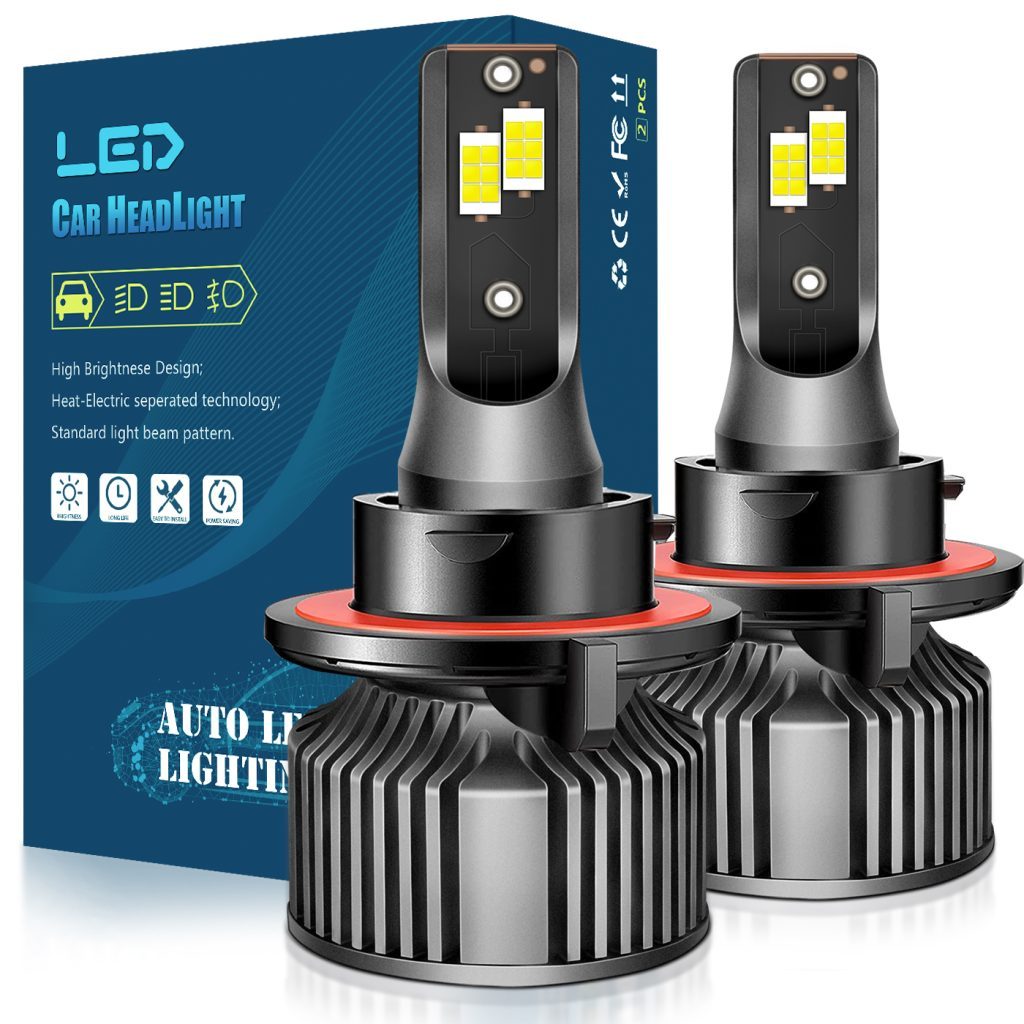
Three Core Factors That Determine LED Headlight Lifespan
(1) Power Output & Heat Dissipation
Higher power generates more heat and raises higher requirements for thermal design. Insufficient heat dissipation leads to trapped heat inside the lamp housing, accelerating LED chip aging and drastically shortening service life. Many drivers blindly boost power to pursue brighter lighting without optimizing cooling, which causes premature lamp failure.
Active cooling solutions (built-in silent cooling fans) push heat away from the aluminum base via air convection once the lamp switches on, effectively maintaining a safe operating temperature.
(2) Stability of the Driver Circuit
Unstable power supply creates constant current fluctuations, triggering flickering, uneven brightness and other faults. Long-term irregular current will wear down LED chips. Reliable built-in drivers deliver steady constant current to sustain stable LED operation.
(3) Operating Environment & Usage Frequency
High-temperature and humid environments speed up electronic component degradation. Frequent switching creates instantaneous current surges that gradually consume component lifespan. Vehicles often travelling on rough roads or under extreme climate conditions will see reduced LED service life.
Lifespan Comparison of Three Main Headlight Types
表格
Headlight Type Average Service Life Key Features
Halogen Around 500 hours Shortest lifespan
Xenon (HID) Around 3,000 hours Requires 3–4 seconds warm-up delay to full brightness
LED 20,000 – 100,000 hours Longest lifespan, up to 30 times longer than xenon lights
Working Principle of Xenon vs LED Headlights
Xenon (HID High-Intensity Discharge Lights)
Filled with xenon and other inert gas inside UV-resistant quartz glass tubes. The vehicle’s 12V power is instantly boosted to 23,000V by a ballast, ionizing xenon gas to create a bright electric arc. Xenon lights deliver over 300% higher brightness than equal-wattage halogen lamps. Instead of sudden burnout, failed xenon bulbs gradually dim, giving drivers time to safely pull over.
LED Headlights
Light-emitting diodes act as the light source, featuring high brightness, rich color options, low power draw and long service life. Their compact size enables flexible, creative headlight styling. However, thermal management and production costs remain major challenges.
Both LED and xenon lights offer weaker penetration in heavy rain and fog compared to traditional halogen bulbs.
Practical Tips to Extend LED Headlight Lifespan
Choose branded LED products with verified quality and reputation
Select appropriate power specifications and prioritize reliable heat dissipation structures
Avoid long-term operation in persistently hot and humid environments
Reduce frequent on/off switching and maintain stable vehicle voltage
Regularly inspect cooling components to ensure normal operation of heat sinks or cooling fans
Industry Development Trend
From a technical perspective, LED technology outperforms xenon, and xenon surpasses halogen. Full LED headlight assemblies hold comprehensive advantages over xenon systems. As production technology matures, costs will continue to drop, so LEDs will gradually replace traditional lighting solutions over time.
That said, buyers do not need to blindly pursue top-tier LED upgrades. Properly matched xenon lights can still fully satisfy most daily driving demands.