You can swap halogen bulbs for LEDs, but only if you address a number of critical factors. Otherwise, you’ll introduce serious safety issues. If you replace the bulbs without also fitting proper lenses or reflectors that match the LED’s light pattern, the beam will scatter badly. The driver won’t see the road clearly, and the glare will dazzle oncoming traffic – that’s the most obvious and dangerous risk.
- How halogen, xenon, and LED compare
Halogens have low brightness, short range, high heat output, and average lifespan (500–1,000 hours). Xenon (HID) lights are brighter, with a colour close to sunlight and longer life, but they’re complex, require lenses, take 3–4 seconds to warm up, and lose penetration in rain, snow, or fog. LEDs are energy‑efficient, respond in microseconds, are bright and compact, and last 60,000–100,000 hours – but they’re expensive, hard to service, and demanding when it comes to cooling.
- The core problems with a direct swap
Different light‑emitting points: halogens are 360° point sources; LEDs are directional surface emitters. The focal point of an LED rarely matches the reflector bowl designed for a halogen filament. The result is scatter, poor road coverage, and severe glare.
Heat management: LEDs generate significant heat during operation. If it’s not dissipated quickly, the chips suffer rapid lumen depreciation or even burn out. Many cheap LEDs on the market use copper‑braid cooling, but their power ratings are often overstated – the cooling can’t keep up with the actual heat produced.
Power and decoding: most factory halogens are rated at 55W or 60W. A 55W halogen gives about 1,000 lumens, while a good 20–30W LED can reach around 3,000 lumens. But the power difference can trip the car’s fault detection system – swapping a 55W halogen for a 30W LED changes the current draw enough that the ECU thinks the bulb is broken. A decoder (capacitive, resistive, or software‑based) is often needed to simulate the original current signature.
Colour temperature and bad‑weather performance: many LEDs run at around 7200K – short wavelength, poor fog/rain penetration. They look flashy but don’t cut through mist as well as halogens do. So‑called “dual‑colour‑temperature” products often end up with white that’s too white and yellow that’s too yellow – not very useful in practice.
- A safe way to upgrade
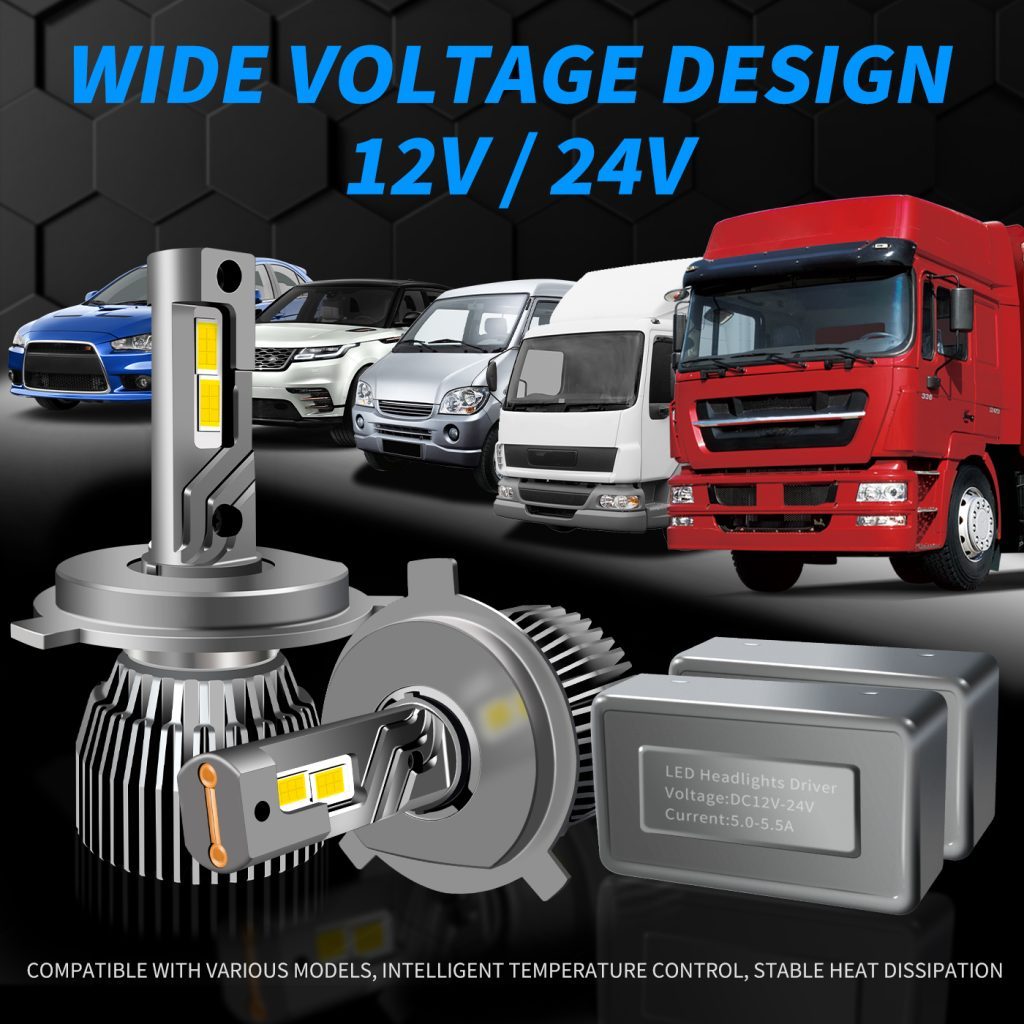
Prefer LEDs that come with a built‑in lens, or better yet, install a complete projector‑lens assembly to focus the beam properly.
Choose products with integrated cooling – fins, fans, or heat pipes.
Wear gloves during installation – skin oils on the LED chips cause localised overheating and accelerate degradation.
Match the power and socket type exactly to your original bulbs. Some cars will need a decoder.
Keep colour temperature at or below 6500K, and always aim the beam so that the low‑beam cut‑off is sharp and horizontal, with no upward scatter.
- Bottom line
Yes, you can replace halogens with LEDs – but only if you get the lens, cooling, decoding, and aiming right. If you just buy a cheap pair of LEDs and plug them in without any of that, the result will likely be worse than your original halogens – and genuinely unsafe.