When evaluating automotive headlight performance, both xenon (HID) and LED technologies have their own technical strengths. However, modern demands for safety and efficiency are steadily pushing lighting technology toward smarter, more efficient solutions.
- Brightness specifications compared
Traditional xenon headlights produce light through a high‑voltage arc that excites xenon gas. Their typical output ranges from 3200 to 3600 lumens, with a colour temperature close to natural daylight. Their long‑range illumination is stable and effective on open roads at night.
Modern LED headlights use multiple high‑density chips working together. Individual chip power is small, but overall system output has improved dramatically – mainstream vehicles now deliver 3000–4500 lumens, with some premium configurations exceeding the upper limit of xenon. The key advantage is direct conversion of electricity into light, giving higher energy efficiency than xenon. The beam is more concentrated, more evenly distributed, and renders road surfaces and details more accurately.
- Response time and safety
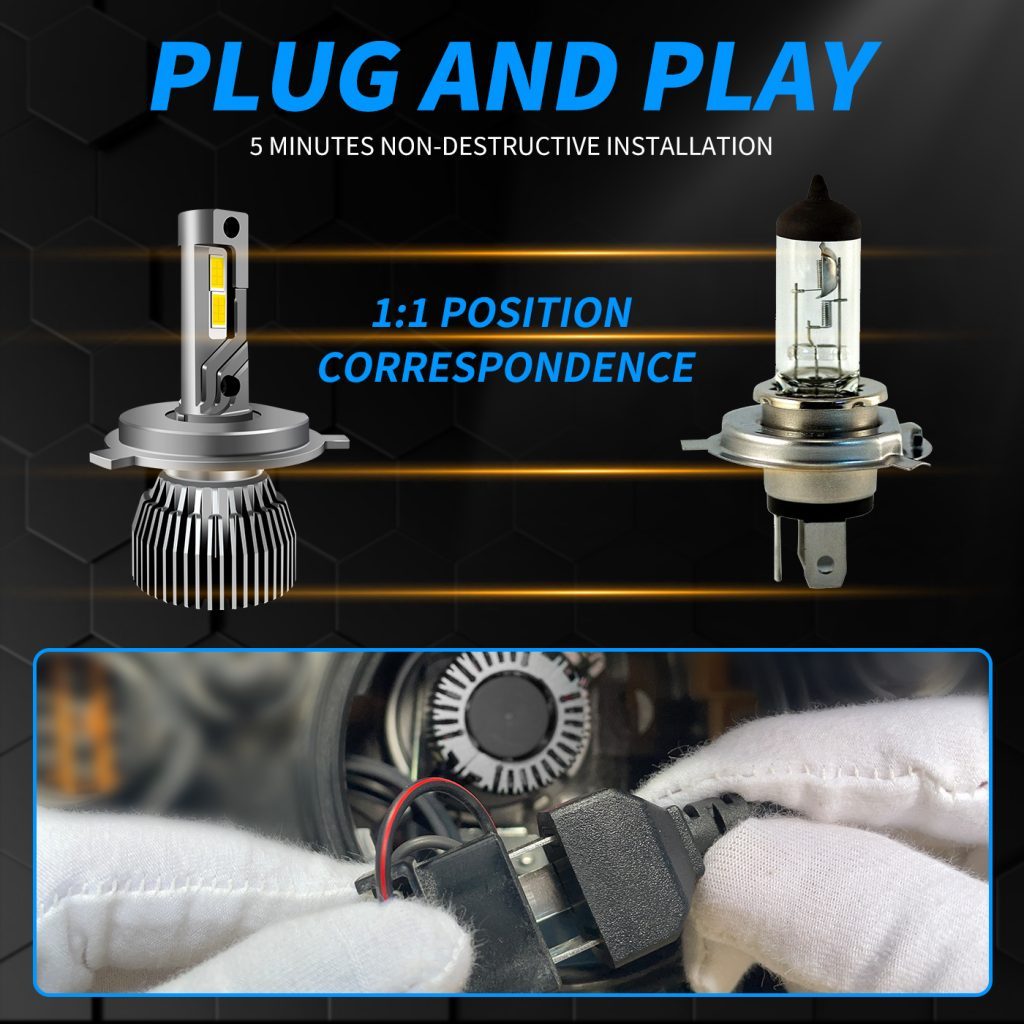
Xenon lamps take several seconds to warm up to full brightness – a noticeable delay. LEDs, by contrast, reach full output in milliseconds. Whether entering a tunnel, taking a night corner, or making an emergency manoeuvre, LEDs provide immediate full illumination – giving the driver extra reaction time and significantly improving safety.
- Durability and cost‑effectiveness
LEDs are compact, highly shock‑resistant, and adaptable to rough roads. Their typical lifespan exceeds 50,000 hours – well above xenon’s 30,000 hours – meaning little to no maintenance over the vehicle’s life, with better long‑term economics.
- Performance in fog and rain
Xenon’s lower colour temperature (around 4300K) was traditionally seen as better for fog penetration. Today’s LEDs, with precisely controlled colour temperature (4500K–5000K) and advanced optical lenses, achieve excellent fog‑visibility performance – matching or even exceeding xenon in practice. More importantly, LEDs allow precise beam‑shaping that reduces glare for oncoming traffic and meets strict lighting regulations.
- Conclusion
If you compare peak brightness alone, xenon still has a slight edge. But across overall performance – brightness output, response time, efficiency, lifespan, and beam control – LEDs come out ahead. What really matters isn’t paper specifications, but whether the light can consistently, stably, and safely illuminate every metre of road ahead. On that count, LEDs deliver the more complete package and have become the preferred choice for modern vehicle lighting.
Supplement – choosing the right light for your driving needs
No single light type fits every scenario – the key is matching the technology to your actual driving environment and personal needs:
Halogen: warm yellow light (around 3000K–3500K) penetrates fog and rain well, reducing visual distortion. Not as bright as newer technologies, but stable and cheap to maintain – a practical choice for drivers in wet or foggy regions.
Xenon (HID): roughly twice as bright as halogen, with a colour temperature close to midday sunlight (4300K–5000K), giving natural, clear vision. The broad beam helps reduce fatigue on long highway drives. But it needs a warm‑up period and must be paired with proper lenses – best suited to factory‑fitted or professionally retrofitted systems.
LED: instant response, low energy use, long life (up to 100,000 hours), and compact design. With smart systems, they offer automatic high‑beam switching and cornering lights – now mature and reliable in most mainstream models.
Laser: range exceeding 600 metres, far brighter than conventional sources, with very low energy draw. Currently used mainly in premium vehicles as a high‑beam supplement to LEDs. Complex and expensive – not yet widely available, but ideal for users who demand the ultimate in lighting performance.