When upgrading automotive headlights, LED and xenon (HID) are the two main contenders. This article compares them across brightness, beam characteristics, lifespan, response time, installation complexity, and typical use cases – backed by advice from experienced drivers – to help owners make an informed decision.
- Brightness and illumination quality
Brightness output
Xenon lamps deliver 3200‑3600 lumens – over 300% brighter than halogen – giving a clear advantage for long‑range illumination on unlit remote roads at night. LEDs range from 2000‑4000 lumens; though slightly lower on paper, their higher electrical‑to‑light conversion efficiency and better beam focus deliver clear, practical illumination.
Beam characteristics
Xenon light is relatively concentrated but darker at the edges – it absolutely requires a lens; without one, the beam scatters and dazzles oncoming traffic. A 4300K xenon lamp penetrates fog and rain reasonably well. LEDs produce a more even beam with less distortion and generally don’t require colour filters. They perform well for low‑beam use, but their higher colour temperature (around 5000K) means weaker penetration in wet or foggy conditions.
- Performance and durability
Lifespan
LEDs are rated for up to 100,000 hours – their solid‑state construction has no filament to burn out. At one hour of use per day, that translates to 8‑13 years. Xenon lamps typically last 3,000‑10,000 hours but depend on ballasts, which often have a shorter life; their glass envelopes can also crack under extreme temperature changes.
Response time
LEDs light up instantly with no warm‑up delay – ideal for tunnels, lane changes, or any situation requiring immediate full illumination. Xenon lamps need 3‑5 seconds to reach full brightness – a brief but noticeable lag that can affect visibility when pulling away or changing lanes at night.
- Installation and compatibility
Installation complexity
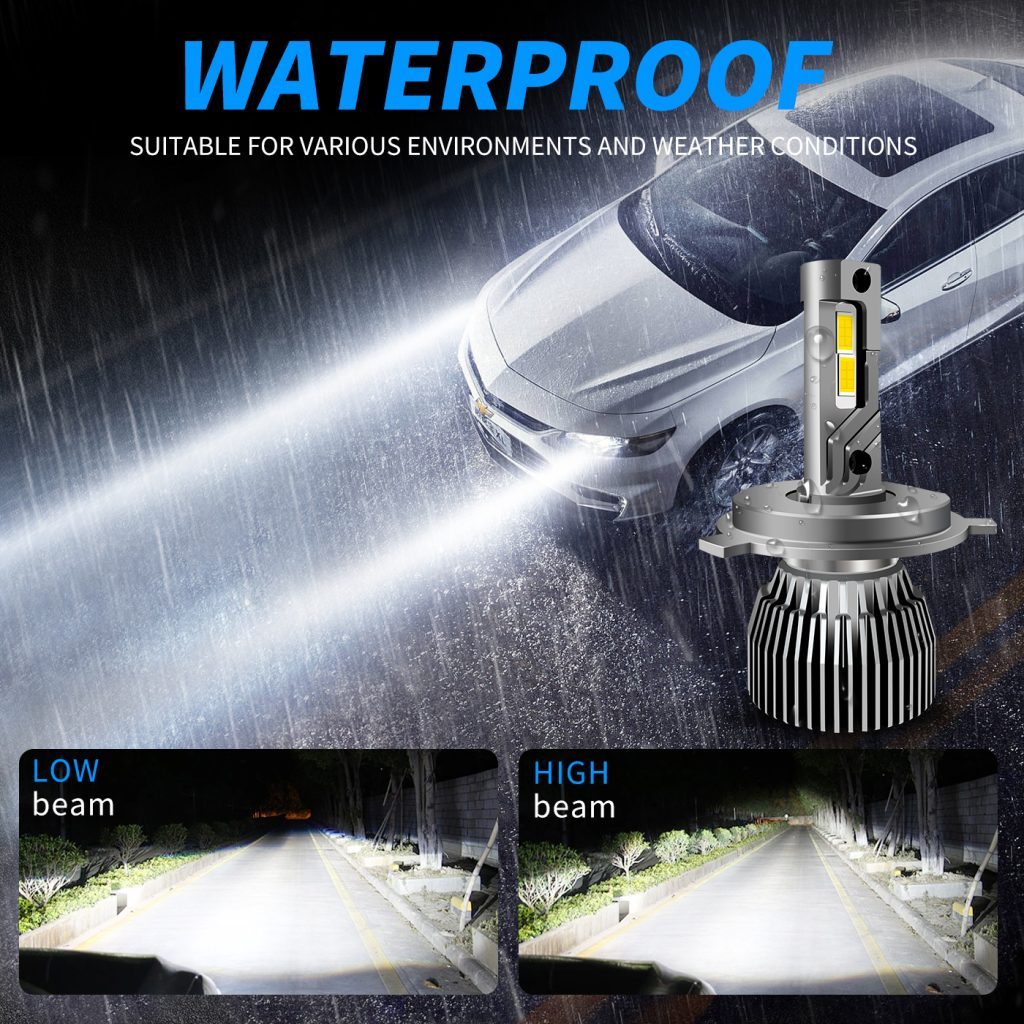
LEDs are relatively simple to install – compact size, direct replacement for most factory halogen bulbs, no extra hardware, usually under 30 minutes. Xenon retrofits are more involved – they require ballasts, sometimes decoders, and professional aiming – typically taking 1‑2 hours.
Use cases
Xenon suits drivers on a budget who primarily drive at night or on highways, or those whose cars already have factory projector lenses. LEDs suit a wider audience – daily commuters, those prioritising durability, drivers wanting instant lighting and energy savings, and vehicles with limited space or specific styling requirements.
- Critical cautions
Legal compliance: xenon must be fitted with bi‑xenon projector lenses – otherwise it’s an illegal modification. LEDs are also strongly recommended to be used with proper lenses to prevent scatter.
Temperature tolerance: LEDs may show slight brightness reduction in extreme cold. Xenon lamps run hot and can affect the socket and housing over time.
- Advice from experienced drivers
Advice 1 – choose your upgrade path by needs
You can replace just the bulbs or upgrade both bulbs and lenses together. Xenon generally outperforms LED across most metrics, but LEDs excel in instant start‑up, energy efficiency, and safety. LEDs do have a weakness in high‑beam scatter and are not as bright as xenon – but for low‑beam use, they are a solid choice.
Advice 2 – on xenon start‑up delay
The delay depends on the installer’s skill. When the light comes on, it appears blue at first, then shifts to white within one to two seconds. Flashing isn’t affected because that involves the lens shield, not the bulb itself – and most retrofits use bi‑xenon projectors. It’s wise to keep halogen bulbs for the high‑beam assist to compensate for poor rainy‑weather penetration.
Advice 3 – the overlooked value of halogen
Halogen bulbs are cheap, penetrate fog well, and don’t dazzle – making them ideal for wet or misty conditions. Halogen is a thermal light source – heat radiates away with the light. LEDs are a cold source – heat doesn’t fully radiate with light, so they need additional cooling; without it, thermal degradation occurs. Also, if any LED component fails (e.g., the cooling fan), the whole unit often needs replacing.
Advice 4 – how bi‑xenon projectors work
Modern xenon setups use bi‑xenon projectors, which switch between high and low beams via an electromagnetic shield – dropping or raising a cut‑off plate. The xenon bulb stays on continuously – there is no “extended” start‑up once it’s running. The so‑called “delay” only refers to the initial warm‑up when the headlights are first turned on.
Advice 5 – colour temperature and weather adaptability
In dense fog, LEDs let you see clearly up to about 40 km/h – beyond that, visibility drops. Halogens won’t let you see clearly at high speeds in fog either. Bi‑xenon projectors are currently the most common setup – they have a brief initial warm‑up but no delay on subsequent switching. A colour temperature around 5000K is optimal; anything higher reduces visibility in rain, so 5000K‑5500K is widely recommended.