“My factory halogens are too dim – should I upgrade to xenon or LED?” This is a question owners ask every day. Headlights are a car’s “eyes” – brightness directly affects night‑driving safety. But with so many options on the market, especially xenon and LED, beginners can easily make the wrong call. Drawing on 15 years of driving experience and four headlight upgrades, this article combines real test data with practical use cases to break down the pros and cons of each and help you avoid common pitfalls.
- Operating principles and key features
LED (Light Emitting Diode) is a semiconductor‑based system that converts electricity directly into light. It offers fast start‑up, high brightness, low energy consumption, compact size, and long life. Its wide colour‑temperature range allows for various colour and brightness options.
Xenon (HID) is a high‑voltage gas‑discharge system – high voltage excites xenon gas inside the bulb to produce intense light. It delivers high brightness, high colour temperature, low energy use, and decent lifespan – but requires a longer start‑up time and depends on a ballast to operate.
- Core specifications – real‑world test data
Brightness and beam quality
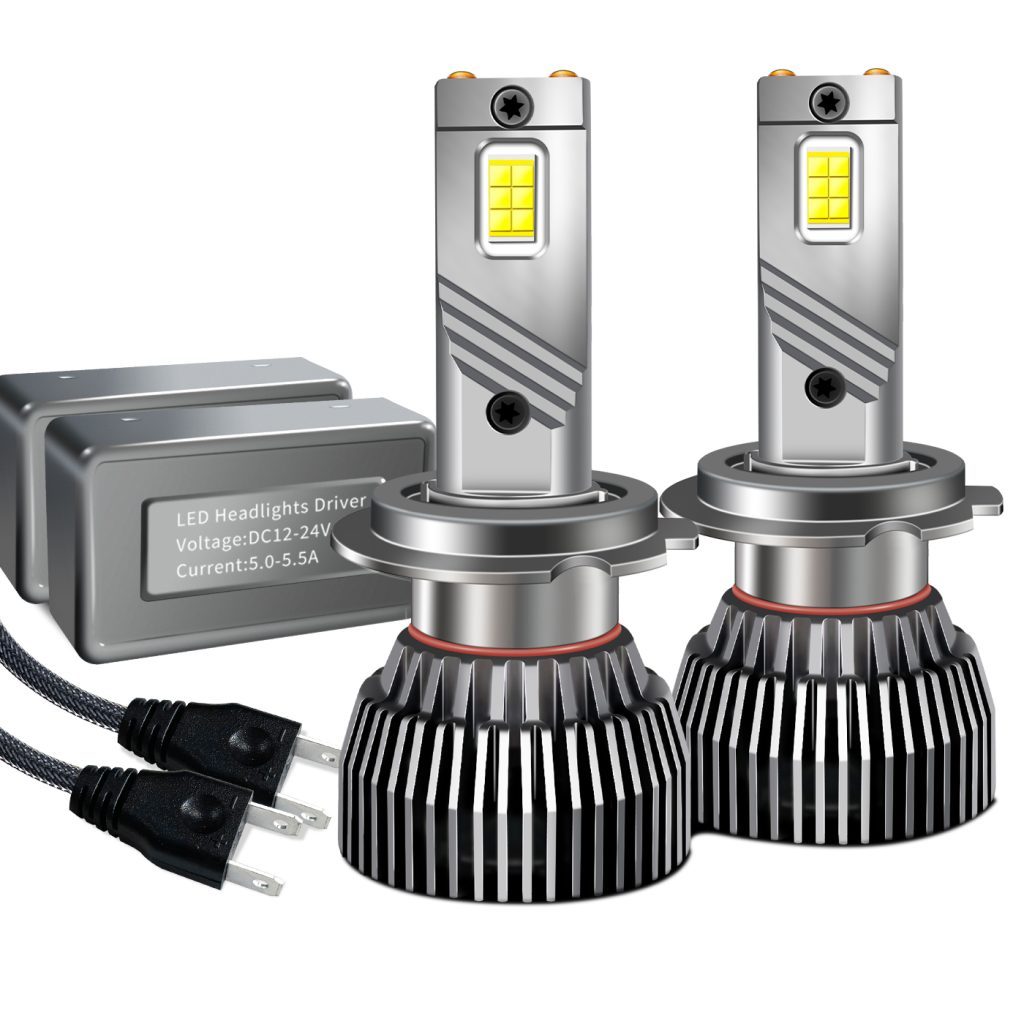
Test data shows xenon delivers 3200‑3800 lumens, while LEDs range from 3000‑4500 lumens – on paper, LEDs have a slight edge, but the actual lighting experience differs. Xenon produces a warm‑white light (4300K‑6000K) with a wide, even spread – ideal for suburban or mountain roads, where roadside obstacles and kerbs are clearly visible with minimal blind spots. LEDs produce a cooler white (5000K‑6500K) with stronger focus and a throw that’s 5‑8 metres longer than xenon – great for city arterials or highways – but the narrower beam can leave blind spots at the kerbs.
Lifespan and stability
LEDs have no filament – they rely on chips, lasting 5‑8 years under normal use, with strong vibration resistance even on rough roads. Xenon lamps require a ballast to boost voltage – the ballast is a wear‑prone component that may fail in 2‑3 years, and bulb life is 3‑5 years, with higher replacement costs later. Xenon also suffers from “start‑up delay” – 3‑5 seconds to reach full brightness, which can be a safety concern when pulling away at night. LEDs light up instantly.
Installation and cost
LEDs are more installation‑friendly – most models are direct plug‑and‑play replacements for factory halogens, no wiring changes needed, DIYable in under 30 minutes, costing roughly 300‑800 CNY per set. Xenon requires ballasts and sometimes decoders, otherwise warning lights appear – professional installation is recommended, costing 500‑1200 CNY including labour and materials. However, xenon replacement costs are more flexible – just the bulb can be swapped; LEDs generally require a full‑unit replacement.
- Scenario‑based recommendations
Scenario 1 – City commuter: choose LED
City roads have ample street lighting – extreme beam range isn’t critical – but frequent stop‑and‑go driving needs instant lighting. LEDs start instantly, their cool white light stands out under streetlights, installation is simple, and maintenance is minimal. On a tight budget, 300‑500 CNY domestic brands work; with more to spend, go for Philips or Osram for extra stability.
Scenario 2 – Frequent suburban/mountain driving: xenon is safer
Fewer streetlights and more complex road conditions require wide, even beam coverage. Xenon’s warm‑white light penetrates light rain and fog slightly better than LEDs, and its even spread reduces blind spots – helping you spot pedestrians or obstacles at the roadside. Opt for 4300K xenon for a good balance of brightness and penetration; avoid 6000K or above, as higher colour temperatures cause glare and reflection in rain.
Scenario 3 – Tight budget + older car upgrade: LED for value, xenon for durability
For cars over 5 years old, a simple brightness boost on a budget under 300 CNY – go for a domestic LED kit; easy install and noticeable improvement. If you’re willing to spend around 500 CNY and want a more durable setup, choose xenon with a branded ballast – installation is more involved, but the lighting experience is superior and will last 3‑4 years reliably.
- Vehicle fitment and market trends
LEDs – compact, bright, long‑lasting – suit premium luxury models. Xenon’s high colour temperature and high brightness suit sporty cars and SUVs where driving experience is emphasised. Market‑wise, LED share is growing year on year as technology improves and costs fall, and LEDs are expected to become the mainstream choice in the future.
Summary comparison table
Metric Xenon (HID) LED
Brightness (lumens) 3200-3800lm 3000-4500lm
Colour temperature 4300K-6000K (warm white) 5000K-6500K (cool white)
Beam characteristic Wide, even, minimal blind spots Focused, longer throw, kerb blind spots
Start‑up speed 3‑5 sec delay Instant
Lifespan 3‑5 years (ballast 2‑3 years) 5‑8 years
Installation Complex – ballast & decoder needed Simple – plug‑and‑play
Cost 500‑1200 CNY (incl. installation) 300‑800 CNY
Best for Suburban, mountain, long‑distance City commuting, highways