Full English Polished Article (Reorganized & Rewritten)
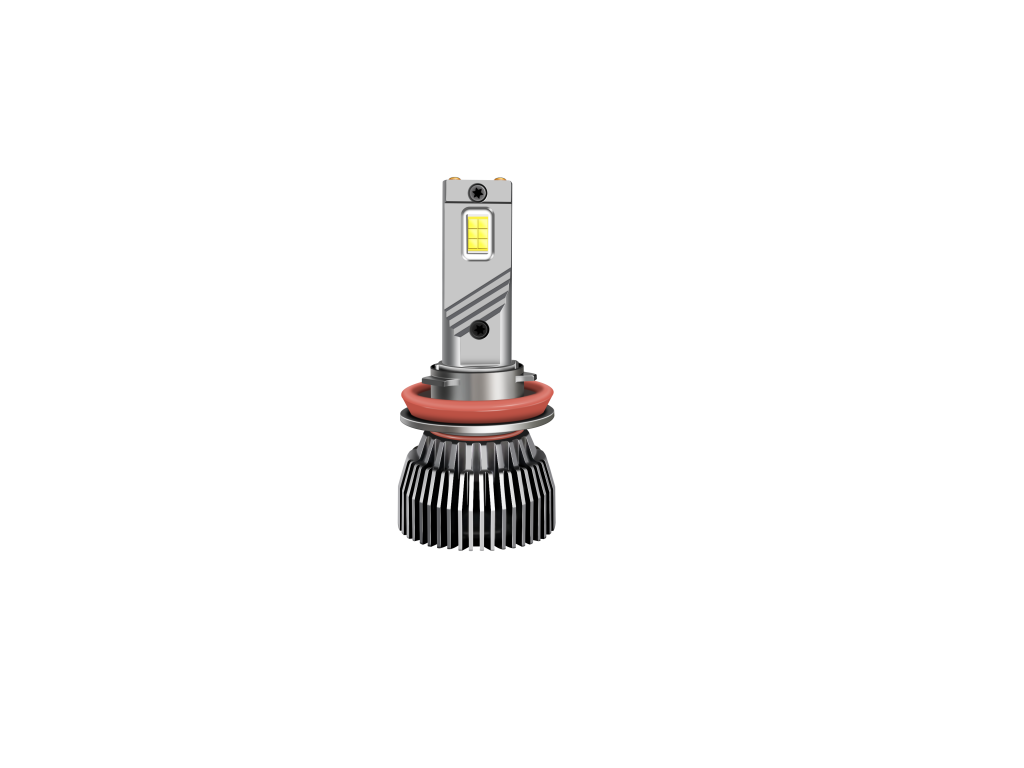
Many car owners wonder how bright LED headlights can truly get and what lumen range delivers the safest and most comfortable night vision. Unlike fixed factory halogen or xenon lights, LED headlight brightness varies significantly depending on chip quality, wattage efficiency, heat management, and overall design. Understanding the real lumen standard can help you avoid falsely labeled high-power bulbs and unsafe over-bright upgrades.
In actual vehicle applications, the ideal luminous efficiency for automotive LED bulbs ranges from 80 to 100 lumens per watt, with a mainstream average of 91 lm/W. This is the most stable and reliable efficiency range for long-term driving use. For example, a standard 35W LED headlight typically outputs around 3200 lumens, while a 20W–40W LED headlight generally delivers 2000 to 4000 lumens in real steady-state brightness. For most daily vehicles, 1600 to 3500 lumens is the most balanced and practical brightness range.
To better understand LED brightness advantages, it is necessary to compare it with traditional factory lighting sources. Original halogen low beams normally produce about 1000 lumens, and halogen high beams reach roughly 1200 lumens. Stock xenon HID headlights usually work at 2000 lumens, with a peak brightness of 3200 lumens. For professional 35W–55W automotive xenon bulbs, the lumen range can extend from 3500 to 5500 lumens. In contrast, high-quality LED headlights can achieve a maximum steady-state output of up to 6200 lumens, providing far higher luminous efficiency with lower power consumption.
Different headlight beam types and vehicle lamp structures also have standardized lumen ranges. For high beams (35W–60W), the suitable lumen output is 3400–5900 lumens to support long-distance road observation at night. For low beams (35W–55W), the optimal range is 3400–5400 lumens, ensuring clear near-road illumination without producing strong glare. Most automakers adopt 35W as the standard headlight configuration, while some high-visibility factory high beams use 55W power. In terms of vehicle structure, two-lamp and four-lamp headlight systems follow the same lumen specification standards, with four-lamp designs separating dedicated low beams and long-range high beams for more layered lighting performance.
Although higher wattage theoretically generates higher lumens, blindly pursuing ultra-high power is unsafe and unnecessary. High-wattage LED bulbs produce massive heat during continuous operation. To maintain a lifespan of more than 30,000 hours, the LED chip operating temperature must be kept below 85°C. Excess power without matched heat dissipation will cause rapid luminous decay, brightness drop, and even bulb burnout. In addition, vehicle factory wiring has fixed load limits. Over-rated LED headlights will overload the circuit, cause wire overheating, and bring potential fire risks.
Another key point for accurate lumen selection is avoiding market false labeling. Many merchant bulbs marked 40W–50W cannot reach their advertised power and brightness. The practical luminous ceiling for ordinary mass-produced LED chips is 100 lm/W. Though premium chips can theoretically reach 110–130 lm/W, such high efficiency is rarely seen in civilian vehicle bulbs.
Compared with traditional halogen lamps, LED lighting has an obvious efficiency advantage. LED bulbs can provide brighter vision at the same wattage, which means drivers do not need to upgrade to higher-power bulbs for better brightness. Replacing stock bulbs with equal or even slightly lower-power LED lights can achieve superior lighting effects while ensuring circuit safety, lower heat generation, and longer service life.
In conclusion, when selecting LED headlight lumens, drivers must comprehensively consider factory original power parameters, luminous efficiency standards, heat dissipation capacity, and daily driving scenarios. Reasonable brightness matching balances driving safety, electrical system stability, and long-term durability, avoiding both dim lighting and unsafe excessive brightness.