My stock halogen headlights are too dim. Should I upgrade to Xenon or LED headlights?” This is one of the most common questions from car owners every day. Vehicle headlights function as the “eyes of the car”, and night driving safety is directly determined by lighting brightness, clarity, and field of vision.
Currently, three mainstream headlight technologies dominate the market: Halogen, Xenon (HID), and LED. Each has distinct working principles, performance characteristics, and applicable scenarios, making it confusing for new drivers to choose the right upgrade. In this comprehensive guide, we will compare the three headlight types in terms of lighting mechanism, brightness, energy consumption, lifespan, weather penetration, installation difficulty, and overall cost. We will also share practical selection tips and pitfalls to help you make a one-time correct decision without wasting money.
- Lighting Principle: Three Completely Different Light-Generating Mechanisms
The core difference between halogen, xenon, and LED headlights lies in their energy conversion methods, which fundamentally determine their performance, response speed, and efficiency.
Halogen Headlights work by heating a tungsten filament to incandescent status through thermal radiation. Most electrical energy is converted into heat rather than light, resulting in extremely low energy efficiency.
Xenon (HID) Headlights rely on high-voltage arc discharge to excite inert xenon gas for illumination. A dedicated ballast is required for voltage boosting, leading to unavoidable startup delay.
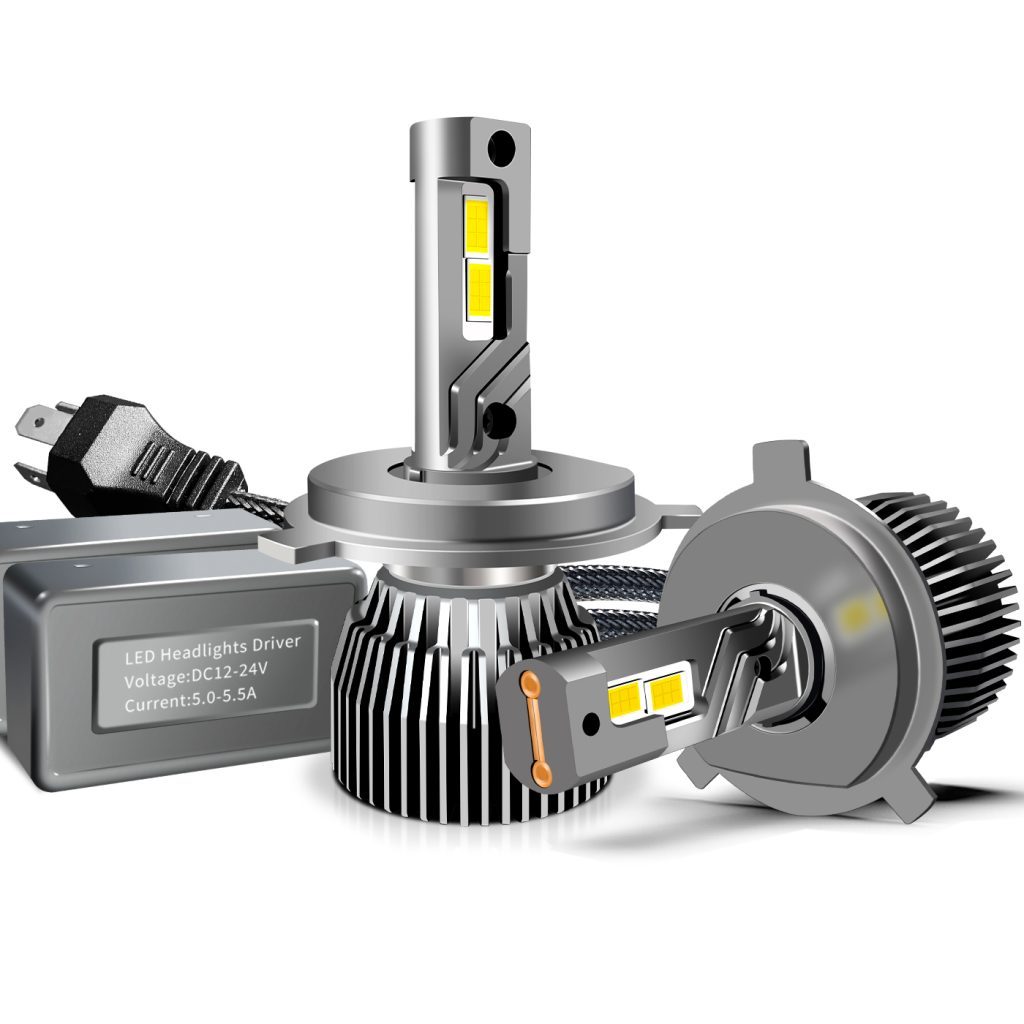
LED Headlights adopt electroluminescence technology. Light is released through the recombination of electrons and holes in semiconductor materials. Electric energy is directly converted into light energy, delivering the highest response speed and energy efficiency among the three types. - Brightness Performance: Real Lumen Data Comparison
Brightness is the most critical indicator of headlight performance, measured by luminous flux (lumen/lm). Under the same test conditions, the actual brightness data is as follows:
Halogen (55W): Approximately 1000 lm. The lowest brightness level with yellowish and dim light, limited road coverage, and obvious visual fatigue during long night driving.
Xenon (35W): Approximately 3200–3500 lm. Medium-high brightness with uniform and soft light distribution, providing wide road illumination with fewer blind spots.
LED (35W): Approximately 3200–4500 lm (high-quality models). The highest peak brightness with excellent light focusing performance. The straight irradiation distance is 5–8 meters longer than xenon lights, delivering clearer long-distance vision.
Key Reminder: When selecting headlights, prioritize lumen value (actual brightness) instead of wattage. Higher power does not mean brighter lighting. Real road illumination also depends on illuminance and optical lens design, which determines whether the light is concentrated on the road or scattered as glare. - Energy Consumption & Efficiency: LED Is the Most Energy-Saving
Halogen Lights: Rated at 55W with only 10%–20% luminous efficiency. Most power is wasted as heat, causing high vehicle load and increased fuel consumption.
Xenon Lights: Rated at 35W with moderate efficiency. Additional power loss occurs due to ballast operation.
LED Lights: Rated at 20–35W with 80%–90% luminous efficiency. The power consumption is only one-third of halogen lights. Lower electrical load protects the original vehicle circuit, especially for older models, and indirectly reduces fuel and energy consumption. - Service Life & Durability: LED Achieves Long-Term Zero Replacement
Lifespan is a key factor measuring long-term cost performance (calculated based on 2 hours of daily night driving):
Halogen Lights: 500–2000 hours (0.7–2.7 years). Fragile tungsten filaments are vulnerable to vibration and high temperature, requiring frequent replacement.
Xenon Lights: 3000–5000 hours (4–7 years). The bulb lasts longer, but the ballast is a wearable part that easily fails within 2–3 years, leading to high later maintenance costs.
LED Lights: 50,000–100,000 hours (68–136 years). The solid-state chip structure has no fragile parts, featuring excellent shock resistance and extreme durability, far exceeding the vehicle’s service life. - Startup Response Speed: LED Enables Instant Safety Response
LED Headlights: Millisecond-level instant lighting with zero delay. It supports fast high/low beam switching and instant flashing, greatly improving safety during overtaking and emergency road conditions.
Xenon Headlights: Requires 3–5 seconds to reach full brightness after startup. Temporary insufficient lighting creates potential safety risks during vehicle startup and quick road response.
Halogen Headlights: Lights up instantly but maintains low fixed brightness with no performance advantage. - Rain & Fog Penetration: Halogen Natural Advantage + Modern LED Optimization
Halogen Lights (3000K): Warm yellow light delivers the strongest penetration in rainy, foggy, and hazy weather, with minimal light scattering — its most prominent advantage.
Xenon Lights (4300K–6000K): Balanced penetration, suitable for most weather conditions.
Traditional LED Lights (5000K–6500K): High-color-temperature cool white light scatters severely in fog and rain, resulting in weakened penetration.
Modern High-Quality LED Optimization: Premium LED headlights adjust the color temperature to 4300K–5000K and adopt professional lens beam control, balancing high brightness and all-weather penetration. For rainy and foggy areas, 4300K–5000K LED headlights plus stock halogen fog lights form the best safety combination. - Installation Difficulty & Overall Cost
Halogen Lights: Simplest plug-and-play replacement with no extra accessories required. Low cost, but outdated performance is not recommended for active upgrades.
Xenon Lights: Requires ballast installation and decoding for some vehicle models. Professional shop installation is necessary. Total cost ranges from $70–$170 with labor fees, plus later maintenance costs for vulnerable parts.
LED Lights: Most models support direct interface replacement with integrated design and no extra accessories. Easy DIY installation. Complete sets cost $40–$110 with stable performance and no frequent maintenance. - Styling & Design Flexibility: LED Defines Modern Vehicle Aesthetics
LED components are compact and flexible in layout, supporting advanced lighting designs such as sequential turn signals, matrix beam headlights, and pixel dynamic light patterns. Almost all mid-to-high-end new vehicles are equipped with LED headlights, achieving dual upgrades in both lighting performance and vehicle appearance. - Final Recommendation by Driving Scenario
Urban Commuting & Highway Driving → LED Headlights
High brightness, fast response, energy-saving, durable, and cost-effective — the most balanced daily upgrade solution.
Suburban Mountain & Rural Roads → LED + Professional Lens
Strong focusing and long irradiation distance eliminate road blind spots and improve night driving safety.
Rainy & Foggy Areas → 4300K–5000K LED + Halogen Fog Lights
Balances clear night brightness and bad-weather penetration.
Ultra-Low Budget Temporary Use → High-Brightness Halogen Bulbs
Low cost with limited brightness improvement, only suitable for temporary transition.
Pursuit of Ultra-Uniform Soft Lighting → Xenon Headlights
Smooth and even road lighting, acceptable for users who tolerate startup delay and later maintenance. - LED Headlight Buying Pitfall Avoidance Guide
- Prioritize Lumens, Not Wattage
Power does not represent brightness. Choose steady-state luminous flux above 3000 lm for practical lighting performance. - Choose the Right Color Temperature
4300K–5000K is the most practical all-round range. 6000K is bright on clear nights but weak in bad weather. Avoid 6500K+ blue-white light with severe glare. - Must Match Optical Lens
Direct replacement of LED bulbs on stock halogen reflector housings causes severe light scattering and illegal glare. Lens assembly matching is essential for standard light cutoff and compliant beam patterns. - Check Heat Dissipation System
High-quality LED headlights adopt aviation aluminum housings, silent cooling fans, or dual heat pipe structures. Excellent heat dissipation prevents luminous decay and premature lamp failure.