With LEDs becoming widespread in automotive lighting, many owners are eager to upgrade their factory “candle‑like” halogen bulbs. However, many buyers focus only on “is it bright enough?” – with little understanding of headlight structure, what the values K and LM mean, or key lighting parameters – leading to misconceptions. This article debunks five common myths about LED headlights to help you choose wisely.
Myth 1: Halogen Lights Are Better Than LEDs
Most cars come with factory halogens, leading some to believe halogens are superior. In reality, factory halogens are chosen not because they’re the best, but because they’re cheap to manufacture – a full LED assembly costs tens of times more than a halogen unit.
Halogen’s main advantage is its warm‑yellow light, which penetrates fog and rain better. But rainy/foggy days are a minority of the year. Halogen drawbacks – low brightness, high energy consumption, high heat, and lower perceived quality – are more noticeable. LEDs offer high brightness, low energy, instant start, and pure white light – significantly outperforming halogens overall.
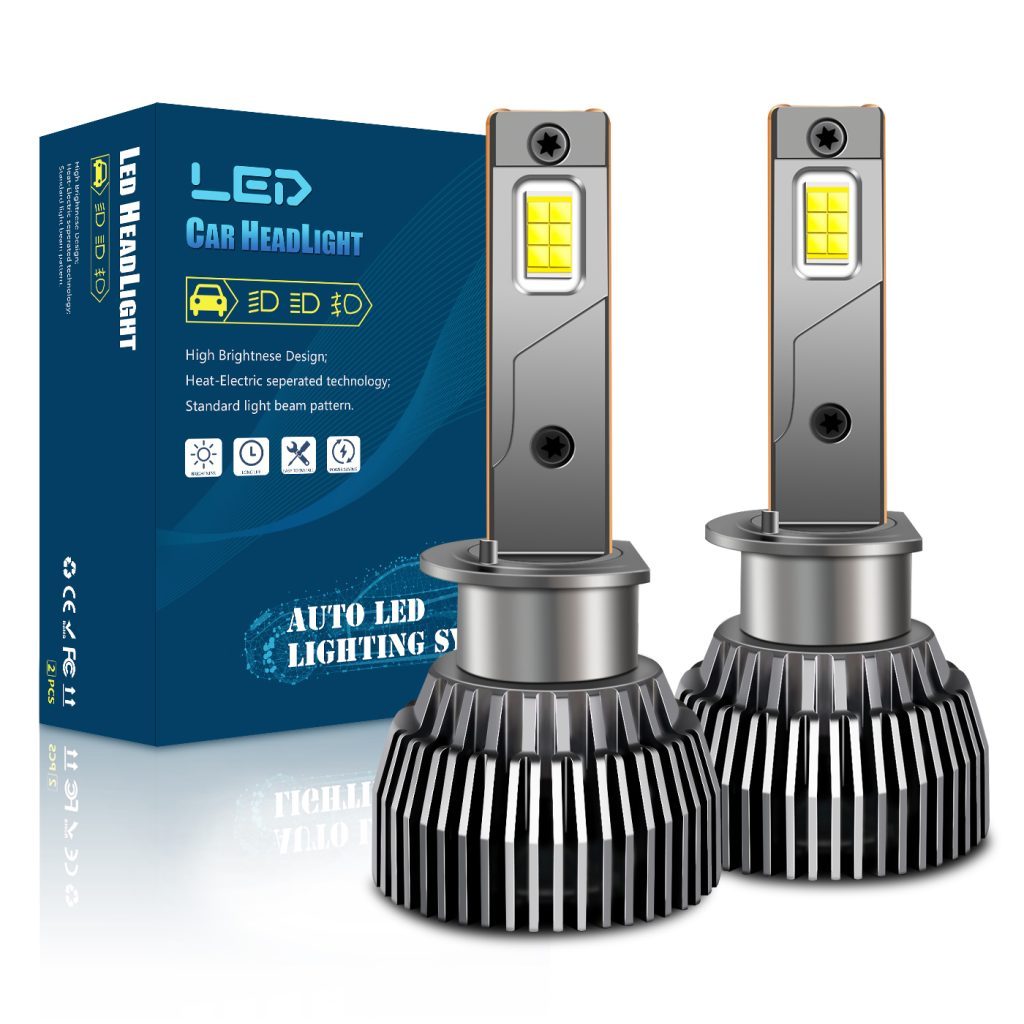
LED weakness: white light penetrates fog/rain less effectively than halogen. This can be addressed with brighter fog lamps. Overall, LEDs are the better choice.
Myth 2: LED Headlights Scatter Light – No Lens Means No Cut‑Off, Affecting Oncoming Traffic?
Beam scatter depends on multiple factors – the light source itself, reflector design, and installation. LEDs are the light source – with a quality emitter, focus is generally not an issue.
The cut‑off line is determined by the reflector bowl – which has a central focal point. Early COB chips had light‑emitting points different from the original halogen filament – not at the reflector’s focus – causing scatter. But modern flip‑chip technology has improved significantly – the light‑emitting point is now close to the original filament position, producing a beam pattern similar to factory halogens, with high brightness and good focus. Not all LEDs require lenses to focus – it depends on the chip design.
Myth 3: LEDs Without Lenses Will Fail Annual Inspections?
Inspection success largely depends on whether brightness meets the required standard. For example, halogens that have degraded after hundreds of hours of use (lumen depreciation) may fail.
LED retrofits with improved scatter (avoiding high‑power COB chips) usually pass inspection. However, replacing the entire assembly or installing lenses is considered modification – altering appearance and wiring. Strictly speaking, regulations do not permit this, and inspection failure risk is higher. Choose compliant LEDs that match the original beam pattern – avoid major appearance or wiring changes.
Myth 4: K Means Brightness – 6000K Means Very Bright?
Some low‑wattage, low‑brightness brands market “6000K brightness” – misleading consumers into thinking 6000K indicates high brightness. K is the unit of colour temperature – it determines whether the light is yellow or white:
- 3000K: Yellow (warm) – strong fog/rain penetration
- 4300K: Warm white – balances brightness and penetration
- 6000K: White – high perceived brightness – but weaker fog/rain penetration
- 8000K+: Bluish – flashy but poor practicality
Colour temperature and brightness are entirely different concepts – don’t confuse them.
Myth 5: Higher Wattage Means Brighter – and Brighter Is Always Better?
Higher wattage generally produces higher luminous flux (lumens) under the same conditions – higher lumens mean more brightness.
But higher wattage also means higher operating temperatures. LEDs demand good cooling – if heat cannot be effectively dissipated, brightness drops or the chip burns out. Two additional problems with excessive wattage (70‑80W+):
- Circuit overload: factory halogens are typically 55‑60W – increasing to 70‑80W or more strains the original wiring and battery.
- Excessive energy consumption: high‑wattage LEDs lose their energy‑efficiency advantage – draining the battery unnecessarily – not worth it.
Recommendation: choose LED bulbs at or below the original halogen wattage – balancing brightness with circuit safety.