When shopping for a new car or thinking about upgrading an older model’s lighting, many owners find themselves stuck on one key question: what truly separates halogen, xenon (HID), and LED headlights, and is LED really worth the extra consideration? Looking at global passenger‑car trends over the past decade—from budget‑friendly family sedans to mid‑ and high‑end business models—LED headlights have shifted from a premium option to a standard fitment across many lineups. That alone tells you they outperform traditional halogen and xenon sources in overall terms.
Most drivers only know that LEDs are “brighter,” but they rarely grasp the deeper benefits in terms of night‑time safety, energy efficiency, lifetime cost, exterior styling, smart integration, and adaptability to tough conditions. This article draws on automotive optics, vehicle electrical systems, retrofit practice, and everyday driving scenarios to give you a full, practical picture of what LED headlights really bring to a sedan.
- Lighting Performance – Clearer and More Uniform
In modern sedan design, LEDs have become a core feature for improving nighttime driving. Unlike halogen filaments or high‑pressure xenon gas, LEDs use semiconductor emission to produce a beam that is brighter, more evenly spread, and far more controllable—tackling visibility issues at their root. Let’s quickly compare the optical shortcomings of the three main types:
Halogen bulbs emit a yellowish light with low lumen output; they tend to illuminate the centre well but leave large dark patches on the sides.
Xenon (HID) lamps are brighter but have a scattered light source—without a proper lens they cause severe glare, and they also suffer from a warm‑up delay.
A properly designed LED unit, paired with a precision reflector or lens, delivers a sharp, well‑defined beam with no sudden dark‑bright transitions, effectively eliminating the flaws of older technologies.
In low‑beam mode, a good LED setup casts a clear, even light covering 30–40 metres ahead, including the kerbs, bicycle lanes, and pedestrians at the edges—no blind zones. The high beam can reach over 100 metres on highways, compressing dark pockets and allowing drivers to spot road signs, obstacles, or crossing cyclists early, even in tunnels, unlit rural roads, or pre‑dawn hours. Lab tests show that, at the same power consumption, LED road illumination is roughly three times that of halogen—a huge help for those who frequently drive long distances at night or on winding mountain roads, noticeably cutting down on eye strain.
- Energy Efficiency – Less Waste, More Range
LEDs are remarkably efficient in converting electricity into light. They consume only about one‑third of the energy that halogens do for the same output—and this matters for both petrol and electric vehicles.
Halogen bulbs have to heat a tungsten filament to over 1,000°C, wasting more than 75% of the electrical energy as heat. That heat not only drains the alternator but also bakes the plastic headlight housing over time, causing yellowing, fogging, or cracking. LEDs, by contrast, are “cold‑light” sources—no filament heating, very little energy wasted as heat, and most power goes directly into visible light.
From the whole vehicle’s electrical load perspective, lower‑power LEDs ease the burden on the alternator and battery. For fuel‑powered cars, that means slightly less engine drag and a tiny fuel saving; for pure EVs and plug‑in hybrids, it reduces battery drain from lighting, giving a measurable boost to driving range. Moreover, LEDs work stably across a 9–32V voltage range (fitting most sedans’ electrical systems), without the bulky high‑voltage igniters that xenon lamps need. Their internal driver circuitry is simpler, so you’re far less likely to see flickering, intermittent shut‑offs, or on‑board computer error codes—making them much more reliable day in, day out. - Instant Response – A Critical Safety Edge
Response time is another major area where LEDs leave halogen and xenon behind. Halogen bulbs take a moment to heat up to full brightness, and xenon lamps can need 3–5 seconds to warm up—during which they’re barely useful. LEDs, however, reach 100% output in microseconds; the delay is practically zero.
This split‑second reaction matters in many real‑world situations: flashing high beams to alert oncoming traffic, alternating beams during high‑speed overtaking, warning pedestrians at intersections, or rapidly switching lights in fog. The instant‑on feature delivers full illumination immediately, sending clear signals to other road users and giving the driver extra time to react in an emergency—reducing the risk of collisions and sideswipes. - Durability and Environmental Tolerance – Built to Last
LED headlights typically have a service life of 30,000 to 50,000 hours. For a family sedan used about 300 hours of night driving per year, that’s over a decade—essentially the whole life of the car. Halogen bulbs can’t compete; they usually last only 500–1,000 hours, and frequent night drivers may burn through a pair in just 3–6 months, adding replacement costs and labour. Xenon lasts longer than halogen, but electrode wear and igniter ageing cause significant brightness drop‑off within 2–3 years.
LEDs use solid‑state semiconductor packaging—no fragile filaments, no glass discharge chambers—so they resist vibration and impact extremely well. Even over speed bumps, rough country roads, or unpaved tracks, the LED chips stay intact. With high‑grade silicone sealing and aviation‑grade aluminium heat‑sink systems, they withstand humid, dusty, scorching summer heat, and freezing winter cold. Luminous decay is very slow; after eight continuous hours of driving, brightness drop is less than 5%, so they maintain steady output year after year. - Styling and Smart Lighting – More Than Just Looks
The small size and modular nature of LED chips give car designers far more freedom than bulky halogen bulbs ever did. Segment‑by‑segment, matrix, or strip‑style LED headlights create distinctive lighting signatures—daytime running lights, dynamic turn signals, and welcome‑light animations are all enabled by tiny LED modules, greatly enhancing the front‑end’s tech appeal and brand identity.
Beyond aesthetics, the compact hardware allows for advanced intelligent lighting systems. High‑end OEM LED matrix units can incorporate ADB (adaptive driving beam), AFS (cornering light), and rain/fog mode optimisation. On‑board cameras detect oncoming vehicles and pedestrians, then independently dim or switch off individual LED chips to avoid dazzling others while keeping the roadside fully lit. When cornering, the beam follows the steering angle to illuminate the inside of the bend, eliminating blind spots. These dynamic adjustments improve overall road safety and reduce accidents caused by glare or poor visibility. - Colour Temperature – Choose Wisely for Bad Weather
A common misconception is that higher colour temperature means brighter and better fog penetration—but the opposite is often true. LEDs with a colour temperature above 6000K (cold white/blueish) tend to scatter heavily in fog, heavy rain, or snow, creating a blinding white wall that makes road markings and guardrails nearly invisible. For areas with frequent rain or snow, industry experts recommend a warm‑white range between 4300K and 5000K. This balances brightness with penetration, giving you clear vision on dry nights while reducing scattering in wet conditions, and the softer light also helps ease eye fatigue on long overnight trips. - Aftermarket Upgrades – What to Watch Out For
If your sedan came with halogen headlights and you’re planning to retrofit LEDs, there are some crucial pitfalls that determine whether you’ll actually get all the benefits—or end up with a failed inspection and irritated fellow drivers.
21
, combined with optimized optical lens design, creating a clear cut-off line-
5
. The concentrated beam prevents glare for oncoming drivers while ensuring uniform road illumination with no dark spots-
4
, enhancing overall driving safety.
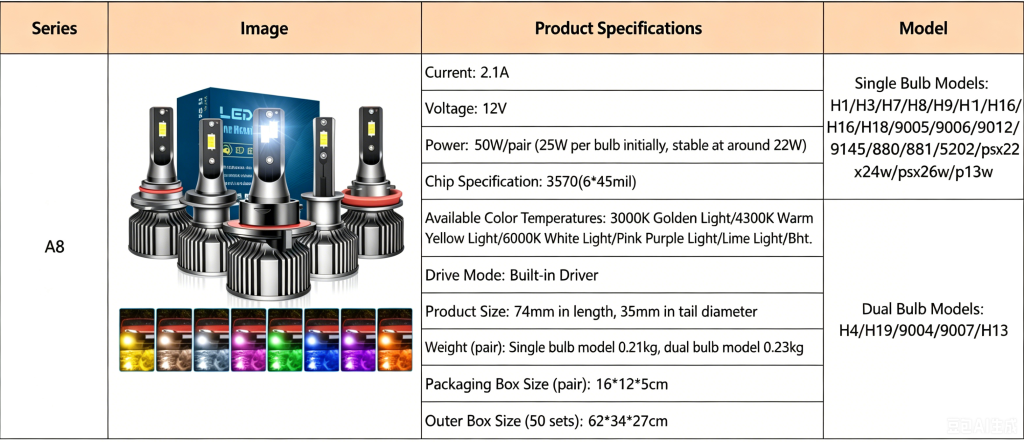
Always choose a kit that includes a proper optical lens, an efficient dual‑structure heat sink, and a built‑in Canbus decoder that matches your car’s electronics.
Cheap no‑name LED bulbs often lack a proper lens, so the light source doesn’t align with the original halogen filament position—resulting in severe glare and beam scatter, failing annual inspections and blinding oncoming traffic.
Poor heat‑dissipation designs (plastic bases) cause heat to build up, leading to rapid degradation or burnout within months.
Without built‑in decoding, they may trigger ECU fault warnings or flickering.
A genuine automotive‑grade LED upgrade uses an aluminium heat sink with a quiet, high‑speed fan, meets thermal standards, and produces a sharp cut‑off line with no stray light—fully compliant with road regulations and inspection requirements, replicating the performance of factory‑fit LEDs.
Overall Verdict
Taking everything together—lighting performance, energy efficiency, instantaneous response, long‑term durability and shock resistance, styling freedom, intelligent lighting integration, all‑weather adaptability, and lower maintenance costs—LED headlights clearly outshine halogen and xenon in all eight dimensions. As manufacturing technology continues to advance, with ever‑better heat dissipation, optics, and electronic control, LEDs have become the undisputed mainstream choice for modern sedans, SUVs, and business cars. For anyone who commutes at night, takes long road trips, or drives in hilly areas, a good‑quality LED headlight set delivers clearer vision, lower running costs, and greater peace of mind—making it a highly cost‑effective safety upgrade that truly pays off in everyday use.