After buying a car, owners often pay meticulous attention to every detail – and the headlights are no exception. Halogen bulbs, once the standard for most models, no longer meet the growing safety demands of modern drivers. As a result, LED headlight upgrades have become a popular trend. But is a 55‑watt LED really bright enough? And more importantly, how do you pick a truly high‑quality lamp among the myriad options? This article breaks down the facts, the technology, and the key selection criteria.
- Brightness Performance of a 55W LED Headlight
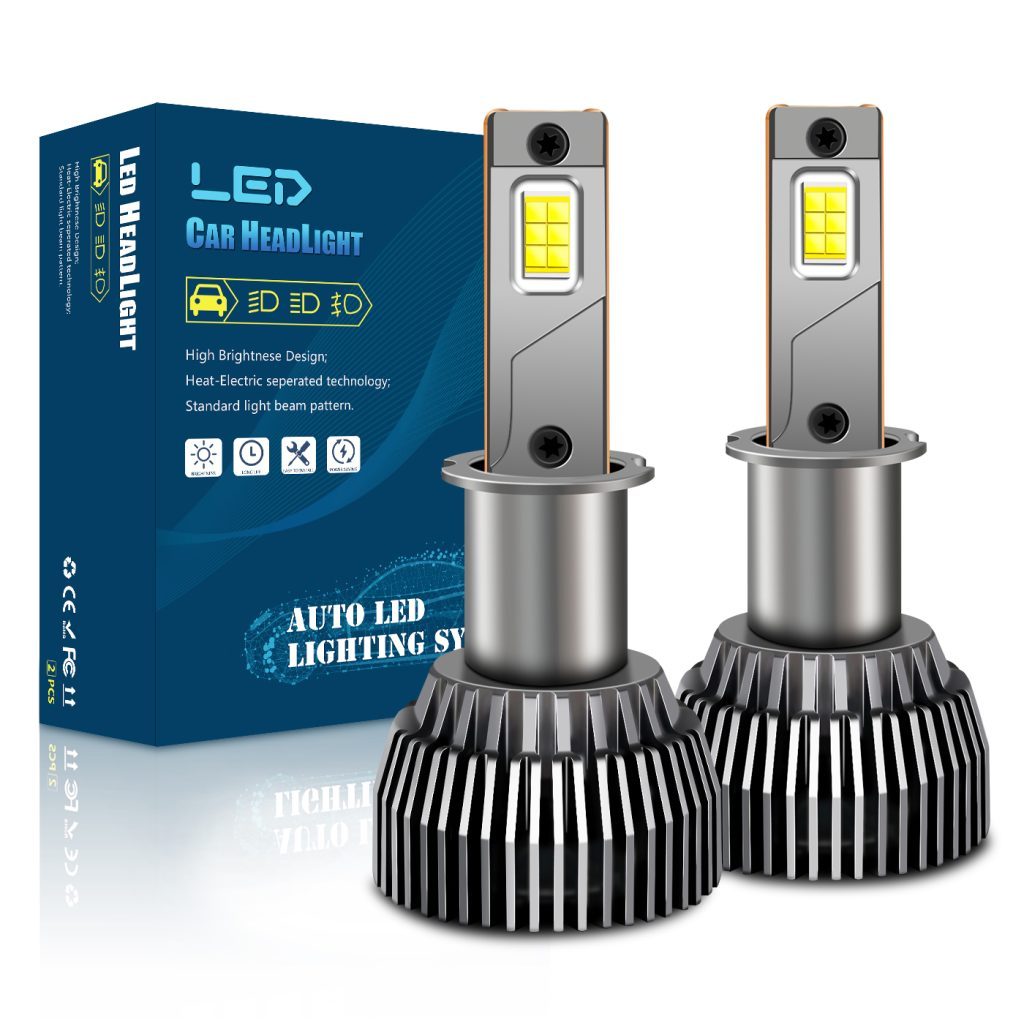
In terms of raw output, a 55‑watt LED headlight is more than adequate for most driving conditions. To put it in perspective, a 55W halogen bulb produces roughly 1,000 lumens, whereas a 55W LED can generate four to six times that amount – around 4,000 to 6,000 lumens. This dramatic increase translates into a practical illumination distance of 100 to 200 metres, far exceeding both halogen and HID (xenon) lamps. Even when compared with a 35W xenon bulb (about 3,500 lumens) and a 35W LED (around 3,200 lumens), the 55W LED clearly leads in light output.
However, wattage is not the sole determinant of perceived brightness. Colour temperature, measured in Kelvin (K), plays a crucial role in visual clarity and fog‑penetrating ability. The brightest colour temperature is 6000K – a crisp daylight white that offers excellent visibility. When the temperature drops below 6000K, the light becomes warmer and slightly dimmer, but it gains superior penetration through rain, fog, or dust. For instance, in fog‑prone areas like southwestern China, a 5000K–5500K lamp is recommended, while 6000K suits most other regions with clear weather.
- Energy Efficiency and Longevity
LED headlights also excel in energy savings. Surprisingly, a modest 20W LED can already satisfy daily commuting needs, and the 55W version consumes far less power than a halogen lamp of equivalent brightness. Moreover, LEDs boast an impressive lifespan of over 50,000 hours – assuming 5 hours of nightly driving, that’s nearly 27 years of service, outliving most vehicles. They also maintain stable colour temperatures across both left and right lamps, ensuring uniform beam patterns. And unlike HID bulbs, LEDs contain no mercury, making them an environmentally friendly choice that aligns with modern automotive trends. - Four Key Criteria for Selecting a Quality LED Headlight
a. Lumen Output – The Brightness Benchmark
Lumens (lm) measure the total amount of visible light emitted – the higher the lumens, the brighter the lamp. A good LED typically offers 100–130 lm per watt, so a 55W unit can deliver roughly 5,500–7,150 lm in theory. However, avoid excessively high lumens that might dazzle oncoming traffic; balance is essential.
b. Thermal Management – The Lifeline of LEDs
Have you ever noticed headlights dimming over time? That’s luminous decay, and heat is the primary culprit. Poor heat dissipation drastically shortens a lamp’s lifespan. Modern LED headlights use two cooling approaches:
Active cooling – typically a miniature fan that forces airflow, which is the most popular and effective method today.
Passive cooling – using copper strips or aluminium heat sinks to conduct heat away.
For high‑power LEDs, active cooling is highly recommended, as it excels at reducing hot spots and maintaining even temperatures, thereby extending the product’s life.
c. Beam Focus and Light Pattern
Brightness alone is useless if the light scatters chaotically. A premium LED headlight must produce a sharp, well‑defined beam pattern that illuminates the road ahead without blinding oncoming drivers. Good focus ensures excellent “road‑spread” – you see clearly, and others see you safely. Poorly focused lamps not only reduce your own visibility but also pose a hazard to traffic in the opposite direction – so avoid them at all costs.
d. Choosing the Right Colour Temperature for Your Region
As mentioned earlier, colour temperature affects both brightness and penetration. Halogen bulbs sit around 3000K (yellowish), while OEM xenon lamps range from 4200K to 4800K. LED headlights commonly offer 4000K–6500K. For foggy or rainy areas, opt for 5000K–5500K to balance brightness and penetration; for clear‑weather regions, 6000K delivers the maximum visual impact