Xenon (HID) and LED headlights are the two mainstream automotive lighting solutions, each with distinct strengths and weaknesses. This article delivers a systematic comparison covering working principle, structure, performance, service life, safety, environmental impact, brightness, lighting characteristics, durability, response speed and installation complexity to help you make the optimal choice.
- Working Principle & Structure
Xenon (HID) Headlights
High-voltage electric current ionizes xenon inert gas to generate intense white light similar to natural daylight. The system consists of xenon bulb, ballast and igniter. There is no tungsten filament inside the bulb; light comes from an electric arc between two electrodes surrounded by high-purity inert gas.
LED Headlights
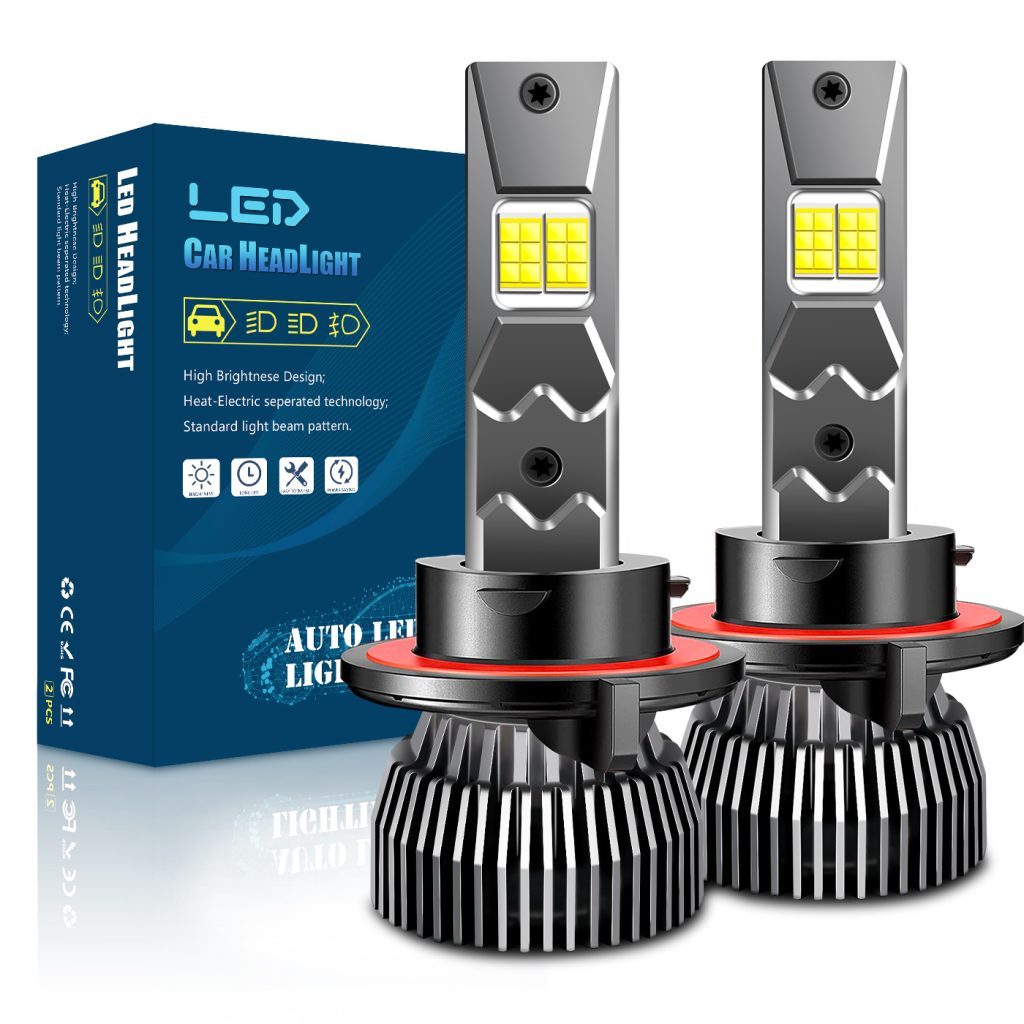
Light-emitting diodes produce light via semiconductor electroluminescence. Lenses or reflectors concentrate the light into directional beams. The assembly includes LED chips, heat sinks and constant-current driver circuits. Each tiny chip can be individually controlled for brightness and color, enabling advanced lighting functions. - Performance & Service Life
| Comparison Item | Xenon (HID) Headlights | LED Headlights |
|---|---|---|
| Brightness | Higher, 3,200–3,600 lumens | Moderate, 2,000–4,000 lumens |
| Color Temperature | 4300K–6000K, close to natural daylight | Typically around 5000K neutral white |
| Startup Response | Requires 3–5 seconds warm-up to full brightness | Instant full brightness, zero delay |
| Lifespan | 3,000–10,000 hours | Up to 100,000 hours for premium units |
| Power Consumption | Relatively high, requires high-voltage ignition | Low power draw with high electro-optic efficiency |
Xenon Highlights: High brightness, daylight-matched color temperature, clear long-distance vision and strong beam throw.
Xenon Drawbacks: Slow warm-up, higher power consumption, risk of glare without lenses, strict demands on vehicle electrical systems.
LED Highlights: Instant activation, low energy consumption, compact size and flexible styling. Supports high-low beam switching, cornering auxiliary lighting and adaptive high beam systems.
LED Drawbacks: Strict thermal management requirements; improper design leads to rapid luminous decay; mid-to-high color temperature versions suffer weaker penetration in rain and fog.
Lifespan reminder: Both outperform halogen bulbs significantly. Xenon bulbs last roughly 2,000–3,000 hours. Quality LED units exceed 50,000 hours, depending on operating environment and usage frequency.
3. Safety & Environmental Performance
Safety
Both outperform halogen lights and reduce driver fatigue and accident risks by improving night visibility.
Poorly fitted xenon lights easily produce severe glare disturbing oncoming vehicles and pedestrians; proper beam angle adjustment and timely beam switching are essential.
LED systems can utilize intelligent control modules to suppress stray light and avoid glare more effectively.
Environmental Friendliness
LEDs are more eco-friendly. Low power draw cuts fuel consumption and carbon emissions; raw materials contain no toxic heavy metals and are easier to recycle.
Xenon systems consume more power, increasing fuel usage. Manufacturing involves complex processes and hazardous substances, making recycling more difficult.
4. Brightness & Lighting Characteristics
5. Durability & Response Speed
Service Life
LED adopts solid-state semiconductor structure with no fragile filaments. Used for 1 hour daily, quality LEDs can serve 8–13 years.
Xenon systems rely on ballasts with limited service life; quartz glass capsules risk cracking under drastic temperature swings.
Response Speed
LED lights reach full brightness instantly, supplying adequate illumination when passing through tunnels or meeting oncoming traffic.
Xenon brightness rises gradually over 3–5 seconds of warm-up, potentially limiting visibility during sudden lane changes or night-time start-up.
6. Installation Complexity
LED Headlights
Simple installation. Compact size allows direct plug-and-play replacement of factory halogen bulbs for most models. Complete fitting can be finished within 30 minutes without extra auxiliary hardware.
Xenon (HID) Headlights
More complicated installation. Requires mounting ballasts and optional CANBUS decoders. Professional calibration is necessary for many vehicles, and the whole process takes 1–2 hours.
7. Selection Guidance by Driving Scenarios
| Driving Scenario | Recommended Light Source | Reason |
|---|---|---|
| Daily urban commuting | LED Headlights | Instant response, even road illumination, long lifespan and low power consumption |
| Frequent highway & long-distance night travel | Xenon (HID) Headlights | Strong long-range penetration and excellent far-field illumination |
| Regions with frequent rain, fog and haze | 4300K Xenon Lights | Warm white light achieves better penetration than high-temperature LEDs |
| Limited upgrade budget | Xenon HID Kits | Lower initial purchase cost |
| Pursuit of long-term low-maintenance reliability | LED Headlights | Ultra-long service life, fewer replacements and lower cumulative costs |
There is no absolute winner between xenon and LED headlights. The best choice depends on your driving scenarios, budget and personal demands. As LED technology matures and prices keep falling, market penetration will keep rising. Nevertheless, xenon lighting still holds irreplaceable advantages for long-distance night driving and fog-prone areas