Vehicle headlights are essential for night driving safety and play an important role in vehicle styling. LED and halogen bulbs are the two mainstream light sources on the market. Due to different light-emitting principles, they have obvious gaps in brightness, service life and long-term maintenance costs. This guide analyzes their pros and cons based on real driving scenarios to help drivers select suitable lighting upgrades.
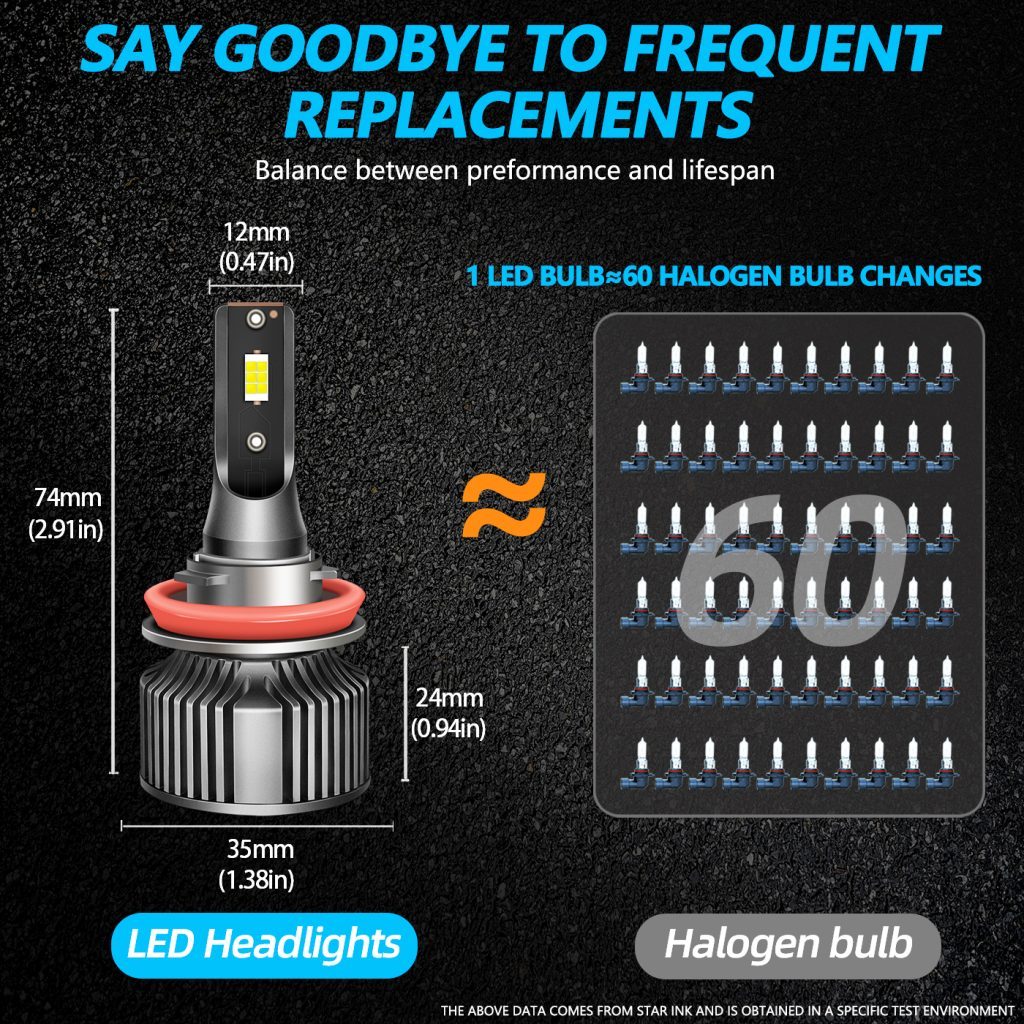
1. Brightness Comparison: LED Delivers Higher Output; Watch Out for Fake Power Marking
Brightness determines visible distance during night travel. The two light sources perform differently due to distinct working principles.
LED Headlights: High Brightness & Even Beam
LED generates light through semiconductor electroluminescence with superior energy efficiency.
- Illumination range: Low beams cover over 60 meters, high beams reach above 150 meters. Standard halogen low beams only reach around 40 meters, high beams roughly 100 meters. At highway speed, longer visibility offers drivers around 2 extra seconds for emergency response.
- Uniform light distribution: Multi-chip design reduces dark zones on the road and improves lateral vision when matched with qualified optical housings.
Halogen Bulbs: Strong Fog Penetration with Limited Maximum Brightness
Halogen lights work by heating tungsten filaments, producing warm yellow light around 3000K.
Warm yellow light scatters less in heavy rain and thick fog, offering better penetration than cool white 6000K LED light.
However, halogen brightness is limited. Standard 55W halogen outputs 1000–1500 lumens, while LED can reach 3000–5000 lumens under similar power consumption, nearly three times brighter.
Critical Reminder: Fake power ratings on cheap LED bulbs
Many low-cost aftermarket LED products mark high wattage on packaging while running at half the claimed power. Always refer to tested lumen value instead of judging performance merely by labeled wattage.
2. Lifespan Comparison: Longer Theoretical Life for LED; Heat Dissipation Decides Actual Durability
Service life directly affects maintenance frequency. Although LED boasts longer rated lifespan, its performance heavily depends on hardware design.
LED Headlights
Under ideal conditions, LED reaches a theoretical lifespan of 50,000 working hours. The lighting industry widely adopts the L70 standard: LED reaches end of effective service life once brightness drops to 70% of initial output.
✅ Premium LED: Equipped with solid aluminum heat sink and cooling fan, chip temperature stays controlled. Effective lifespan hits 30,000 hours. Factory-installed OEM LED only loses roughly 10% brightness after continuous 5-year usage.
❌ Low-grade LED: Poor thermal design leads to rapid lumen depreciation under high temperature; visible dimming may appear after only several thousand hours.
Halogen Bulbs
Average lifespan only 500–1000 hours. Voltage fluctuation and frequent switching accelerate tungsten filament evaporation, shortening service life to 300 hours in extreme cases.
The biggest advantage is simple replacement; car owners can finish bulb swap within 10 minutes with basic hand tools.
Compatibility Notice
Most older vehicle ECUs are calibrated for halogen load. Direct LED replacement often triggers dashboard error codes or flickering, especially on European vehicles. An extra CANBUS decoder is required. Factory integrated OEM LED headlights are fully calibrated without such issues.
3. Cost Comparison: Higher Upfront Cost for LED, More Economical In Long Run
Total expenses include product price, labor fees and replacement cycles. Short-term and long-term costs show opposite results.
| Light Source | Single Bulb Price | Price for One Pair | Effective Lifespan |
|---|---|---|---|
| Halogen | $3–$8 | $6–$15 | 500~1000 hours |
| Aftermarket LED | $15–$45 | $30–$90 | 20000~30000 hours |
- Halogen bulbs: Low purchase price. Self-installation costs nothing; workshop labor fees stay low. But frequent replacement accumulates continuous maintenance spending.
- LED bulbs: Higher initial investment. Extra labor fees (up to $15–30) may apply if decoder or bumper removal is required. Once installed properly, repeated replacement is unnecessary for over 10 years.
Long-term Cost Estimation (20,000km annual mileage, 2 hours night driving daily)
Halogen: Requires replacement around four times every year. Annual total maintenance cost: $40–$60.
LED: One-time investment; almost no extra spending within 10 years.
4. Scenario-Based Buying Recommendations
- Daily urban commuting: LED is preferred Road lighting is sufficient in cities. LED lights achieve full brightness instantly, consume less power and rarely need replacement.
- Driving frequently on rainy, foggy mountain roads: Halogen works better 3000K warm yellow light features stronger fog penetration. If upgrading to LED, select low-color-temperature 4300K LED, and keep original halogen fog lights as auxiliary lighting.
- Short-term driving with tight budget: Choose halogen as temporary solution. For long-term vehicle ownership, select compliant LED kits.
Important Warning: Do not directly install LED bulbs into original halogen reflector housings without projectors. Unfocused light creates severe glare for oncoming traffic and usually fails vehicle inspection.