Xenon (HID) headlights operate on high‑voltage gas discharge – requiring a ballast to step up the vehicle’s 12V supply to 23,000V, ionising xenon gas inside the quartz tube to create an arc. This introduces a start‑up delay. Quality lens‑equipped xenon units suppress glare during oncoming traffic. Xenon offers excellent colour rendering and is 4‑5 times brighter than halogen – with superb night‑time coverage. Note: colour temperature is measured in Kelvin (K) – operating temperature ≠ colour temperature.
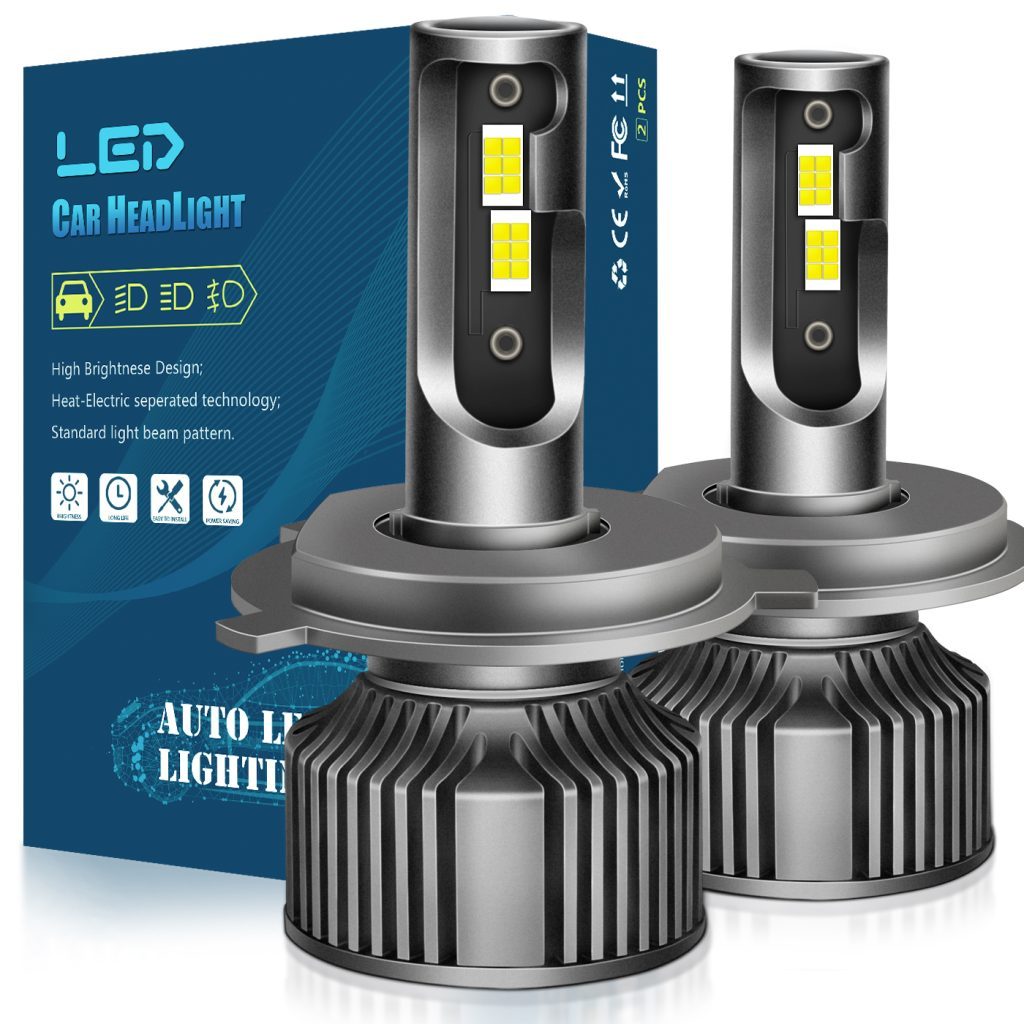
LED headlights consist of multiple LED chips – reaching full brightness instantly with no start‑up delay. They offer high efficiency, lower operating temperatures, stable performance, and longer lifespans – but quality complete systems come at a higher cost.
The gap between standard LED bulbs (direct reflector‑bowl replacement, no lens) and lens‑equipped LED headlights is substantial – not simply a matter of swapping one bulb for another.
- Core Differences
Beam Pattern & Glare
Aspect Lens‑Equipped LED Standard Lens‑Free LED
Beam pattern Lens focuses and shapes light – sharp, defined cut‑off line LED light‑emitting point differs from original halogen – reflector can’t focus effectively
Glare Light directed at the road – no scatter to oncoming drivers Significant upward scatter – severe glare – affects oncoming traffic
Compliance Meets headlight beam standards – safer for oncoming traffic Safety hazard – may fail inspection in some regions
Road Illumination
Lens‑equipped LED: even light distribution – long range – complete beam pattern – clear recognition of road signs and potholes – stable low‑beam performance
Standard lens‑free LED: bulb appears bright – but actual road illumination is poor – light scatters – bright up close but dim at distance – “bright bulb, dim road”
Retrofit Compatibility & Inspection
Lens‑equipped LED: optically designed beam pattern – compliant – easier to pass inspection – typically full assembly or bi‑LED projector retrofit – more complex and costly
Standard lens‑free LED: simple plug‑and‑play replacement – low cost – only suitable for vehicles with factory lenses; reflector‑bowl swaps almost certainly scatter and fail inspection
Lifespan & Cooling
Lens‑equipped LED assembly: integrated design – matched cooling, driver, and lens – stable operating conditions – slow depreciation – longer life
Standard LED replacement bulb: limited by size – cooling quality varies – cheap units overheat – rapid depreciation and failure
- Three Key Functions of Adding a Lens to LED Lights
Eliminate glare – ensure oncoming safety: lens‑free LEDs naturally scatter light – without a lens, intense light directly hits oncoming drivers – increasing accident risk
Focus light – improve actual road illumination: directs scattered light to the road – converting brightness into usable road lighting – not wasted scatter
Create a standard cut‑off line – meet regulatory requirements: lenses produce a compliant beam pattern with a sharp cut‑off – illuminating your path without upward spill – meeting automotive beam standards
- Simple Selection Guide
Vehicle Configuration Recommended Approach Reason
Factory‑fitted lenses Replace with quality LED bulbs Good performance – cost‑effective
Reflector‑bowl only (no lens) Don’t swap bare LED bulbs – prioritise bi‑LED projector retrofit Avoid scatter, glare, and inspection failure
Only after cheap and simple Bare LED swap Likely scatter – inspection failure – night‑driving safety risk
In a nutshell: A lens is the key to unlocking an LED headlight’s true performance – lens‑free LEDs appear bright but scatter; lens‑equipped LEDs deliver solid road coverage and safe oncoming interaction.