Night‑driving safety depends heavily on a vehicle’s lighting system. As automotive lighting technology evolves, LED and xenon (HID) headlights have become the two most popular upgrade options. This article compares these two light sources across multiple dimensions – technical specifications, real‑world performance, and typical use cases – to help you make an informed decision.
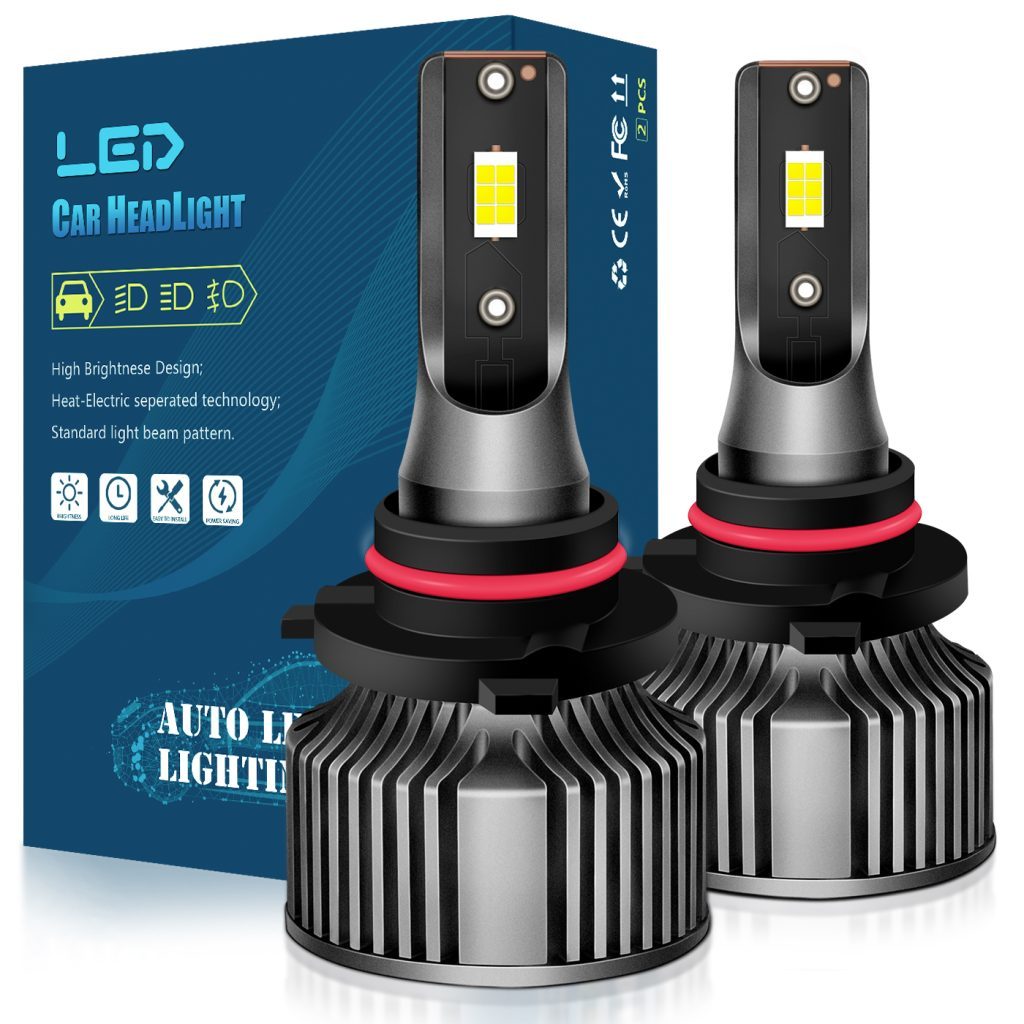
- Core specification comparison
Metric Xenon (HID) LED
Principle High‑voltage gas discharge Semiconductor emission
Power 35-45W 20-30W
Brightness ~3500 LM ~2800 LM
Colour temp 4300K-6000K 5800K-6000K
Lifespan ~5,000 hours 50,000-100,000 hours
- Response time and beam quality
Xenon lamps have a noticeable warm‑up delay – typically 3‑5 seconds to reach full brightness, even longer in cold conditions. This can be a safety concern on highways where quick high‑beam switching is needed. LEDs light up in about 0.1 seconds – effectively instant – giving drivers faster reaction time in unexpected situations.
In terms of beam quality, xenon without a proper lens scatters easily – low beam fails to project properly and high beam spreads out. LEDs, with their 5800K daylight‑like colour temperature and proper lenses, produce a more even beam pattern. But cheap LED bulbs without lenses can also create glare.
- Energy consumption and durability
LEDs draw 20‑30W – only 50‑60% of what a xenon system uses – reducing the vehicle’s electrical load over time. LEDs are also rated for 50,000+ hours – about 10 times longer than xenon. Xenon does outlast halogen, but it suffers from gradual lumen depreciation over time.
- Installation complexity and compliance
LEDs are typically plug‑and‑play – the whole swap takes about 5 minutes and is fully reversible. Xenon retrofits are more involved – they need additional ballasts, lenses, and wiring modifications, with professional labour typically costing 600‑1200 CNY.
- Use cases and recommendations
Xenon: with ~3500 LM output and good penetration, suits drivers who frequently use highways or rural roads – but be aware of the start‑up delay.
LED: with fast response and low energy use, better suits city driving and daily commuting.
Fog/rain: lower‑colour‑temperature xenon (e.g., 4300K) penetrates better than high‑colour‑temperature LEDs – LEDs above 6000K tend to scatter in wet conditions.
Bottom line: for most daily use, LEDs are the better choice. If you want maximum output and don’t mind the delay, xenon is still a valid option. Whichever you pick, make sure you have proper lenses to avoid glare. If budget allows, OE‑grade LED assemblies give the best combination of compliance and performance – some even include adaptive high‑beam functions.
Eight common myths – clarified
Myth 1 – Higher lumens are always better?
No – lumens should stay within a reasonable range. Too dim or too bright both hurt visibility. Some sellers overstate specs – chasing extreme lumen numbers is misguided; real‑world performance matters more.
Myth 2 – Higher wattage means better LEDs?
Raising wattage to boost brightness often backfires – LEDs are sensitive to heat, and overdriving them shortens their lifespan.
Myth 3 – Which is better: LED or xenon?
It depends on your car and your needs. Upgrading a reflector‑type housing to xenon requires new lenses (expensive). Good LEDs can work with the original reflectors – so the answer varies by case.
Myth 4 – Which cools better: fan or braided copper?
Cooling is about the whole system, not just one component. You need to consider overall heat dissipation, installation space, and the housing environment together.
Myth 5 – Are Cree and Philips chips always better?
Chip choice depends on brightness, beam pattern, and cooling – not just brand name. Also, Philips’ lighting division (Lumileds) is the actual chip maker – calling them “Philips chips” isn’t quite accurate.
Myth 6 – Do LEDs need a ballast?
No – LEDs work on a different principle and don’t need a ballast like xenon does. But every LED lamp does come with its own driver.
Myth 7 – Do LEDs need a decoder?
Only if your car’s ECU detects an abnormal power draw after the swap. LEDs use low current and don’t bother most cars, but models that monitor wattage closely may require a decoder.
Myth 8 – Do LEDs need a specific mounting base?
LEDs are designed to match the original halogen base types. Most come with the right base; professional shops have various adaptors to adjust the beam pattern and fit most vehicles without issues.