My factory halogen headlights are too dim. Should I upgrade to Xenon or LED headlights?” This is one of the most frequently asked questions from car owners.
Vehicle headlights are essentially the “eyes of the car”. Night driving safety heavily depends on headlight performance. However, many drivers feel confused when choosing between Xenon (HID) and LED headlights, as both have unique advantages and weaknesses. With 15 years of driving experience and four headlight upgrades, I will share real test data, practical pros and cons, and professional selection tips to help you make the right choice without wasting money.
1. Core Parameter Comparison: Brightness, Lifespan & Cost
Never trust exaggerated merchant promotion alone. The key is to compare real parameters and actual road performance. I conducted a real test using 35W Xenon and LED headlights at the same price level for a fair comparison.
Brightness & Lighting Performance: Xenon Uniformity vs LED Focus
Test results show that Xenon headlights output around 3200–3800 lumens, while LED headlights range from 3000–4500 lumens. Although LED has a slight advantage in pure lumen figures, their actual lighting characteristics differ greatly.
Xenon HID Headlights generate light through gas discharge, producing warm white light at 4300K–6000K. They feature an ultra-wide and even illumination field with almost no blind spots. When driving on mountain roads and country roads, Xenon lights clearly reveal road edges, obstacles, and roadside conditions, delivering comprehensive safety coverage.
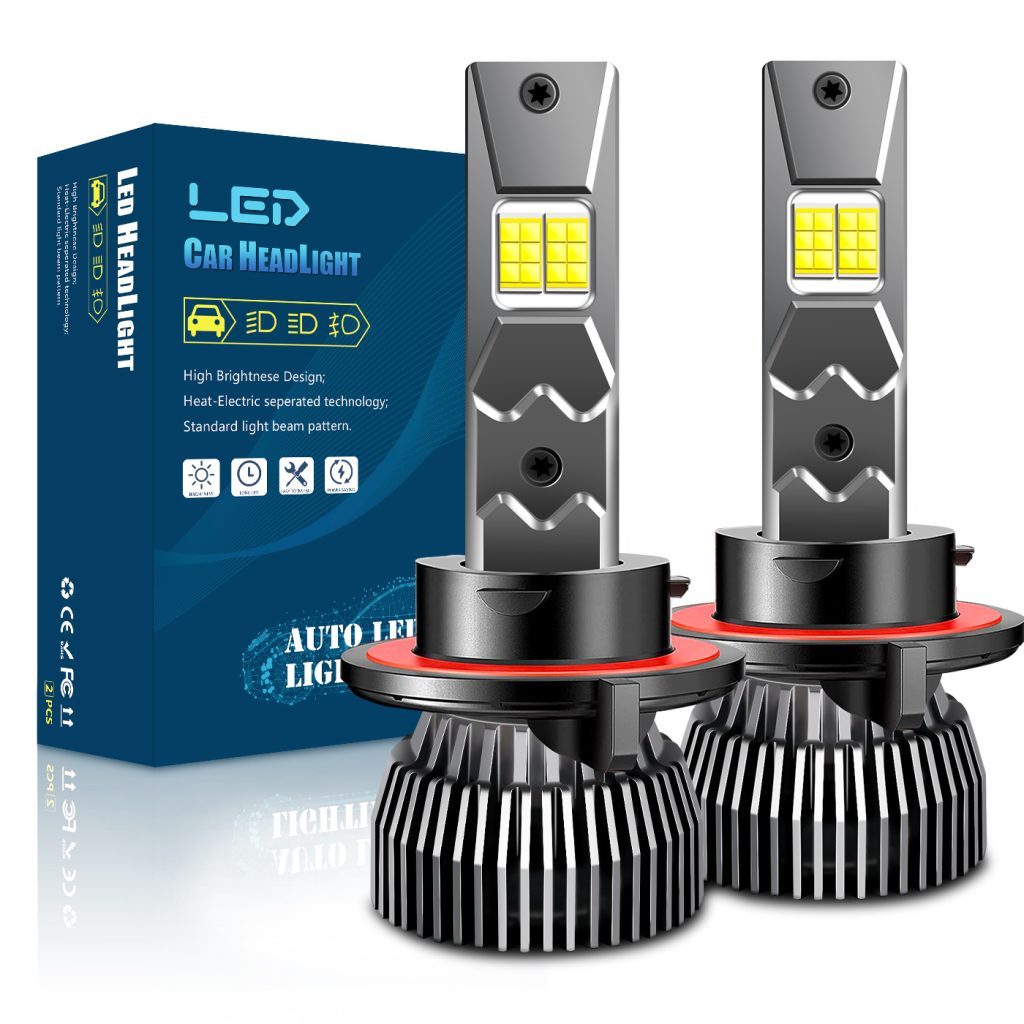
LED Headlights adopt semiconductor lighting with a higher color temperature of 5000K–6500K, producing cool white light. LEDs have stronger light focusing capability and deliver 5–8 meters longer straight beam distance than Xenon lights, making them perfect for urban roads and highways. However, their irradiation width is relatively narrow, easily creating blind zones on road shoulders.
Verdict: Choose Xenon for frequent mountain and national road driving; choose LED for city commuting and highway cruising.
Lifespan & Stability: LED Takes the Lead
The gap in durability between the two is obvious:
LED headlights have no fragile filaments. The chip-based lighting structure supports a service life of 5–8 years with excellent shock resistance, maintaining stable performance even on bumpy roads.
Xenon headlights rely on ballasts for high-voltage ignition. Ballasts are vulnerable wearable parts that often fail within 2–3 years, and Xenon bulbs only last 3–5 years, resulting in higher long-term maintenance costs.
In addition, Xenon lights have an obvious startup delay of 3–5 seconds to reach full brightness, which creates potential safety risks during temporary starts and quick light flashes. By contrast, LED lights light up instantly with zero delay, responding immediately for safer driving.
Verdict: LED is more reliable and maintenance-free. Xenon is acceptable if you do not mind delayed lighting and later maintenance.
Installation & Cost: LED Is More User-Friendly
LED headlights support direct plug-and-play replacement for most vehicles without wire modification. Many car owners can finish installation independently. A complete LED headlight set costs approximately $40–$110.
Xenon upgrades require matched ballasts, and some vehicles need special decoding to avoid error codes. Professional installation is highly recommended. With material and labor costs, a full Xenon set usually ranges from $70–$170.
One advantage of Xenon lights is that owners only need to replace the bulb separately when damaged, while most LED headlights require integral replacement.
Verdict: LED is ideal for budget-friendly and DIY installation; Xenon suits drivers pursuing ultra-even road lighting.
2. How to Choose High-Quality LED Headlights (4 Key Standards)
If you decide to upgrade to LED headlights, follow these four professional criteria to avoid inferior products.
1. Lumen Brightness: Match Scenarios, Not Blindly High
3000–4000 lumens is sufficient for well-lit urban roads. For dim rural roads and highways, 4000–6000 lumens provides safer long-distance vision. Avoid ultra-high lumens that cause severe glare and disturb oncoming traffic.
2. Color Temperature: Balance Brightness & Bad-Weather Penetration
– 3000–4000K (Warm Yellow): Excellent penetration in rain and fog but slightly dim in visual brightness.
– 4300–6000K (Natural White): The most balanced option, offering bright clear-night vision and reliable all-weather penetration.
– 6500K+ (Bluish White): Visually bright but poor rain/fog penetration, easily causing glare. Not recommended for daily use.
3. Heat Dissipation: Decides Long-Term Lifespan
LED chips generate massive heat during operation. Poor heat dissipation causes rapid luminous decay, brightness drop, and premature burnout. Premium LED headlights adopt aviation aluminum bodies, dual heat pipes, and silent cooling fans to ensure stable chip temperature and long-term durability.
4. Brand Quality & Vehicle Compatibility
Well-known brands guarantee strict production standards, stable performance, and reliable after-sales service. Always confirm bulb interface, size, and model compatibility before purchasing to avoid installation failure.
3. Final Selection Summary (Simple & Practical)
Choose Xenon Headlights If:
- You frequently drive on mountain roads, country roads, and winding routes
- You prefer ultra-even wide-area lighting with minimal blind spots
- You can accept slight startup delay and later maintenance
Choose LED Headlights If:
- Your daily routes are urban roads and highways
- You want faster beam response, longer irradiation distance, and maintenance-free use
- You have a limited budget and prefer easy plug-and-play installation