Replacing stock halogen bulbs with LED bulbs is a mature and mainstream vehicle upgrade solution, with a wide range of plug-and-play LED products specially designed for halogen socket replacement. However, many car owners get completely different results after upgrades: some achieve clearer night vision with perfect lighting effects, while others regret the replacement due to glare, poor road illumination, fault codes, and fast brightness decay. The core difference lies in whether you avoid several critical technical and installation pitfalls.
Before upgrading, it is necessary to clarify the differences between LED and Xenon (HID) headlights to select the most suitable lighting solution for your vehicle.
LED vs Xenon (HID) Headlights: Full Parameter Comparison
| Comparison Items | Xenon (HID) Headlights | LED Headlights |
|---|---|---|
| Lighting Principle | High-voltage gas discharge, generating arc light via 23,000V high-voltage ionization of xenon gas | Electron transition luminescence of semiconductor materials |
| Startup Speed | Delayed lighting, taking several seconds to reach full brightness | Instant on, zero-delay full brightness |
| Working Temperature | High, reaching 300–400°C | Low, stable at 50–70°C |
| Brightness Performance | 4–5 times brighter than halogen bulbs | Brighter than halogen, even exceeding standard xenon lights |
| Power Consumption | Relatively high (around 35W) | Ultra-low power consumption (around 20W) |
| Service Life | 2,000–3,000 hours | 30,000–50,000 hours |
| Upgrade Cost | Medium cost | Slightly higher cost with better cost performance |
| Anti-Glare Performance | Good anti-glare effect with professional lenses | Depends on optical design; 1:1 filament positioning ensures optimal anti-glare performance |
Summary: Xenon lights feature strong weather penetration but suffer from startup delay and high working temperature. By contrast, LED lights boast instant response, low heat generation, and ultra-long service life, becoming the most mainstream and cost-effective upgrade option for modern vehicles.
Four Critical Problems of Halogen-to-LED Replacement (Must-Know)
1. Light Pattern Mismatch — The Biggest Upgrade Pitfall
The original vehicle reflector bowl is precisely designed for halogen filament parameters. The thin halogen filament emits light at 360° from the exact focal point of the reflector, forming a standard, uniform, and well-cutoff beam pattern after reflection.
LED bulbs adopt flat chip light sources with completely different luminous positions and angles. If the LED chip fails to align with the original halogen filament focal point, the reflected light will scatter disorderly. The typical result is dazzling to oncoming drivers but blurry for your own road vision, with uneven road lighting, messy light spots, and no clear light-dark cutoff line.
Solutions:
- Prioritize LED bulbs marked with 1:1 filament positioning or 1:1 factory light pattern to ensure the luminous point perfectly matches the original focal position
- Install auxiliary professional lenses for lensless original lamp assemblies to concentrate light and eliminate stray glare
- Adjust the headlight height strictly after installation to keep low-beam cutoff lines horizontal and avoid high beam irradiation disturbing oncoming traffic
2. Poor Heat Dissipation — Invisible Killer of LED Lifespan
Although LED bulbs work at far lower temperatures than halogen lights, LED chips are extremely sensitive to high temperatures. Overheating will cause irreversible luminous decay, continuous brightness attenuation, and even direct chip burnout.
The original halogen lamp cavity has no targeted heat dissipation design for LED bulbs. After replacement, heat accumulation inside the sealed lamp cavity cannot be discharged in time, especially for long-time lighting in summer and compact lamp cavity models, which seriously shortens the service life of LED bulbs.
Solutions:
- Choose LED bulbs equipped with silent cooling fans, aviation aluminum heat sinks, or copper heat pipe heat dissipation structures
- Ensure internal air circulation after installation; do not let the dust cover squeeze the heat dissipation components
- Select high-quality branded products to avoid inferior bulbs with fast luminous decay and poor heat resistance
3. Circuit Incompatibility — Dashboard Error Codes & Light Flickering
Factory halogen bulbs are high-power resistive loads (55W–60W) with large operating current, while LED bulbs only consume 20W–30W with extremely low current draw. The vehicle’s BCM (body control module) judges bulb working status by detecting loop current.
After low-power LED replacement, the system detects abnormal low current and misjudges the bulb as damaged, triggering headlight fault warning codes or frequent light flickering on the dashboard.
Solutions:
- Prefer LED bulbs with built-in CANBUS decoders (anti-interference modules)
- The decoder simulates the resistance load of halogen bulbs to fool the vehicle’s computer system and eliminate error codes
- Install external load resistors separately for LED products without decoding functions (more complicated installation)
4. Compliance Risk — Annual Inspection & Road Legal Issues
Vehicle lighting regulations have clear requirements for brightness, color temperature, beam range, and light pattern. Random LED replacement easily causes non-compliance problems:
- Failed annual lighting inspection caused by scattered light patterns, excessive or insufficient brightness, and abnormal color temperature
- Road penalties for severe glare affecting the normal driving of oncoming vehicles
Solutions:
- Choose 5500K–6000K neutral white light; avoid ultra-high color temperature blue-white light with poor rain and fog penetration
- Calibrate the light pattern to ensure a standard and clear low-beam cutoff line without stray light
- Vehicles with factory lenses achieve better lighting effects and higher compliance after LED replacement
Supplementary Advantages of LED Upgrades Over Xenon Lights
Faster Response: LED lights achieve instant lighting with zero delay, perfectly adapting to frequent high and low beam switching during overtaking and night driving; xenon lights require 3–5 seconds to reach full brightness, with poor emergency response capability.
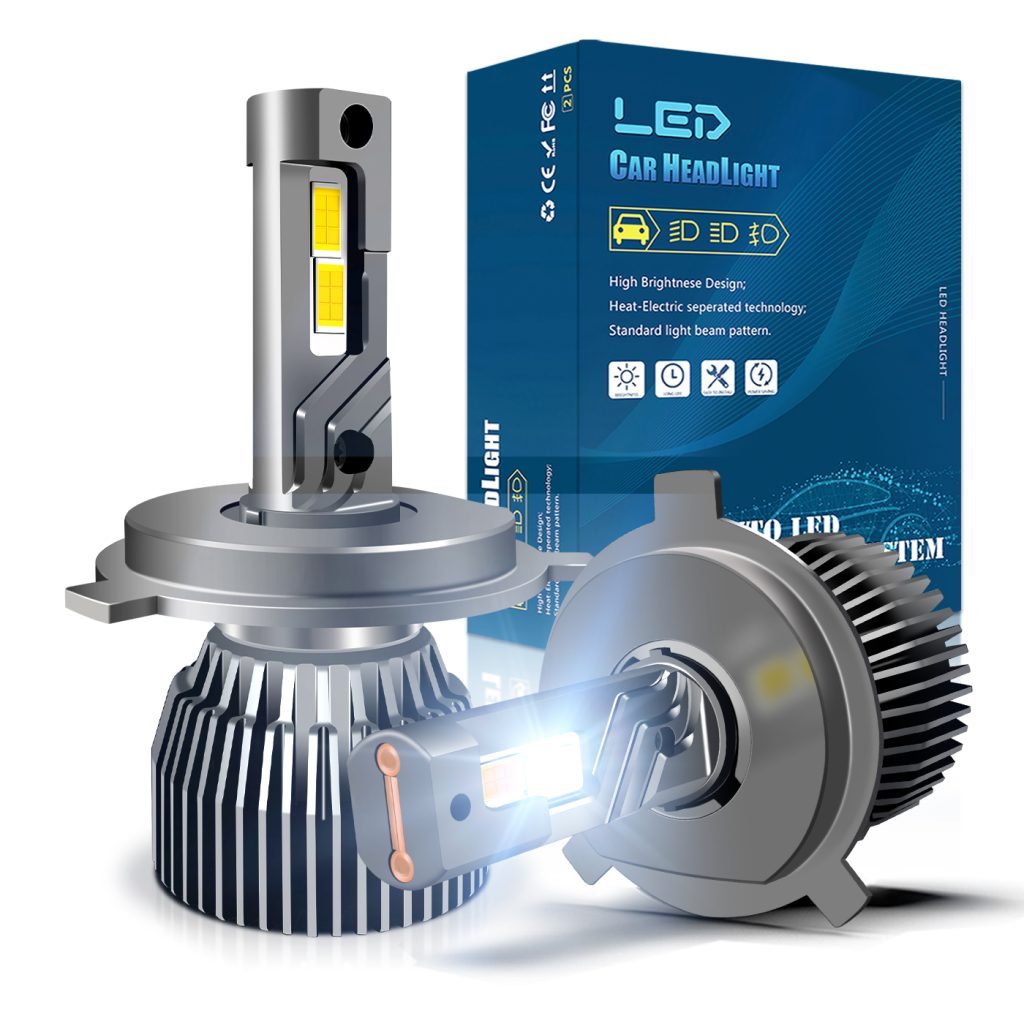
Higher Safety: Xenon lights generate 300–400°C high temperature during operation, accelerating the aging of lamp covers and line harnesses. LED lights maintain a low temperature of 50–70°C, effectively reducing hidden heat risks.
Superior Energy Saving: LED power consumption is only 1/3 of halogen lights and 1/2 of xenon lights, reducing the load on the vehicle generator and battery, saving energy and protecting the original vehicle circuit system for a long time.
Final Conclusion
Halogen-to-LED replacement is a safe, mature, and highly cost-effective upgrade solution. The key to perfect effects is selecting 1:1 optically positioned, CANBUS-decoded, high heat dissipation LED bulbs and matching standard light pattern calibration. With correct product selection and standardized installation, LED headlights can completely surpass traditional halogen and xenon lights in brightness, safety, stability, and service life, becoming the best choice for daily night driving upgrades.