Car LED headlights and halogen headlights differ greatly in working principle, power consumption, brightness, service life, color temperature and price. You need to consider your real‑world usage and avoid common pitfalls related to product quality and compatibility.
- Core Comparison
Working Principle
Halogen Headlight: It works by heating tungsten filament to incandescent state. It is a thermal‑radiation light source and generates massive heat during operation.
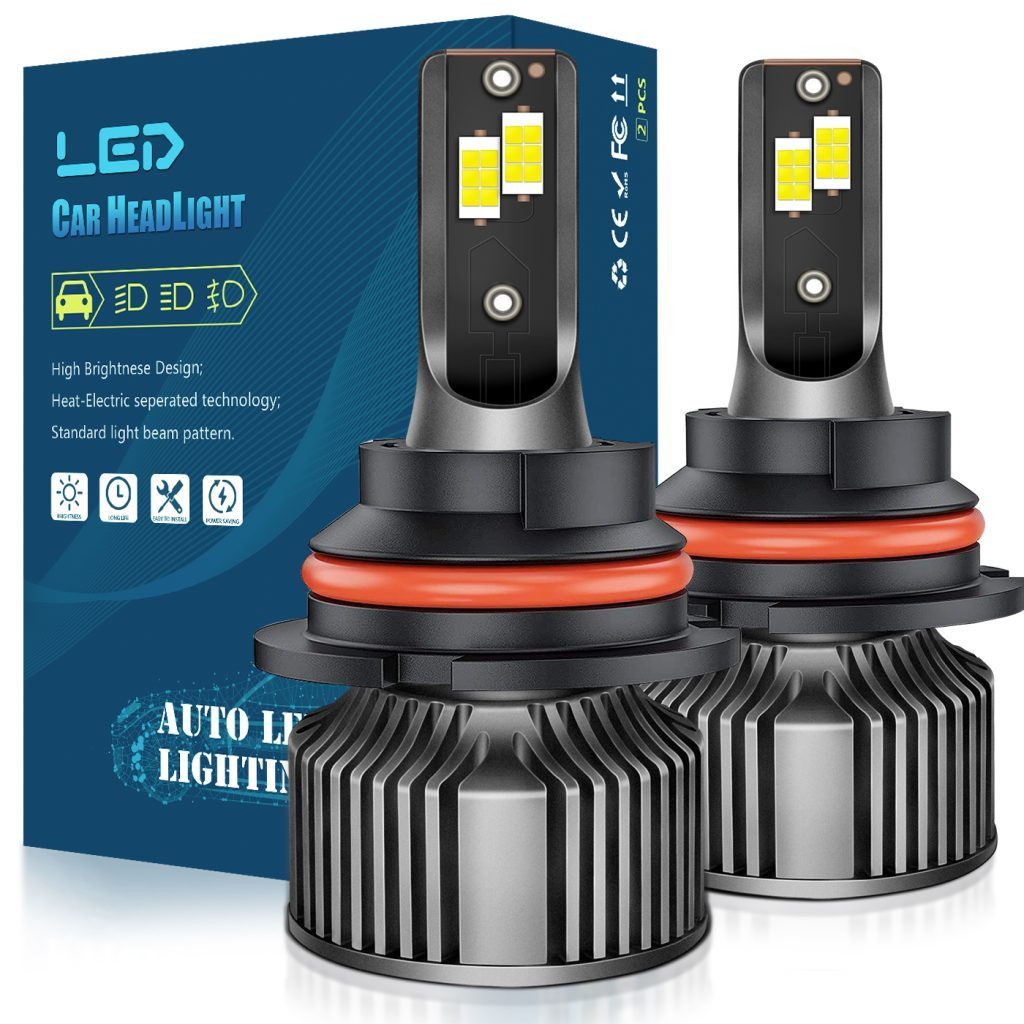
LED Headlight: Light‑emitting diode produces light via semiconductor chips. Electric energy is converted directly into light without filament, with much less thermal radiation.
Power Consumption
Standard halogen bulb runs at 55W with high power draw.
LED headlight works at around 20W. Its power consumption is only 1/3‑1/2 of halogen, reducing load on vehicle electrical system and indirect fuel consumption.
Brightness
Halogen: Around 1000 lumens, yellowish and scattered beam.
LED: Over 3000 lumens for quality units. Concentrated beam delivers clearer night‑time vision.
Service Life
Halogen: Approximately 500 working hours, frequent replacement required.
LED: Up to 50000 hours, long‑term low‑maintenance lighting solution.
Color Temperature
Halogen: 2700K warm yellow light, excellent penetration in rain and fog.
LED: 4300K‑6000K, daylight‑like white light with good color rendering. Higher color temperature means weaker performance in bad weather.
Price
Halogen bulbs are low‑cost, OEM parts cost $30‑$70.
LED kits are more expensive, OEM assembly ranges from $140‑$430, yet brings better long‑term value thanks to long lifespan. - Common Modification Pitfalls
Poor‑quality products
Avoid cheap unbranded LED bulbs without official certifications. They usually suffer bad heat dissipation and fast light decay. Pick products certified by ECE or DOT for stable performance and plug‑and‑play installation.
Compatibility issues
Double‑check bulb base type, power and dimension before purchase. Some vehicles require load resistors / decoders to eliminate dashboard error warnings.
Improper installation
DIY wiring may cause short‑circuit and overheating risk. Professional workshop installation is recommended. Headlight aiming adjustment is necessary to prevent glare for oncoming traffic.
Regulation & Inspection risk
Retrofit lights shall comply with local vehicle safety standards. Over 6000K color temperature or distorted light pattern will fail vehicle inspection.
False parameter marking
Watch out for exaggerated lumen marking. Do not fully trust product labels; refer to real road‑test performance or third‑party test reports. - Application Suggestions
Daily commuting & frequent rain/fog weather: Halogen is cost‑effective with great weather penetration for limited‑budget users.
Long‑distance & heavy night driving: LED delivers high brightness and long service life for improved driving safety.
Retrofit from factory halogen: Choose plug‑and‑play upgrade kits and keep original vehicle wiring intact.
Practical note: Many factory vehicles still keep halogen for high beam. Super‑bright LED used for high beam will create severe glare and endanger opposite drivers. LED is more suitable for low‑beam application. Halogen’s superior fog‑penetrating capability keeps it irreplaceable under harsh weather.
Pros & Cons of Halogen Bulbs
Halogen is an improved version of incandescent lamp.
✅ Advantages: Simple structure, low cost, adjustable brightness, excellent color rendering (Ra=100).
❌ Disadvantages: Low luminous efficiency. Only 6%‑10% energy turns into light, most energy is lost as heat. Short service life with frequent replacement needed.