To assess whether an LED headlight meets quality standards, multiple dimensions must be examined – appearance, cooling performance, circuitry, LED chips, brightness, and beam pattern. The following is a complete testing methodology to help car owners scientifically evaluate LED headlight quality.
- Appearance and Safety Inspection – Visible Quality
Structural integrity: The lamp head, plastic housing, and tube assembly should fit tightly, with no separation under high temperatures
Flame retardancy: Housing plastics must be flame‑retardant and high‑temperature‑resistant; circuit board and ballast frames should also use flame‑retardant materials
Circuit protection: Appropriate fuses or protective components should be present to ensure automatic cut‑off in case of overload
- Cooling Performance Testing – Critical to Lifespan
Check temperature rise after 5 minutes of operation. If the temperature rises gradually and you can keep your hand on the housing comfortably, the cooling design is adequate. Internal temperatures of low‑power lamps typically do not exceed 60°C. For high‑power circuits, check whether PFC (Power Factor Correction) is used and its efficiency, and whether internal capacitors are high‑temperature, long‑life, high‑frequency, low‑impedance types.
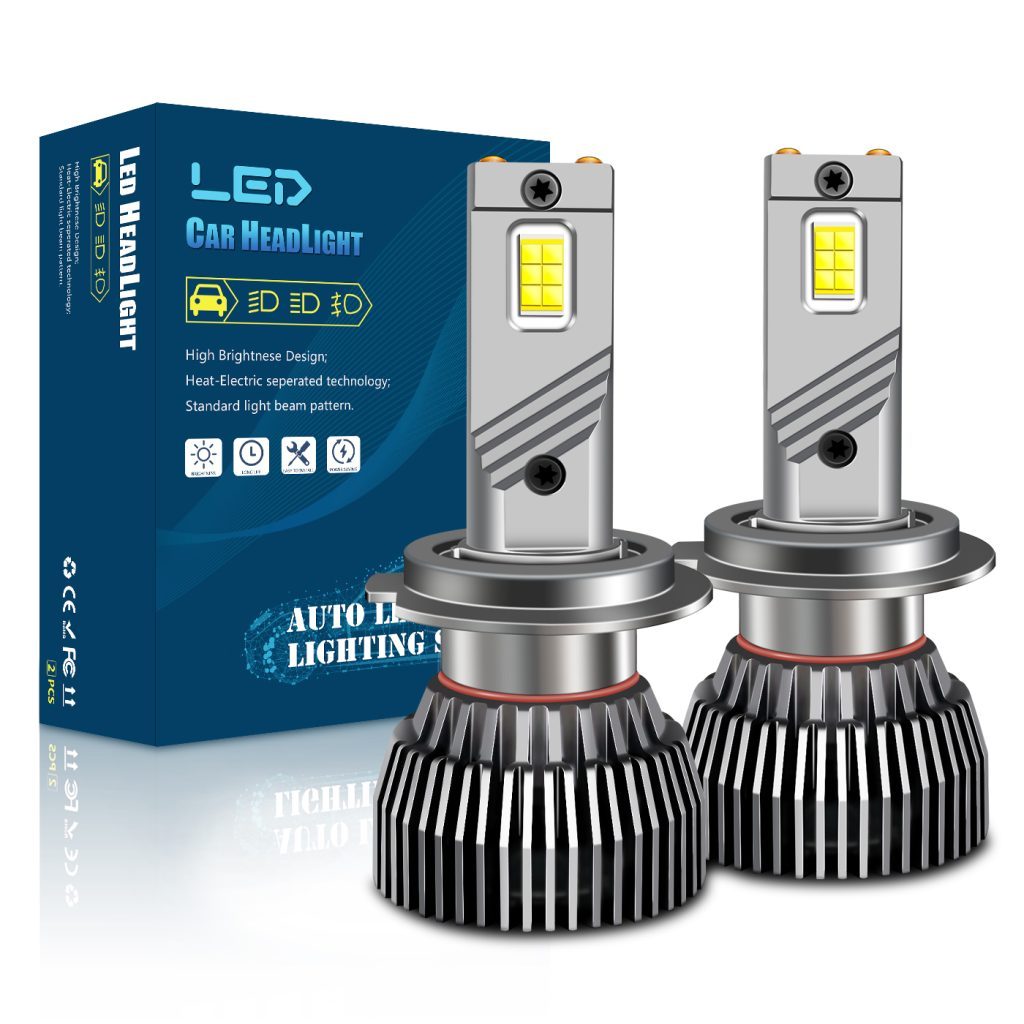
- Circuit and Driver Testing – Ensuring Stability
Constant‑current circuit: Ask the seller whether the lamp uses a constant‑current circuit and the current rating per bulb
PFC and efficiency: Whether power factor correction is used in high‑power circuits and its efficiency
Capacitor quality: Whether internal capacitors are high‑temperature, long‑life, high‑frequency, low‑impedance types
- LED Chip Reliability Assessment – The Core of Brightness
Chip quality is difficult to judge directly and usually requires consulting the manufacturer. Key indicators:
Chip size: Larger chips are more reliable – 45mil is more reliable than 30mil, but more expensive
Luminous efficacy: Higher efficacy means less heat generation and greater reliability
- Brightness and Beam Pattern Testing – Real‑World Performance Verification
A compliant LED headlight should demonstrate:
Brightness: Significantly higher than halogen
Standard beam pattern: Accurate focus – wall projection matches the original halogen pattern
Stability: No noticeable lumen depreciation after 3‑6 hours of continuous operation
Installation convenience: Non‑destructive installation – no wire cutting or cover modification
Testing methods:
Brightness test: Use a lux meter in a dark room to measure illuminance at the brightest point of the beam
Beam pattern test: Compare the LED beam pattern with the halogen pattern
Endurance test: Operate for over 8 hours at 80°C ambient temperature – check for power changes
Installation test: Check for decoder compatibility, non‑destructive fit, and secure mounting
- Technical Standards and Regulatory Requirements
Automotive headlight standards specify requirements for luminous flux, colour rendering index, and red ratio, as well as beam distribution (including cut‑off line shape and position, and illuminance at key points). Online testing technologies must ensure high speed, efficiency, automation, and accuracy.
Key inspection points:
High‑beam intensity: Has specific luminous intensity requirements
Appearance: Must not be altered without approval
Common failure reasons: Headlight malfunction, ageing, and beam misalignment
- Core Performance Advantages of Compliant LED Headlights
- Illumination Performance: Significantly brighter than halogens – low beam clearly covers 30‑40 metres ahead, high beam extends beyond 100 metres, dramatically expanding the field of view and improving hazard detection.
- Energy Efficiency: Over 80% electrical‑to‑light conversion efficiency – power consumption only one‑tenth of traditional bulbs – reducing electrical system load and optimising overall vehicle energy performance.
- Response Speed: Microsecond‑level response – instant illumination for braking or turning, providing quicker warning signals to following vehicles.
- Lifespan: Typically 50,000‑100,000 hours – essentially matching the vehicle’s service life. Solid‑state, filament‑free design offers excellent vibration and shock resistance.
- Cooling and Stability: With aluminium heatsink substrates and efficient thermal conduction structures, stable light output is maintained during continuous operation, effectively preventing brightness depreciation.
- Optical Precision: Precision lenses and multi‑layer light‑shielding designs deliver sharp cut‑off lines and anti‑glare optimisation – uniform low‑beam distribution, wide high‑beam coverage without hot spots, minimising interference with oncoming traffic.
- Colour Temperature: Set between 5500K and 6000K – close to natural daylight – clean, soft white light significantly enhancing night visual clarity and comfort.
- Environmental and Design Benefits: No UV or IR radiation, mercury‑free – aligned with green manufacturing trends and safely recyclable. Compact size allows factory‑socket direct connection for most models, requiring no wiring modifications.