LED headlights are gradually becoming the new standard in automotive lighting, thanks to their impressive performance. However, they also come with a few notable drawbacks. Here’s a balanced look across three dimensions: advantages, disadvantages, and adoption hurdles.
Advantages
High energy efficiency – LEDs convert electricity directly into light, with an efficiency of 80–90%. They consume only about one‑tenth of what a halogen bulb uses, which reduces fuel consumption and protects the vehicle’s electrical circuits from overload.
Environmentally friendly – Their spectrum contains no UV or infrared, they emit little heat, no radiation, and minimal glare. They’re mercury‑free and recyclable – a truly green lighting solution.
Exceptional lifespan – With no filament or loose parts, there’s no risk of burnout, thermal deposition, or rapid degradation. Under proper conditions, they can last 80,000 to 100,000 hours – over ten times longer than conventional bulbs, often outliving the car itself.
High brightness and low heat emission – since most energy goes into light rather than heat, they run cooler and are safer to handle.
Compact size – gives designers freedom to create distinctive front‑end styles, from matrix arrays to light strips and dynamic turn signals.
Durable and shock‑resistant – resin‑encapsulated chips are tough to break, making them easy to store and transport.
Pure colour output – vivid and precise, with wavelength deviation within 10 nanometres, often eliminating the need for colour filters.
Instant response – lighting up in microseconds, whereas traditional bulbs take about 0.3 seconds. This delay‑free reaction is crucial for brake and turn signals, helping prevent rear‑end collisions.
Disadvantages
Higher cost – quality LED headlights are still more expensive than halogens, though prices are steadily falling.
Demanding heat management – poor cooling leads to lumen depreciation and shortens life significantly. Proper heatsinks or fans are essential.
No unified industry standard – quality varies wildly. The same‑looking product can cost double or half depending on the LED brand used inside.
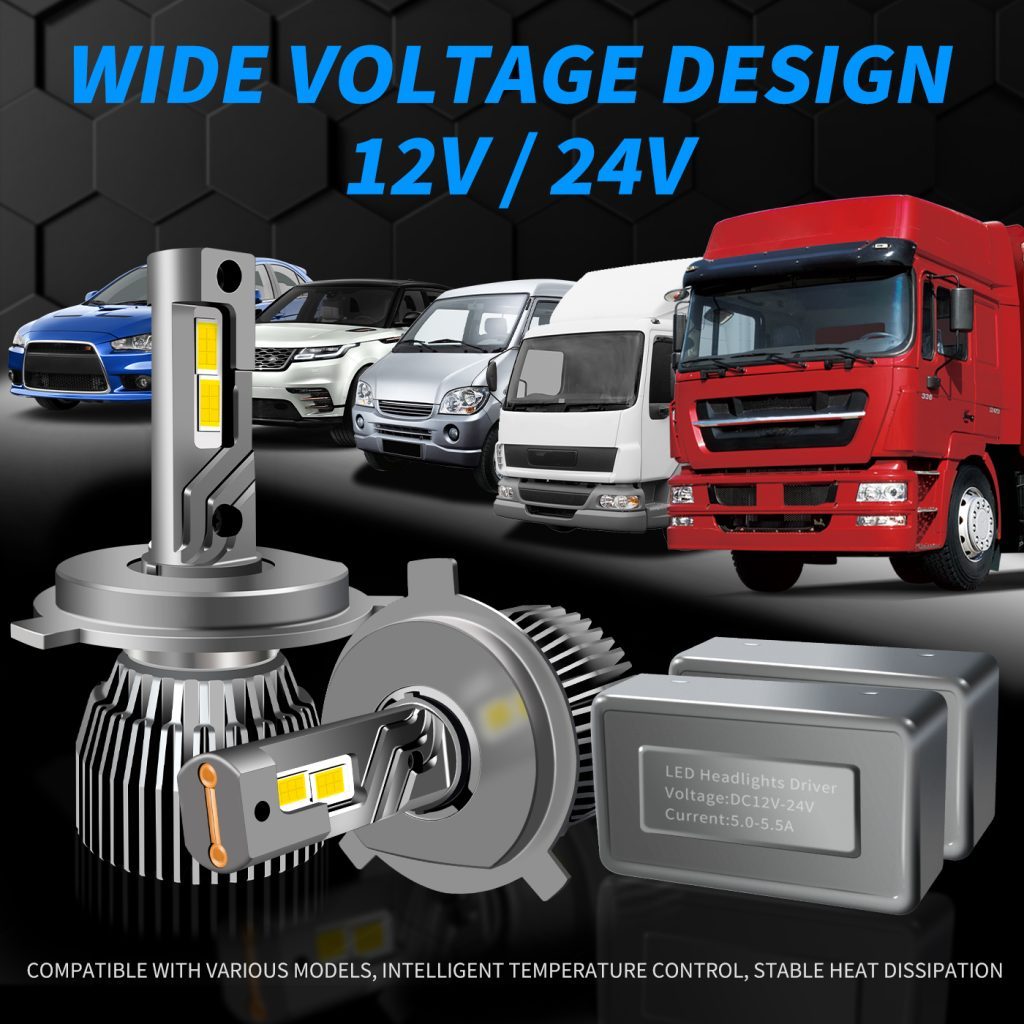
Compatibility headaches – some cars show dashboard errors or flickering after LED replacement, often requiring an additional decoder.
Regulatory restrictions – in some regions, LED retrofits are tightly controlled, so check local rules before upgrading.
Barriers to wider adoption
Cost remains a hurdle – an LED headlight assembly can cost several to more than ten times that of an incandescent counterpart, and high‑power units are even pricier. The pace of cost reduction will largely determine how fast LEDs go mainstream.
Reliability demands are rising – as more LEDs are packed into each headlight, the chance of failure increases, so automakers are imposing stricter quality requirements on suppliers.
Market chaos – new suppliers keep entering, but product quality is inconsistent, which hurts consumer confidence. Once the price of LEDs matches that of incandescent bulbs, large‑scale adoption will accelerate across all but the most budget‑friendly models.
Quick recap: 7 core strengths of automotive LEDs
Energy‑saving – uses just 1/20th of halogen power; costs drop ~20% annually
Long life – 50,000–100,000 hours, matching the vehicle’s lifespan
Tough – shock‑ and vibration‑proof, adaptable to harsh conditions
Space‑saving – compact size enables creative designs
Rapid response – microsecond switching for better safety alerts
Low brightness decay – maintains output far better than halogen
Low‑voltage DC drive – no boost converter needed, tolerant of varying environments