To ensure safe night driving and proper illumination, follow these steps to adjust the focus of your LED headlights.
- Pre‑adjustment Preparation
Choose a flat, level surface to park on. Turn off any other light sources, make sure tyre pressures are correct, and engage the handbrake firmly.
Position the car so that the front faces a wall, keeping a distance of 7.6 to 10 metres (depending on your model) – the wall will serve as your projection reference.
- Basic Calibration
If your vehicle has a headlight height adjustment dial, set it to “0” first.
Use a spirit level to mark two reference lines on the wall: the centre height of the low‑beam (usually equal to the headlight’s height from the ground) and the vehicle’s centre axis. These marks help you align the beam pattern correctly.
- Mechanical Adjustment Steps
Turn on the low beam and observe whether the light patch falls within the reference lines on the wall.
Adjust using the screws at the back of the headlight:
Vertical adjustment: use the screw marked with “↑↓” to raise or lower the beam – too high and you’ll dazzle others, too low and you lose forward visibility.
Horizontal adjustment: use the screw marked with “←→” to centre the beam so that it spreads symmetrically on both sides of the vehicle centreline.
Work one direction at a time and check the effect before moving to the other – this avoids confusion.
- Real‑World Verification
Masking method: when adjusting one headlight, cover the other with a cloth or have an assistant block it, so you can focus on a single beam.
Road test: find a straight, unlit road and check the beam pattern. The low beam should cover the road evenly for about 30–40 metres ahead, while the high beam should project a concentrated spot much further.
- Special Cases and Troubleshooting
Persistent scatter: if the beam remains unfocused after adjustment, the issue may be that the LED chip’s focal point doesn’t match the reflector, or the reflector itself is aged. In that case, you’ll need an LED bulb designed specifically for your car’s housing.
Lens cleaning: regularly wipe the outer lens to remove dirt or yellowing that can reduce light transmission.
Deeper Dive into Scatter Problems
Many drivers find that their LED headlights don’t perform as well as expected at night – the road ahead looks blurry, a phenomenon often called poor “road coverage”. Clearly, that kind of illumination isn’t safe. So how can we refocus the headlight beam to get better results?
First, we need to recognise that scatter can come from design flaws or incorrect retrofitting. Some people think adding a projector lens is the fix, since lenses do concentrate light well.
However, lens‑equipped LED units aren’t suitable for every car. For one thing, some models lack the physical space to house a lens, especially if they didn’t come with one from the factory – retrofitting is complicated. For another, dismantling the bumper and headlight housing to fit a lens may break the seal, leading to moisture ingress and fogging inside.
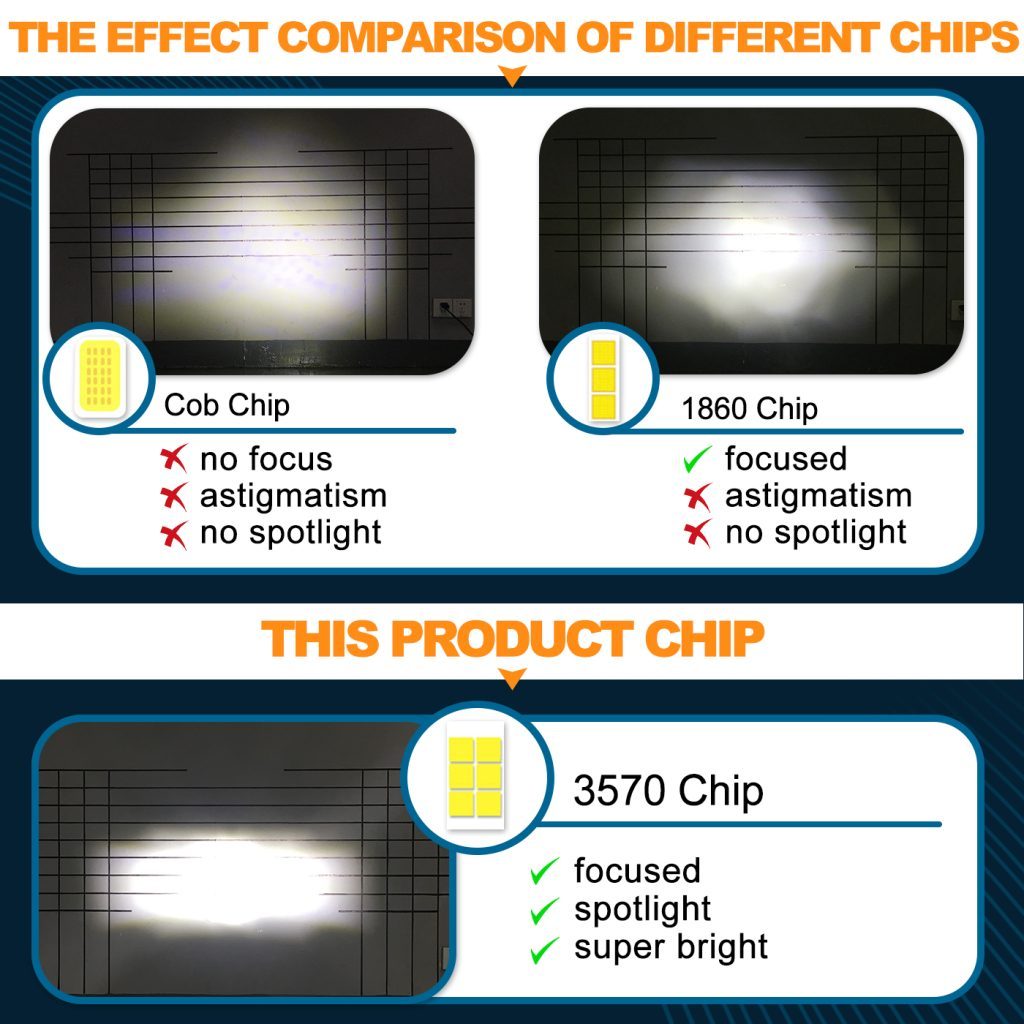
So what’s the practical solution for LED scatter? In many cases, poor beam performance simply means the bulb isn’t sitting at the reflector’s exact focal point. You can fix that by adjusting the screws at the back of the headlight. Here’s a straightforward method:
Park the car about 7.6 metres from a wall and turn on the headlights.
Look at where the beam lands on the wall, then adjust the angle accordingly. If your car has a height‑adjustment dial, set it to “0” first. Measure the distance from the headlight to the ground and from the headlight to the vehicle centreline.
Mark matching reference lines on the wall to guide your adjustments. Project the beam and check if it’s shifted sideways or set too high/low – then tweak it.
Keep in mind that different models use different screw types and positions, so check your car’s specific layout.
If all this sounds too involved, here’s a quick rule of thumb: ask someone about 180 cm tall to stand 7.6 metres in front of the car – the low‑beam cut‑off should not shine higher than their hip level. If it does, dial it down. Of course, for absolute accuracy, you can always have a professional check it during your next service.
Finally, it’s worth noting that traditional halogen bulbs often give better focus than LEDs, simply because they emit light from a single filament point – a true “point source”. That point light is refracted by the reflector into a concentrated, even patch on the road, giving the driver a bright and clear view ahead.