“How bright are LED headlights exactly?” This is the top concern for car owners planning headlight upgrades. Headlight brightness directly determines night vision clarity and overall driving safety. Many users only focus on advertised lumen numbers but ignore real-road performance, optical design, and brightness stability. This article fully explains the actual brightness performance of LED headlights with real data, scene-based standards, and professional buying tips to help you avoid overhyped products and wrong upgrades.
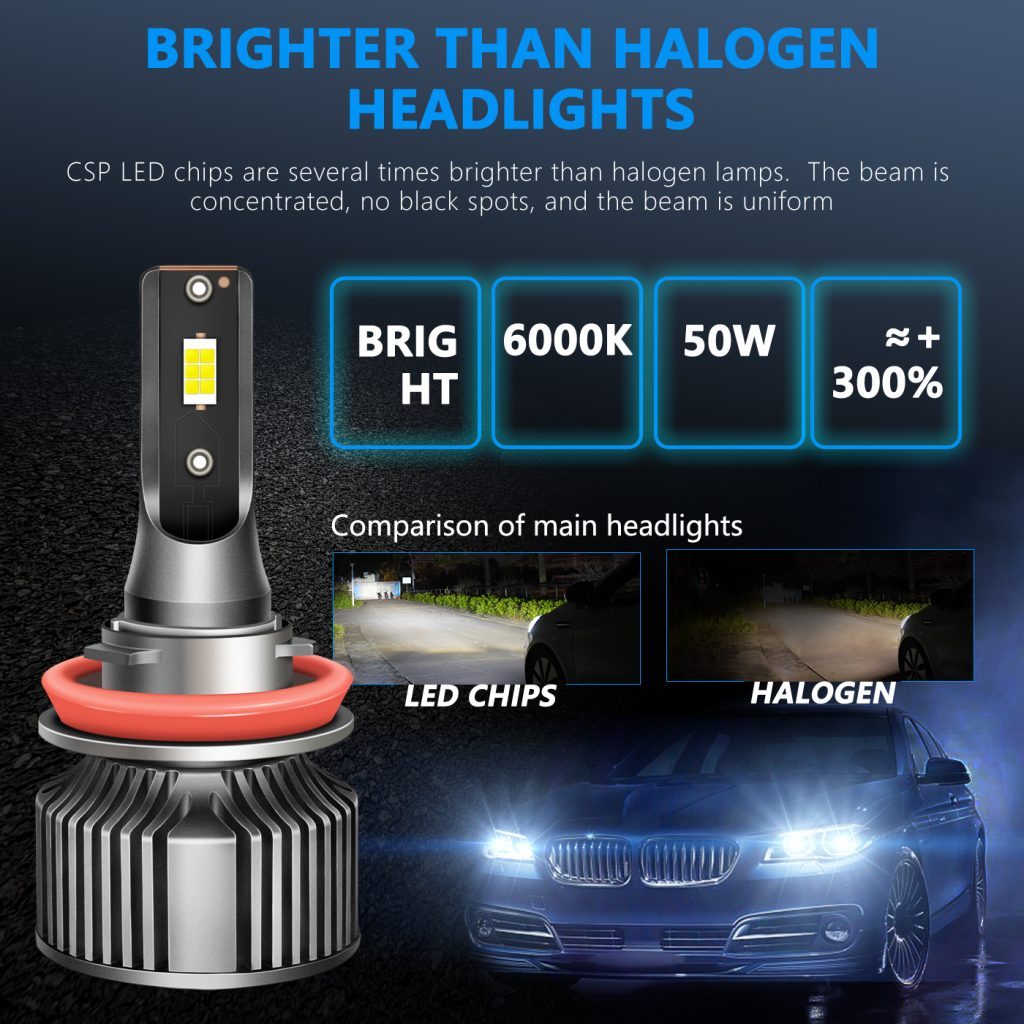
- Real LED Brightness Data: Compared with Halogen & Xenon
LED headlights deliver far higher energy efficiency and actual brightness than traditional halogen lights and show competitive advantages over xenon HID lights. According to industry standards, high-quality LED chips achieve 80–100 lumens per watt.
A standard 35W LED headlight outputs around 3200 lumens, while most mainstream vehicle LED headlight systems range from 3500 to 5500 lumens in steady-state brightness.
Here is the real brightness comparison of the three mainstream light sources under standard power configuration:
Halogen (55W): approx 1000 lumens
Low luminous efficiency, dim yellow light, basic lighting only.
Xenon HID (35W): approx 3500 lumens
Stable and uniform brightness with wide coverage.
LED (35W): approx 3200–4500 lumens
Higher peak brightness, better focusing ability, and lower power consumption.
The data clearly proves the core advantage of LED technology: lower power, higher brightness, and higher energy conversion rate.
In terms of vehicle headlight structural standards, vehicles adopt two-lamp and four-lamp systems. In a four-lamp setup, outer lamps serve as dual high/low beams, while inner lamps are dedicated high beams.
High beam: 35–60W, 3400–5900 lumens
Low beam: 35–55W, 3400–5400 lumens
Most automakers use 35W as the factory standard, while some high-visibility high beams adopt 55W configurations for longer irradiation distance. - Brightness Is More Than Just Lumens: Optical Design & Thermal Management
Many car owners misunderstand that “higher lumens equal better lighting”. In actual road conditions, optical structure and heat dissipation determine real effective brightness.
Optical System Determines Road Lighting Effect
High-quality lens and reflector design accurately converges light onto the road surface, forming a clear cutoff line, concentrating effective brightness, and eliminating glare. Simply increasing lumen and power without optical optimization will only produce scattered stray light, dazzling oncoming drivers and reducing actual driving visibility instead of improving it.
LED lighting performance heavily relies on matching optical accessories. Only well-matched lenses and reflectors can convert high lumen values into practical road illumination.
Thermal Management Determines Brightness Stability & Lifespan
LED chips generate intensive heat during continuous operation. Poor heat dissipation leads to rapid luminous decay, obvious brightness drop after long-time lighting, and even permanent chip burnout.
Genuine high-brightness LED headlights are equipped with professional heat dissipation solutions such as aviation aluminum housings, silent cooling fans, and heat pipe conduction systems to ensure long-term stable brightness output. - Recommended Lumen Ranges for Different Driving Scenarios
There is no one-size-fits-all brightness standard. The most suitable lumen value depends on your daily driving environment.
Urban Road (Street Lights Available): 1600–2500 Lumens
Sufficient auxiliary lighting from urban street lights. Excessively high brightness causes glare and light waste.
Suburban Roads & National Highways: 2500–3500 Lumens
Poor natural lighting requires improved brightness to enhance road edge recognition and obstacle detection.
Unlit Mountain & Remote Roads: 3000–3500 Lumens
Maximize irradiation range and long-distance visibility to ensure night driving safety margins.
For stock lamp upgrade reference:
Original halogen low beams are around 1000 lumens, and high beams around 1200 lumens. Upgrading to LED above 2000 lumens brings an obvious visual improvement.
Original xenon lamps already maintain 2000+ steady-state lumens, so LED upgrades need 3000+ lumens to achieve a noticeable performance leap.
National Lighting Standard Note: The legal low-beam lumen range is 1050–1450 lumens, and high-beam 1450–1750 lumens. These are minimum safety thresholds, not optimal brightness standards. With qualified light patterns and no glare, proper brightness upgrade effectively improves night driving safety. - Beyond Brightness: Multi-Functional Value of LED Headlights
LED headlights are not only for road lighting. They also undertake multiple safety functions including turn signal indication, brake warning, and emergency hazard lights.
In foggy, rainy, and low-visibility weather, stable and high-brightness LED output provides clear light signals for surrounding vehicles, greatly reducing collision risks.
Daily maintenance such as keeping lamp covers clean, avoiding water condensation, and regularly adjusting beam height can maintain stable LED brightness and extend the service life of the entire lighting system. - LED Headlight Buying Pitfalls: Avoid Fake High-Lumen Products
The market is full of falsely labeled LED bulbs. Many products marked 6000 lumens cannot even reach 3000 lumens in actual steady-state output. To avoid low-quality products, follow these core selection rules: - Prioritize tested steady-state lumens, not nominal peak data
Peak transient brightness is meaningless; only long-term stable lumens represent real performance. - Check professional heat dissipation structure
Aviation aluminum body, heat pipes, and silent fans are essential marks of high-quality LED headlights. - Standard light pattern with clear cutoff line
Qualified LED lights focus on road lighting without scattering glare to oncoming traffic. - Choose reputable formal brands
Famous brands have strict production standards and reliable after-sales service, avoiding severe virtual labeling and premature failure. - Final Summary & Best Configuration Recommendation
LED headlight selection requires comprehensive consideration of original vehicle power, daily driving scenarios, optical matching, and heat dissipation performance. Do not blindly pursue ultra-high lumens, nor settle for dim and ineffective lighting.
Most Balanced & Universal Upgrade Solution for Family Cars:
35–40W power, 3000–4000 steady-state lumens, 5000–6000K color temperature, matched with professional lens and high-efficiency heat dissipation system.
This configuration perfectly balances brightness, penetration, lifespan, and compliance, fully adapting to urban, highway, and suburban road conditions. It is the safest, most cost-effective, and most practical LED headlight upgrade choice for most drivers.