Short answer: Yes, it creates several changes to your vehicle, yet all negative impacts can be fully controlled as long as you pick qualified LED bulbs and complete standard installation. Below is a full breakdown of all possible influences and corresponding solutions.
1. Electrical System Trouble: Low Power Triggers BCM Fault Warnings
Factory halogen bulbs are normally rated at 55W, while mainstream LED headlight bulbs only draw around 30W, and some low-power versions run at merely 20W.
The core issue: Lower wattage means smaller electric current. Modern vehicles are equipped with a Body Control Module (BCM) / CANBUS system that monitors circuit current to judge bulb health. After switching to low-draw LEDs, the computer detects abnormal low current and misidentifies the bulb as burnt out, triggering permanent dashboard lamp fault alerts or continuous light flickering.
Effective Solutions
- Choose LED bulbs with built-in CANBUS decoders (anti-flicker load modules). The decoder simulates the resistance load of halogen bulbs to fool the vehicle’s monitoring system.
- Premium European vehicles (BMW, Mercedes, Audi etc.) may require professional computer programming to clear matching errors.
- Confirm decoder compatibility with your specific car model before purchasing.
2. Power Consumption: Lower Current Reduces Load on Battery & Alternator
Many drivers worry LED upgrades will drain the car battery faster, but this is the opposite of reality.
Cutting power draw from 55W down to 30W nearly halves operating current. This greatly lessens the burden on the alternator and 12V battery, reduces overall circuit heat buildup, and lowers the risk of blown fuses.
The rumor that “LEDs consume excessive power” only applies to outdated high-power LED products over 50W per bulb. Standard automotive LED headlights on the market only consume 20–30W, far below halogen power ratings. As long as you avoid cheap generic bulbs with fake power labels, power consumption will never be a concern.
3. Heat Dissipation: High Temperature Accelerates Irreversible Luminous Decay
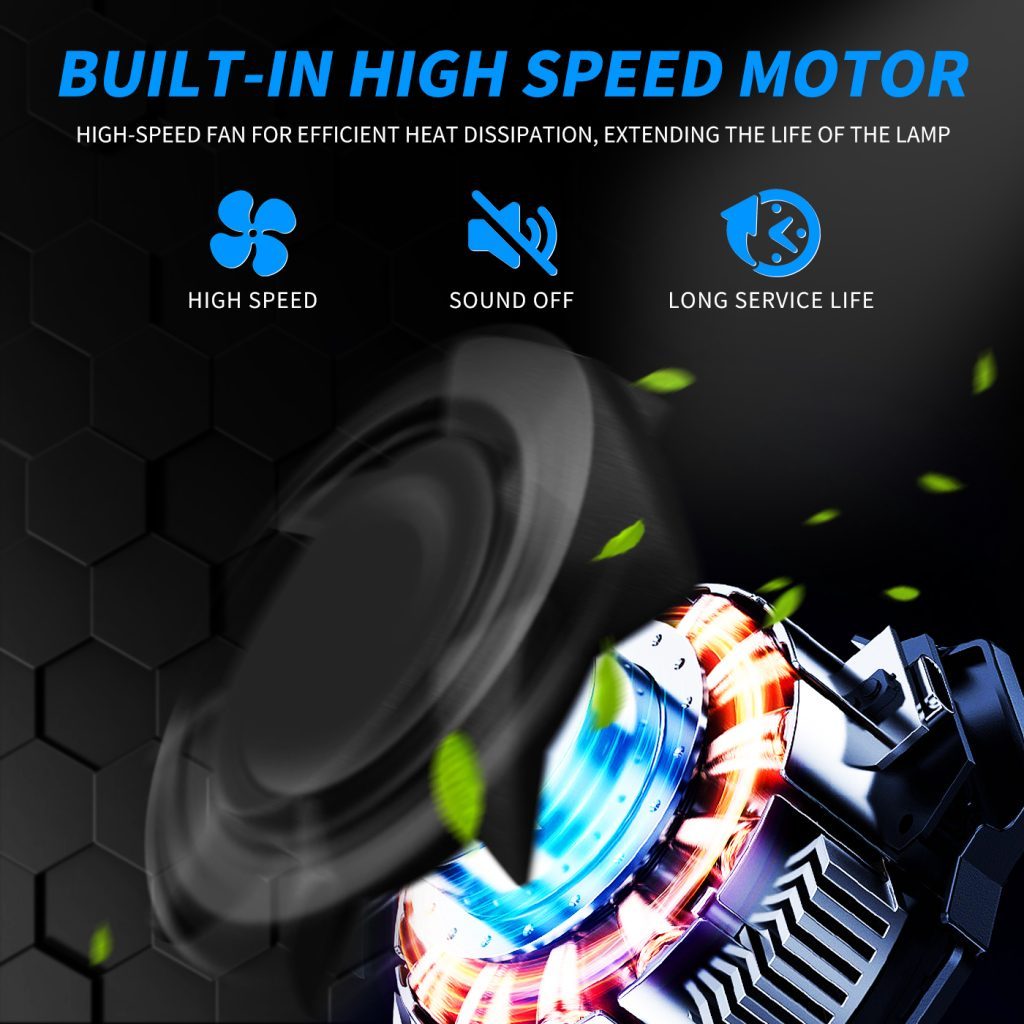
Although LED bulbs operate cooler overall (50–70°C) compared to halogens (200–300°C), LED chips are extremely sensitive to accumulated heat inside the sealed lamp housing.
Sustained high temperatures inside the lamp cavity speed up luminous decay: the bulb will be extremely bright right after installation but dim gradually over months, and this brightness loss cannot be reversed — the only fix is full bulb replacement.
Original halogen lamp housings are not engineered to dissipate heat from LED chips. The overheating risk becomes worse in summer long-distance driving or compact lamp assemblies with tiny internal space.
Effective Solutions
- Select LED bulbs equipped with complete cooling structures: aviation aluminum housing, copper heat pipes, and silent cooling fans are the most reliable combo.
- Leave enough air circulation space after installation; do not squeeze cooling components with the dust cover.
- Avoid ultra-low-cost sealed LED bulbs with zero heat dissipation design.
4. Glare & Poor Road Illumination: Mismatched Light Source Position Causes Scattered Beams
This is the most common complaint after unoptimized LED retrofits: oncoming drivers are blinded by harsh stray light, yet your own view of the road remains blurry, with uneven bright patches and scattered light with no clear cutoff line — widely known as “dazzling others without lighting the road”.
Root Cause
Halogen bulbs use thin tungsten filaments that emit light 360° from the precise focal point of the reflector bowl, which is custom-designed around this filament position. LED chips are flat planar light sources with different luminous positions and angles. If the LED chip fails to align perfectly with the original filament focal point, reflected light disperses randomly instead of focusing on the pavement.
Effective Solutions
5. Service Life & Durability: Product Quality Determines Long-Term Performance
Stock halogen bulbs deliver stable, consistent brightness for years with minimal decay. LED lifespan varies drastically based on build quality:
- Premium branded LEDs: 30,000–50,000 hours service life, slow luminous decay, stable color temperature and brightness long-term.
- Inferior generic LEDs: Fast brightness drop, color shift, poor heat resistance, and complete failure within several months.
Purchasing Standards
- Trust reputable brands such as Philips, Osram, or verified market-proven aftermarket manufacturers.
- Optimal color temperature range: 5500K–6000K neutral white light; avoid ultra-high Kelvin values that sacrifice rain/fog penetration.
- Prioritize models with built-in cooling fans or large-area aluminum heat sinks.
- Prefer products with official certification (3C, ECE) for reliable quality control.
6. What Does “Plug-and-Play Non-Destructive Installation” Mean?
Non-destructive retrofit means no cutting, splicing, or rewiring of the original vehicle circuit.
Nearly all mainstream replacement LED bulbs adopt identical OEM plug interfaces (H1 / H4 / H7 / H11 / H13 etc.). Simply match the bulb model to your factory lamp and plug it directly into the socket without modifying factory wiring. As long as no original cables are altered, the vehicle’s electrical safety remains fully intact.
Final Summary Table
表格
| Concern | Actual Impact | Recommended Solution |
|---|---|---|
| Circuit Compatibility | Lower power reduces current, triggering BCM error codes and flickering | Choose LED bulbs with built-in CANBUS decoders; advanced European vehicles may require ECU programming |
| Power & Battery Load | 30W vs 55W, nearly half the power draw | Lower heat generation, lighter load on alternator and battery, safer long-term use |
| Heat Dissipation Risk | LED chips degrade rapidly under trapped high heat | Pick bulbs with aviation aluminum body, copper heat pipes and cooling fans |
| Scattered Beam & Glare | Misaligned light source creates stray light that blinds oncoming traffic | Select 1:1 filament-positioned LEDs; calibrate beam height post-installation; add lenses for reflector housings |
| Long-Term Durability | Wide quality gap between cheap and premium LEDs | Buy certified well-known brands, avoid ultra-low-cost unbranded products |
| Installation Safety | Risk of damaging original wiring during modification | Stick to matching plug-and-play bulbs without cutting factory wires |